

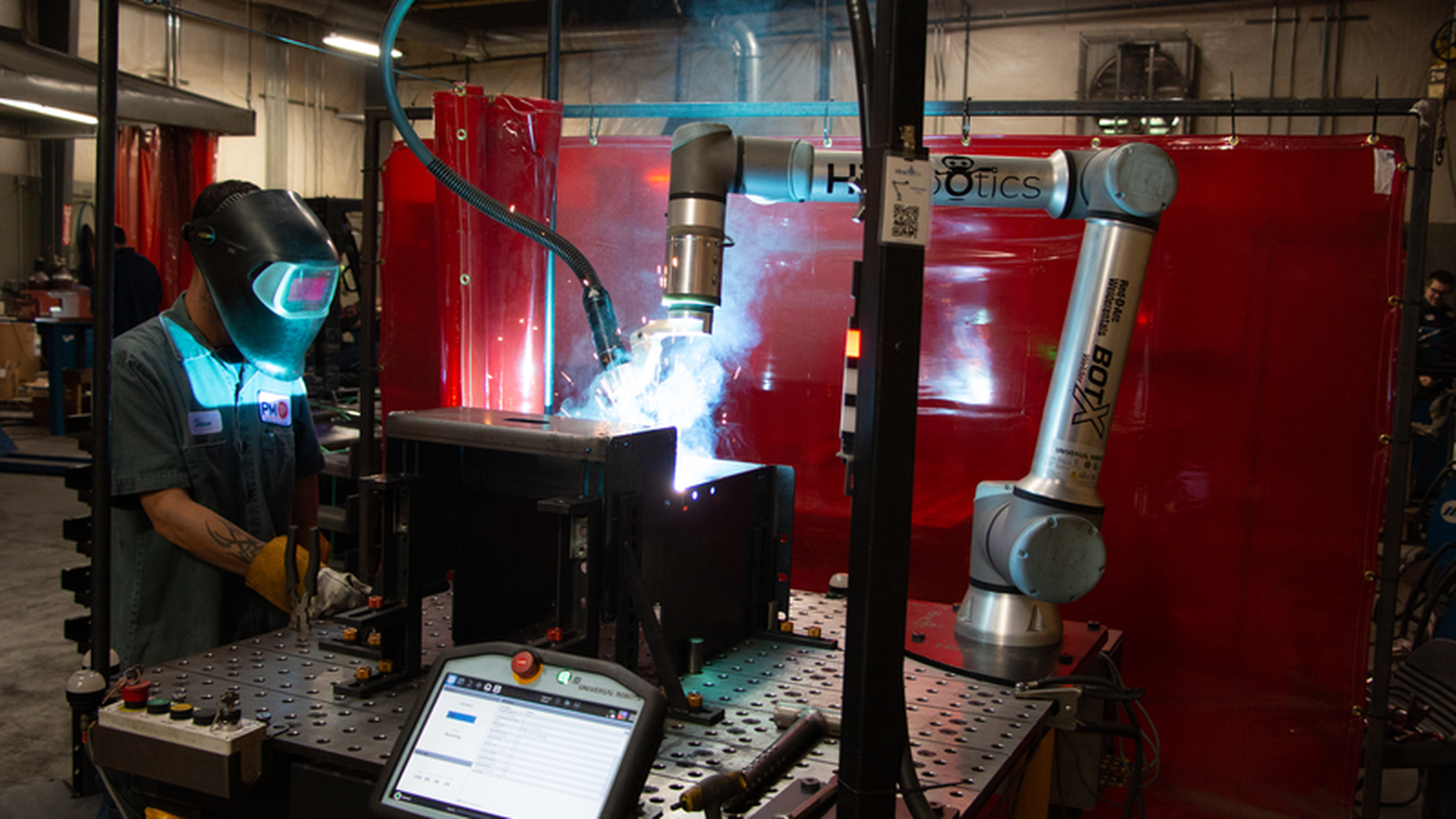
Best 6-Axis Cobot Arm for Welding: 5 Brands Compared
There is no universal “best” welding cobot. The right choice is the arm, controller, welding package, fixture, safety system and local support network that can repeatedly produce your qualified joint. This guide compares Universal Robots, FANUC, Yaskawa, Doosan and ABB using current model data and practical cell-integration criteria.
Choose the cell that proves the weld—not the arm with the longest specification sheet
For high-mix fabrication, Universal Robots is often attractive because of its broad third-party ecosystem. FANUC CRX and Yaskawa HC deserve close attention when welding features, long reach and industrial integration dominate. Doosan offers useful payload and torque-sensing choices. ABB GoFa is compelling where ABB’s pre-engineered collaborative arc-welding cell and software fit the job.
The winning brand can change after the torch, cable dress, wire feeder, positioner, extraction, guarding and local service are included. Shortlist two systems, run the same sample weld and compare measured results.
Six rotary joints let the cell approach complex joints and maintain useful torch angles.
Arc light, fume, spatter, hot parts and external axes remain application hazards.
Count torch, bracket, collision sensor, cable dress and service loops—not only the torch.
Use representative parts, positions, gaps and production-length runs before purchase.
Make the decision in the right order
Five strong routes, each with a different center of gravity
This is a buyer-oriented shortlist, not a universal ranking. Model availability, integrator competence and service coverage vary by country.
Strong partner ecosystem and accessible programming. Compare UR10e for medium reach with UR20 where a larger envelope or dressed payload is needed.
Long-reach options, industrial controller heritage and welding functions such as touch sensing and seam-tracking workflows.
HC10/HC20 families combine collaborative modes with IP67 variants and a mature Motoman welding ecosystem.
M1013 and H-series choices provide useful reach/payload combinations with torque sensing at all six joints.
ABB’s collaborative arc-welding cell packages GoFa 5 with welding components, protective measures and ABB arc software.
Why a six-axis arm is useful for welding
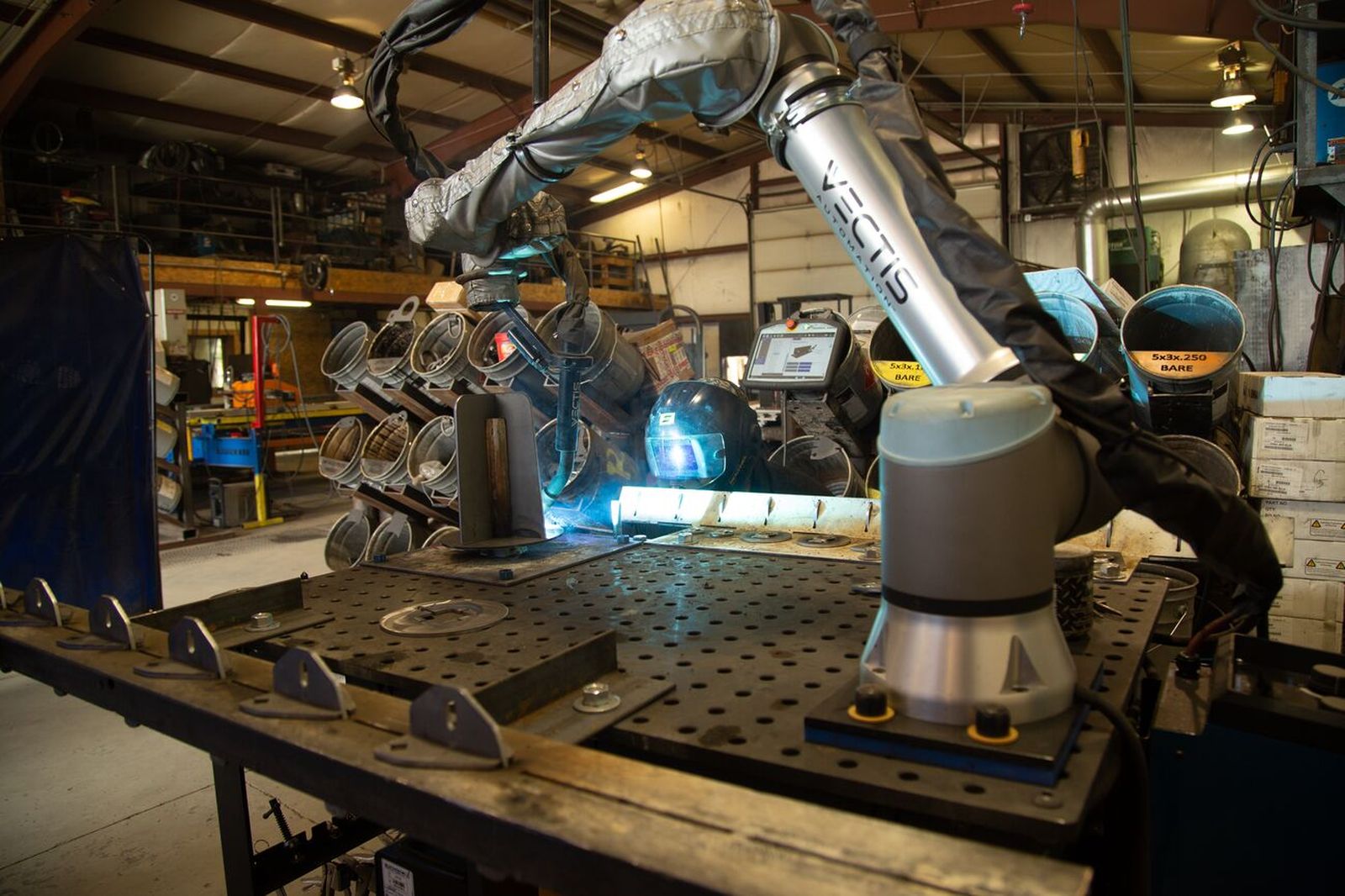
A typical six-axis articulated robot has shoulder, elbow and wrist joints that control both position and orientation. That matters in welding because the tool center point must follow a three-dimensional seam while maintaining workable travel and work angles.
Six axes do not remove all reach limitations. A joint can be physically inside the nominal envelope but still be difficult because of wrist singularity, torch collision, cable twist, positioner interference or an inaccessible approach angle. A reach study should therefore use the complete torch model, dress pack, fixture and workpiece—not a simple radius around the robot base.
Maintain torch angle along corners, cylinders and multi-plane assemblies.
Reduce unnecessary stops and reorientation when the joint changes direction.
Approach several welds from one setup when geometry and safety permit.
Pair the arm with a positioner when gravity, access or weld position demands it.
Seven questions that matter more than brand reputation
Use the same requirement sheet for every supplier. A fair comparison starts when the application, acceptance criteria and included cell scope are identical.
MIG/MAG, TIG and laser welding place different demands on travel speed, cable dress, process I/O, seam finding, shielding and enclosure.
Add torch, bracket, collision sensor, hose bundle, cable support and any carried sensor. Check payload at the real center of gravity.
Model the largest part, fixtures, positioner, stand height, service loops and safe approach. Nominal reach is not guaranteed joint access.
Decide whether accurate fixtures are enough or whether touch sensing, vision, through-arc tracking or offline-program compensation is required.
Spatter, metal dust, grinding debris and cleaning practices affect enclosure rating, protective jackets, torch service and connector placement.
Compare local integrators, welding-process competence, spare availability, response time and support for the controller and power source.
Define bead profile, penetration/fusion evidence, defects, cycle time, uptime, changeover, inspection method and documentation before the order.
Published pose repeatability helps compare arms, but it does not replace weld-procedure qualification, joint control, calibration or process monitoring.
A 10 kg robot does not necessarily have 10 kg available for an application whose tool center of gravity sits far from the flange. Ask the supplier to verify the complete carried load against the manufacturer’s load diagram.
Build a practical welding-cobot shortlist
Select the closest application priorities. The tool compares five brand routes and identifies a starting point for engineering discussion. It does not replace reach simulation, load verification, risk assessment or sample-weld qualification.
Start with Yaskawa HC
The current inputs favor a welding-oriented, long-reach-ready platform with IP67 model options and an established Motoman arc-welding ecosystem.
- Model the complete torch and cable dress.
- Compare HC10 and HC20 against the real envelope.
- Validate seam finding and safety on the target part.
Compare representative models—not brand averages
Manufacturers offer several payload and reach variants. The table uses representative current models that are relevant to welding discussions; exact options and regional availability must be reconfirmed for the quoted configuration.
| Brand / representative model | Rated payload | Reach | Published pose repeatability | Published protection | Why it enters a welding shortlist |
|---|---|---|---|---|---|
| Universal Robots UR10e | 12.5 kg | 1,300 mm | ±0.05 mm | IP54 | Broad partner ecosystem, familiar teach interface and a practical envelope for many high-mix cells. |
| FANUC CRX-30iA | 30 kg | 1,889 mm | ±0.05 mm | IP67 | Long reach, high payload class and access to FANUC welding integration and controller functions. |
| Yaskawa HC10DTP | 10 kg | 1,200 mm | Check current model sheet | IP67 | Welding-oriented Motoman ecosystem and rugged protection for an appropriately designed cell. |
| Yaskawa HC20DTP | 20 kg | 1,700 mm | Check current model sheet | IP67 | Useful payload/reach combination for larger weldments and heavier dress packages. |
| Doosan M1013 | 10 kg | 1,300 mm | ±0.05 mm | Verify quoted variant | Six-joint torque sensing with a reach/payload class comparable to common medium cells. |
| Doosan H2515 | 25 kg | 1,500 mm | ±0.1 mm | IP54 | Higher payload for heavier tooling or process packages when its path and environment fit are proven. |
| ABB GoFa 5 in collaborative arc cell | 5 kg | 950 mm | Verify cell/model sheet | Protective jacket used in ABB cell | Pre-engineered ABB route combining GoFa, welding equipment, software and configurable protective measures. |
Values above are drawn from manufacturer pages reviewed July 2026. They are not a substitute for the official manual, load diagram or quotation for the exact arm and controller revision. Protection applies to specified robot components—not automatically to the complete welding cell.
Where each six-axis cobot route is strongest—and where to be careful
These profiles focus on application fit. The quality of the local integrator can outweigh a small difference between arm specifications.
Best starting point for high-mix shops that value ecosystem and accessibility
UR is widely used in packaged welding solutions because integrators can combine the arm with established power sources, teaching aids, positioners and application software. UR10e’s 1,300 mm reach and 12.5 kg payload suit many compact and medium cells; UR20 extends the working envelope for larger assemblies.
Reasons to shortlist
- Broad network of application partners and compatible welding packages.
- Hand-guided teaching and accessible interface can support frequent changeover.
- Useful route for shops that want an integrator-built cell without a traditional robot-programming barrier.
Verify before ordering
- IP54 on UR10e may require a jacket and better spatter/dust control.
- Confirm the real dressed payload and cable behavior over the full path.
- Compare local welding-process support, not only general UR programming support.
Best fit when industrial controller depth, reach and welding functions lead
FANUC’s CRX range combines collaborative operation with the company’s industrial-robot controller heritage. Long-reach CRX variants are attractive for large weldments, and FANUC publishes welding features that include torch-angle control, touch sensing and through-arc seam-tracking workflows.
Reasons to shortlist
- CRX-30iA publishes 1,889 mm reach, 30 kg payload and IP67 protection.
- Strong fit for plants already standardized on FANUC controllers and support.
- Welding-specific software and process packages can reduce custom integration.
Verify before ordering
- A high-payload arm may be unnecessary for a compact bench cell.
- Confirm which welding options are included, licensed and supported by the integrator.
- Validate cycle time with safety limits, seam finding and real process stops active.
Best fit for welding-oriented integration with rugged HC options
Yaskawa’s HC family benefits from Motoman’s long arc-welding history. HC10DTP and HC20DTP provide 10 kg/1,200 mm and 20 kg/1,700 mm classes respectively, with IP67 protection listed for these models. Yaskawa also promotes HC welding packages for direct welding-cell integration.
Reasons to shortlist
- Model choices span compact and larger weldments.
- IP67 variants help in correctly designed metal-fabrication environments.
- Natural fit where local Motoman integrators understand welding, positioners and process packages.
Verify before ordering
- Risk assessment remains mandatory; IP rating is not a safety system.
- Confirm teaching workflow for the staff who will actually run changeovers.
- Request a reach/singularity study with the real torch and fixture.
Best fit when torque sensing and payload options are central
Doosan uses torque sensors at all six joints across relevant models and offers several useful reach/payload combinations. M1013 is a balanced 10 kg/1,300 mm route, while H2515 raises payload to 25 kg at 1,500 mm. H2017 extends reach to 1,700 mm with 20 kg payload.
Reasons to shortlist
- Multiple payload/reach combinations can accommodate different torch and sensor packages.
- Six-joint torque sensing supports collaborative and force-aware workflows.
- Potentially attractive when a heavier carried process package is unavoidable.
Verify before ordering
- H2515 publishes ±0.1 mm repeatability and IP54; judge both against the process.
- Confirm local welding integration experience, service response and spares.
- Do not assume force sensing corrects part variation or poor fixturing.
Best fit when ABB’s collaborative arc-welding cell matches the envelope
ABB’s OmniVance Collaborative Arc Welding Cell combines a GoFa 5 cobot with an arc-welding power source, torch, wire feeder, software and configurable protective equipment. This makes ABB especially relevant for buyers who prefer a defined cell architecture over building around a bare arm.
Reasons to shortlist
- Pre-engineered cell route can clarify responsibility and integration scope.
- ABB ArcWelding PowerPac and RobotWare Arc support welding programming and process features.
- Configurable roll-up curtain or side panels/safety sensing show a realistic approach to welding hazards.
Verify before ordering
- The standard GoFa 5 cell’s 5 kg payload and 950 mm reach may limit large assemblies.
- Confirm the exact power source, positioner, enclosure and regional cell configuration.
- Run the actual joint family before assuming a standard package is sufficient.
MIG, TIG and laser welding ask different questions of the cobot cell
The arm can be the same six-axis architecture, but the process package, safety controls, programming strategy and acceptance evidence are not interchangeable.
Prioritize cable management and seam adaptation
- Wire feeder, torch lead and liner routing affect wrist motion.
- Touch sensing or through-arc tracking may help when part variation is controlled but not negligible.
- Spatter management, nozzle cleaning and consumable access influence uptime.
- Positioners can improve access and keep welds in favorable positions.
Prioritize stability, fit-up and shielding
- Precise travel and consistent arc length require stable fixtures and calibration.
- Filler-wire delivery adds another path and collision constraint.
- Gas coverage, pre-flow, post-flow and tungsten condition affect acceptance.
- Slower travel can make cycle-time economics more dependent on unattended time.
Prioritize enclosure, optics and process qualification
- High-power laser cells require wavelength-specific engineered protection and interlocks.
- Beam delivery, welding head, focus, wire, shielding and extraction form one process chain.
- Gap tolerance and joint preparation must be proven on real production parts.
- Robot path is only one contributor to keyhole stability, penetration and porosity.
A collaborative arm does not make welding a collaborative application
Robot safety standards treat collaboration at the system and application level. A power-and-force-limited arm can reduce some robot-contact risks, yet welding introduces hazards that remain even when the arm stops on contact.
The 2025 editions of ISO 10218-1 and ISO 10218-2 cover industrial robots and robot applications. ISO/TS 15066 remains a reference for collaborative robot-system guidance while revision work continues. Apply the standards and local regulations through a documented risk assessment conducted by competent personnel.
Use suitable screens, curtains or enclosure so nearby personnel are not exposed to ultraviolet and infrared radiation.
Provide source-capture extraction and evaluate base metal, coating, filler and shielding-gas hazards. OSHA notes that welding fume can contain harmful metal compounds.
Control burns, fire, hot workpieces and ejected spatter. A stopped robot does not make a hot torch or part safe.
The torch, wire and fixtures can create contact or puncture hazards independent of robot speed.
Positioners, clamps, slides and powered doors need their own safeguarding, interlocks and safe states.
The arm is only one component of a welding system
A low arm price can become an expensive project if the buyer later discovers that the quote excludes welding software, seam sensing, torch cleaning, extraction, positioner integration, safety validation or production support.
Ask every supplier to deliver a single responsibility matrix. It should identify who designs, supplies, programs, validates and warranties each part of the cell.
Separate one-time engineering from reusable hardware, then compare identical cell scope. “Robot package” and “production-ready welding cell” are not the same product.
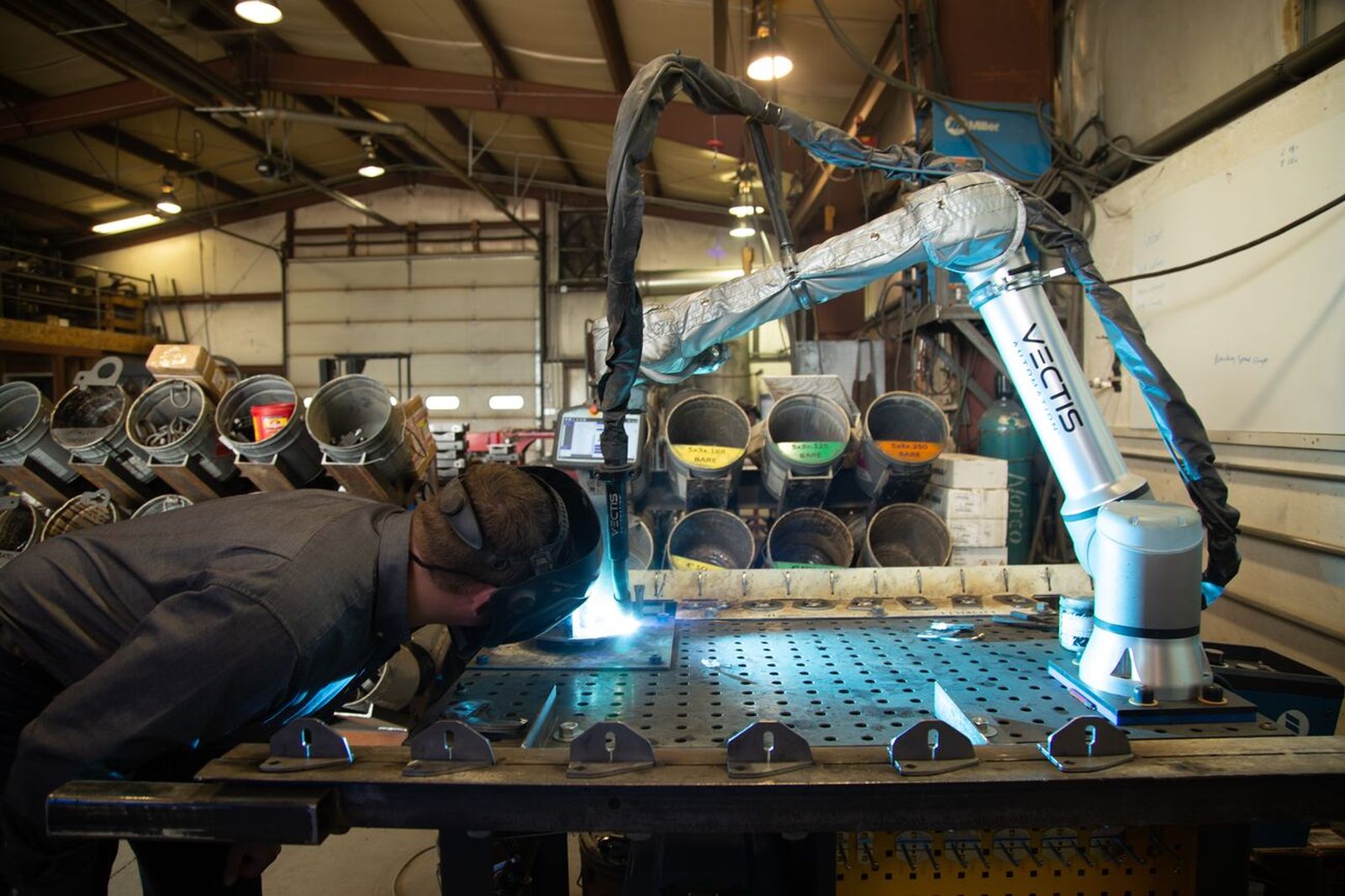
What a production-ready welding-cobot quotation should include
Arm, controller, teach device, mounting, cables, software licences, I/O and network interfaces.
Power source, torch, wire feeder, cooler where required, gas control, process interface and consumables.
Mounting bracket, collision sensor, cable dress, hose support, torch service and optional seam sensor.
Repeatable location, clamps, grounding, anti-spatter strategy, part detection and external-axis coordination.
Risk assessment, screens or enclosure, scanners, interlocks, safe I/O, emergency stops and validation records.
Source capture, airflow, filtration, ducting, make-up air, monitoring and safe disposal for the actual materials.
Part programs, touch-up method, weld schedule, seam finding, calibration, inspection and recipe control.
Training, manuals, backups, spare parts, preventive maintenance, remote support, response time and warranty ownership.
Calculate total cell economics—not a universal robot price
Public “typical system prices” age quickly and hide major differences in fixtures, process equipment, safety, engineering and commissioning. Build the business case from your own labor, takt time, demand, quality losses and utilization.
Separate theoretical arc-on time from recoverable production value. A cobot that welds quickly but waits for loading, inspection or material will not deliver the modeled savings. Include realistic changeover, setup, rework, planned maintenance and operator attendance.
Use the same representative weld to compare both finalists
A disciplined sample test prevents the decision from becoming a brand demonstration. Supply the same material, thickness, joint geometry, preparation, gap range, weld position and acceptance criteria to each shortlisted integrator.
Document alloy, coating, thickness, joint preparation, cleanliness, fit-up range and fixture datum.
Capture power-source settings, travel speed, torch angle, weave, sensing, shielding, filler and pauses.
Use agreed visual, dimensional, macro, destructive or nondestructive methods appropriate to the product and code.
Test repeat loading, changeover, recovery, nozzle service, consumables and heat accumulation over a meaningful run.
Measure the cycle with actual curtains, scanners, interlocks, extraction and safe-speed zones active.
Have the intended user load a part, select a recipe, recover a normal fault and perform a controlled touch-up.
Save videos, photos, parameters, inspection results, program revision, component models and open actions.
Define FAT pass/fail criteria, corrective action, retest and final documentation before the purchase order.
Move from brand comparison to a verified cell requirement
Use these Oceanplayer tools to refine the automation route before requesting a detailed quotation.
Automation System Selector
Compare manual, cobot and robotic approaches using part, duty and production requirements.
Select an automation route →Cobot ROI & Payback
Model labor, quality, capacity, operating cost, annual benefit and payback with your assumptions.
Build the business case →Automation Cycle Time
Estimate process, handling, indexing and utilization instead of relying on robot travel speed alone.
Plan cycle time →Welding Heat Input
Calculate a planning heat-input value from current, voltage, travel speed and efficiency assumptions.
Calculate heat input →Wire Feed Speed
Connect wire diameter and deposition assumptions to an initial feed-rate discussion.
Estimate wire feed →Sample Testing
Send representative parts and acceptance requirements for a practical automation review.
Plan a sample test →Let Oceanplayer review the weld before you choose the arm
Send part drawings or photos, material, thickness, joint types, current process, production target and required inspection. We can help define a practical robotic laser-welding or collaborative automation route and a sample-test plan.
- Material, thickness and joint geometry
- Part size, weight and photos or CAD
- Current weld process and cycle time
- Quality standard and inspection method
- Parts per shift and changeover frequency
- Country, site layout and existing equipment
Best 6-axis cobot arm for welding: FAQ
What is the best 6-axis cobot arm for welding?
There is no universal winner. Universal Robots is a strong ecosystem route for high-mix integration; FANUC CRX and Yaskawa HC are compelling for welding-oriented industrial integration; Doosan offers useful payload and torque-sensing choices; ABB GoFa is attractive when ABB’s pre-engineered collaborative arc-welding cell fits the application. Compare complete cells using the same sample weld.
Is a 10 kg cobot enough for welding?
It may be enough for a lightweight torch and dress package, but the calculation must include every carried component and its center of gravity. Check the manufacturer load diagram and simulate the path. Larger payload classes can provide margin for heavy dress packs or sensors, but may increase cell size and cost.
How much reach does a welding cobot need?
Required reach depends on the part envelope, base location, fixture height, torch length, cable dress, approach angle and positioner. Add margin only after simulating reachable joints and singularities. A nominal reach number does not prove that every weld is accessible.
Can a welding cobot operate without safety fencing?
Do not assume so. A risk assessment must address both robot motion and welding hazards such as arc radiation, fume, spatter, hot parts, the torch and external positioners. The result may require curtains, panels, scanners, interlocks, extraction or a full enclosure even when a power-and-force-limited cobot is used.
Which is better for welding: UR, FANUC, Yaskawa, Doosan or ABB?
The answer depends on the local integrator, process package, payload, reach, environment, software, existing plant standard and service. A capable local welding integrator using the second-ranked arm may deliver a better production system than an inexperienced integrator using the top-ranked arm.
Can the same cobot perform MIG and TIG welding?
The arm may support either process when payload, reach, path and environment are suitable, but the cell hardware and process package differ. TIG may require precise arc-length control, careful shielding and filler delivery; MIG introduces wire-feed, cable, spatter and nozzle-service considerations. Each process needs its own qualification.
Can a six-axis cobot be used for laser welding?
Yes, when the arm’s path, payload and controller integration meet the process requirements. However, high-power laser welding requires an engineered laser-safe cell, wavelength-specific protection, interlocks, beam-delivery controls, fume extraction and a validated joint/process window. The collaborative arm does not reduce the optical hazard classification.
Does robot repeatability guarantee weld quality?
No. Repeatability describes a robot performance characteristic under specified conditions. Weld quality also depends on calibration, fixtures, joint variation, process settings, consumables, shielding, material condition, thermal distortion, seam sensing and inspection. Prove quality through the applicable weld procedure and acceptance method.
How much does a complete cobot welding system cost?
Cost varies widely because the arm is only part of the system. The power source, torch, feeder, fixtures, positioner, safety, extraction, software, engineering, validation, training and support can materially change the installed price. Request scope-matched quotations and model ROI using your own production data.
What should be tested before buying a welding cobot?
Test representative joints at real gap and fit-up ranges, record parameters, inspect quality, measure cycle time with safeguards active, run repeated parts, verify changeover and recovery, review extraction and confirm the operator can use the cell. Tie FAT acceptance to documented pass/fail criteria.
Sources used for this comparison
- Universal Robots — UR10e technical specifications, payload, reach, repeatability, axes and IP rating.
- Universal Robots — UR20 welding debut, welding ecosystem, reach and application context.
- FANUC America — CRX-30iA, published payload, reach, repeatability and IP rating.
- FANUC America — CRX welding cobot cell, welding-cell configuration and application positioning.
- Yaskawa Motoman — HC10DTP, payload, reach, IP rating and collaborative-system notice.
- Yaskawa Motoman — HC20DTP, payload, reach, IP rating and application information.
- Doosan Robotics — H2515, payload, reach, repeatability and joint torque sensors.
- Doosan Robotics — product comparison, M1013, H2515 and H2017 model classes.
- ABB — OmniVance Collaborative Arc Welding Cell, GoFa cell configuration, payload/reach and protective options.
- ABB — Arc welding software, RobotWare Arc and ArcWelding PowerPac functions.
- ISO 10218-1:2025 — Robots and robotic devices, safety requirements for industrial robots.
- ISO/TS 15066:2016 — Collaborative robot safety guidance, listed as current and under revision at the time of review.
- U.S. OSHA — Controlling Hazardous Fume and Gases during Welding.
- American Welding Society — AWS D1.1/D1.1M Structural Welding Code—Steel, where applicable to the product and contract.
Manufacturer specifications, software, packages and standards can change. References were reviewed July 23, 2026. Confirm the exact model revision, safety requirements, regional compliance and welding-code obligations for the intended installation.