

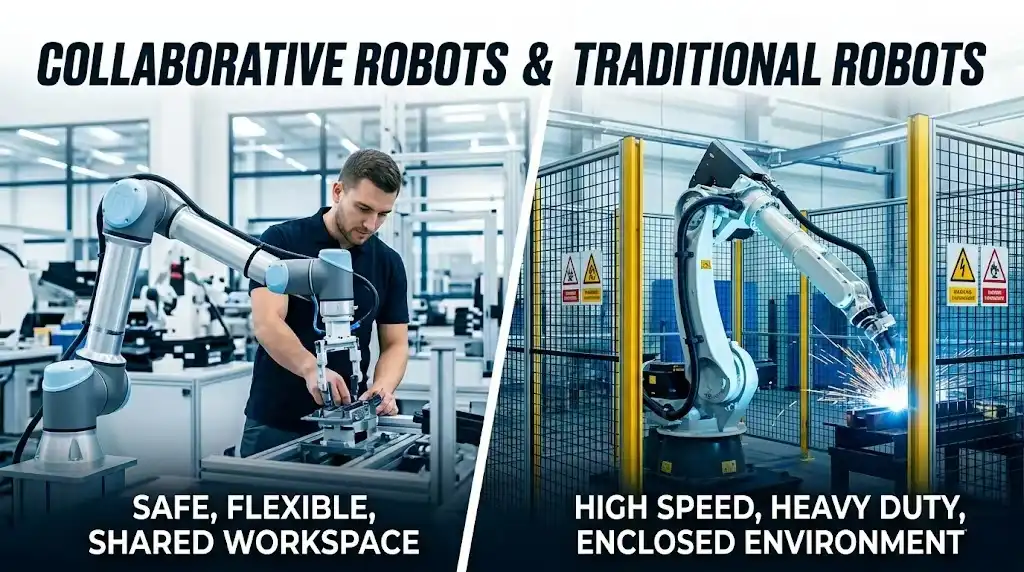
The global collaborative robot market hit $1.9 billion in 2023 and is projected to reach $11.8 billion by 2030, according to MarketsandMarkets research — yet most manufacturers still struggle to articulate the cobot vs robot difference when planning their next automation investment. The core distinction is straightforward: cobots are purpose-built to share a workspace with humans without safety caging, while traditional industrial robots operate in isolated cells at high speed and payload capacities. This guide breaks down five critical differences between cobots and robots — covering safety, programming, performance, flexibility, and cost — so you can match the right technology to your specific production needs.
Cobot vs Robot at a Glance
The core cobot vs robot difference comes down to one thing: who shares the workspace. A collaborative robot (cobot) is engineered to operate safely alongside human workers without physical barriers, while a traditional industrial robot performs tasks inside guarded cells at high speed and force. That single design philosophy split drives every other distinction — cost, programming, payload, and deployment flexibility.
| Factor | Cobot | Traditional Industrial Robot |
|---|---|---|
| Safety Approach | Force-limited joints, ISO/TS 15066 compliant | Safety fencing, light curtains, locked cells |
| Typical Payload | 3–25 kg | Up to 2,300 kg+ |
| Programming | Hand-guiding / no-code interfaces | Proprietary languages (RAPID, KRL, Karel) |
| Deployment Time | Hours to days | Weeks to months |
| Entry Cost | $25,000–$65,000 | $100,000–$400,000+ (with integration) |
| Best For | High-mix, low-volume tasks | High-volume, fixed-process production |
According to the International Federation of Robotics, cobot installations grew roughly 50% year-over-year in recent reporting periods — far outpacing the broader industrial robot market’s single-digit growth. That surge reflects a clear industry verdict: when you need fast ROI and human-robot collaboration on the same line, cobots win. When you need raw speed, reach, or payload, traditional robots remain unmatched.
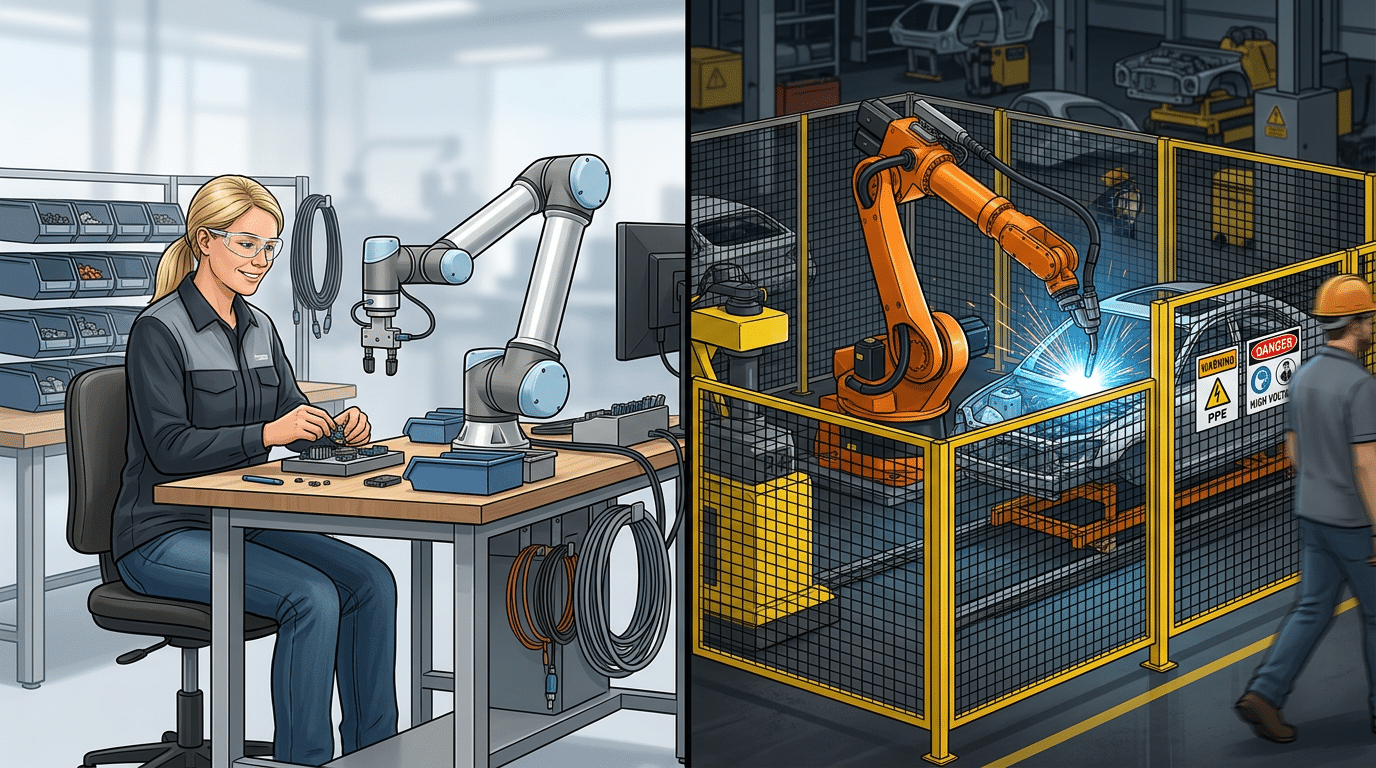
cobot vs robot difference shown side by side — collaborative robot with human worker and fenced industrial robot in factory
What Is a Collaborative Robot (Cobot)?
A collaborative robot — or cobot — is a robotic arm engineered from the ground up to operate safely alongside human workers without traditional safety fencing. The term was coined in 1996 by Northwestern University professors J. Edward Colgate and Michael Peshkin, but the technology didn’t mature until the release of ISO/TS 15066:2016, which defines precise force and pressure thresholds for human-robot contact. Under this standard, a cobot must limit transient contact force to the chest at no more than 150 N — roughly the pressure of a firm handshake.
How does a cobot actually “feel” a collision? Through built-in force-torque sensors embedded in every joint. These sensors sample contact forces at rates up to 1,000 Hz, triggering an immediate stop or controlled retreat when resistance exceeds safe limits. This is called power and force limiting (PFL), one of four collaborative operation modes defined by ISO 10218-2.
The fundamental cobot vs robot difference in design philosophy: traditional robots prioritize speed behind a cage, while cobots sacrifice peak velocity to share the workspace safely.
Why were cobots developed at all? Small and mid-sized manufacturers — companies with fewer than 500 employees — account for roughly 98% of U.S. manufacturing firms, yet most couldn’t justify the floor space, integration cost, or safety infrastructure of conventional industrial robots. Cobots fill that gap. They deploy in hours rather than weeks, require no dedicated safety cells, and can be hand-guided to new tasks by operators with zero programming background. That accessibility is exactly why the global cobot market reached $1.2 billion in 2023 and continues to grow at double-digit rates annually.
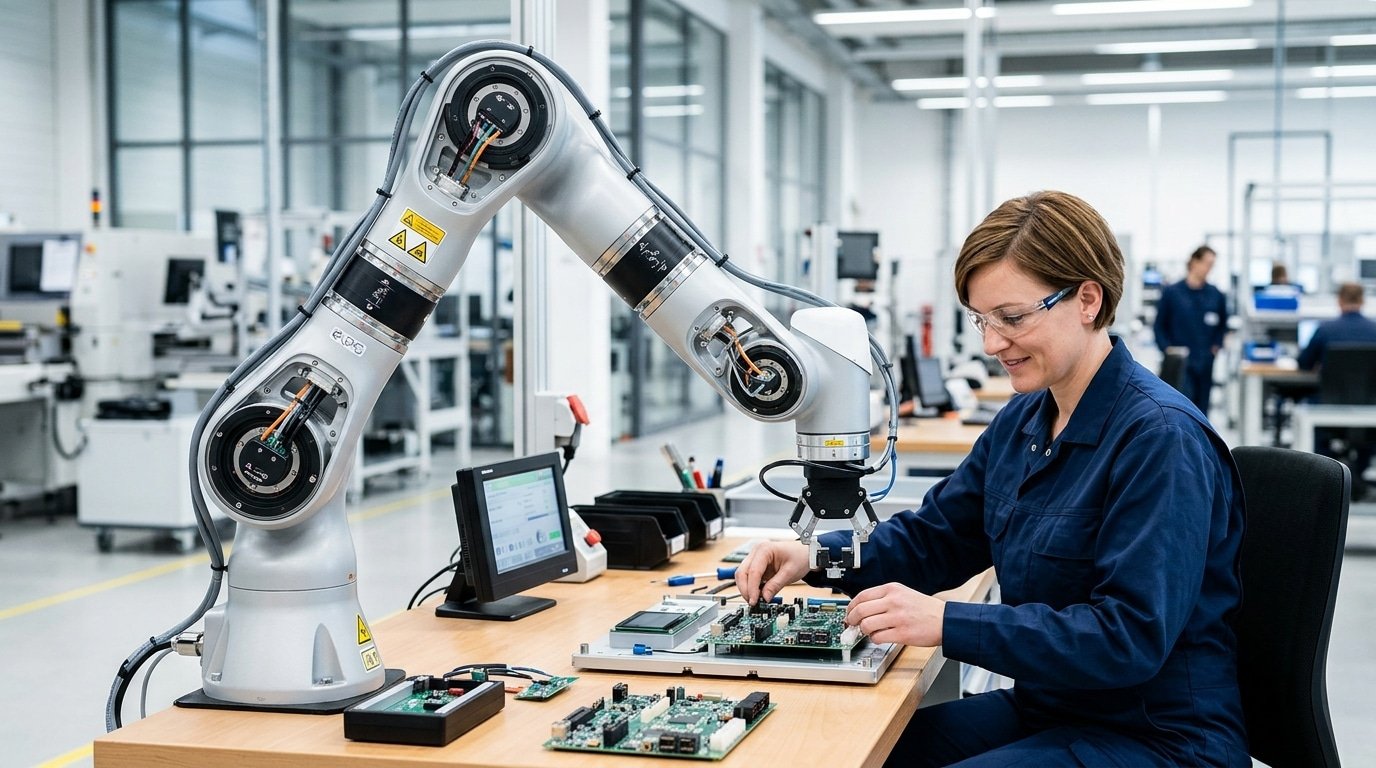
Collaborative robot cobot with force-limiting sensors working safely next to human worker
What Is a Traditional Industrial Robot?
The story starts in 1961, when Unimate — a 1,800 kg hydraulic arm — began pulling die-cast parts from a machine at a General Motors plant in Ewing, New Jersey. That single deployment launched an industry now worth over $16 billion annually, according to the International Federation of Robotics. A traditional industrial robot is a reprogrammable, multi-axis manipulator designed for fully autonomous operation — typically inside a safety-fenced cell where no human enters during a cycle.
What separates these machines from cobots? Raw performance. Industrial robots routinely handle payloads exceeding 500 kg, reach speeds above 2 m/s at the tool center point (TCP), and achieve repeatability within ±0.02 mm. That precision is why they dominate welding, painting, and high-volume palletizing lines.
Common Types of Industrial Robots
- Articulated robots — Six-axis arms (e.g., FANUC M-2000iA) offering maximum flexibility for complex paths.
- SCARA robots — Four-axis units optimized for fast, planar pick-and-place tasks like electronics assembly.
- Delta (parallel-link) robots — Lightweight, ultra-fast designs that can exceed 200 picks per minute in packaging.
- Cartesian (gantry) robots — Linear-axis systems ideal for CNC loading and large-area dispensing.
Understanding these categories is essential when evaluating the cobot vs robot difference, because each type occupies a performance envelope that cobots simply cannot match — yet. If your application demands cycle times under one second or payloads above 35 kg, a traditional industrial robot remains the only viable choice.
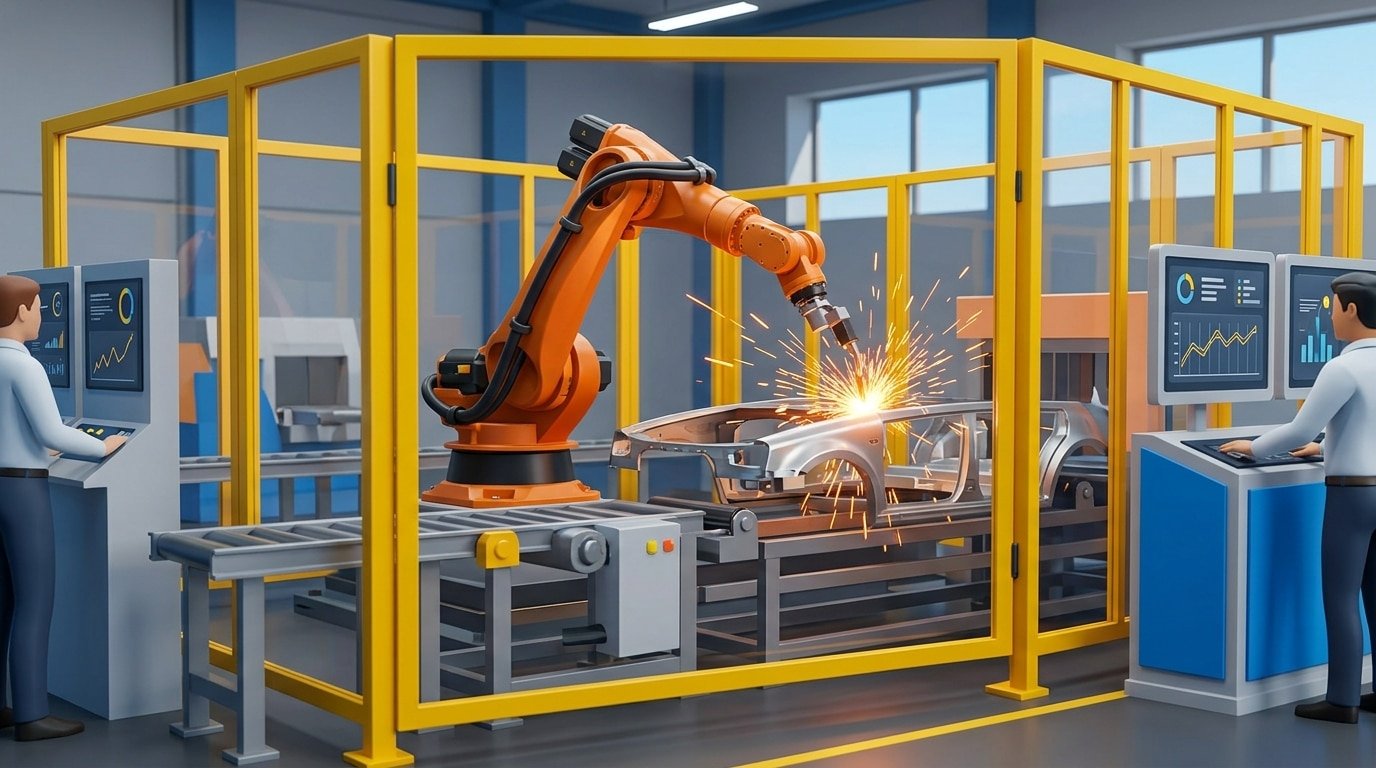
Traditional industrial robot welding inside a safety-fenced cell — key cobot vs robot difference in workspace design
5 Key Differences Between Cobots and Robots
The cobot vs robot difference isn’t a single spec on a datasheet — it’s a cluster of five engineering and economic trade-offs that ripple through every deployment decision you’ll make. The sections below unpack each one in detail, but here’s the high-level framework to keep in mind as you read.
| Difference | Cobot | Traditional Robot |
|---|---|---|
| Safety design | Force-limited, fenceless | Caged, high-force zones |
| Programming | Hand-guided teach or tablet | Offline code, specialist needed |
| Payload & speed | Typically ≤ 35 kg, ≤ 1.5 m/s | Up to 2,300 kg, ≤ 10+ m/s |
| Flexibility | Redeployable in hours | Fixed-cell, weeks to retool |
| Cost structure | Lower upfront, faster ROI | Higher capital, lower per-unit cost at scale |
According to the International Federation of Robotics’ World Robotics 2023 report, cobot installations grew roughly 50% year-over-year while traditional industrial robot shipments rose about 5%. That gap signals a clear market shift — but it doesn’t mean cobots replace industrial robots. They solve fundamentally different problems.
Quick rule of thumb: if a task demands sub-millimeter repeatability at high throughput behind a safety fence, choose a traditional robot. If the task requires frequent changeover, human proximity, or rapid ROI on a lean budget, a cobot wins.
Each of the five differences below gets its own dedicated section so you can drill into the specifics — safety standards, programming paradigms, real payload benchmarks, redeployment workflows, and total cost of ownership calculations. Read them in order for the full picture, or jump to the one that matters most for your project.
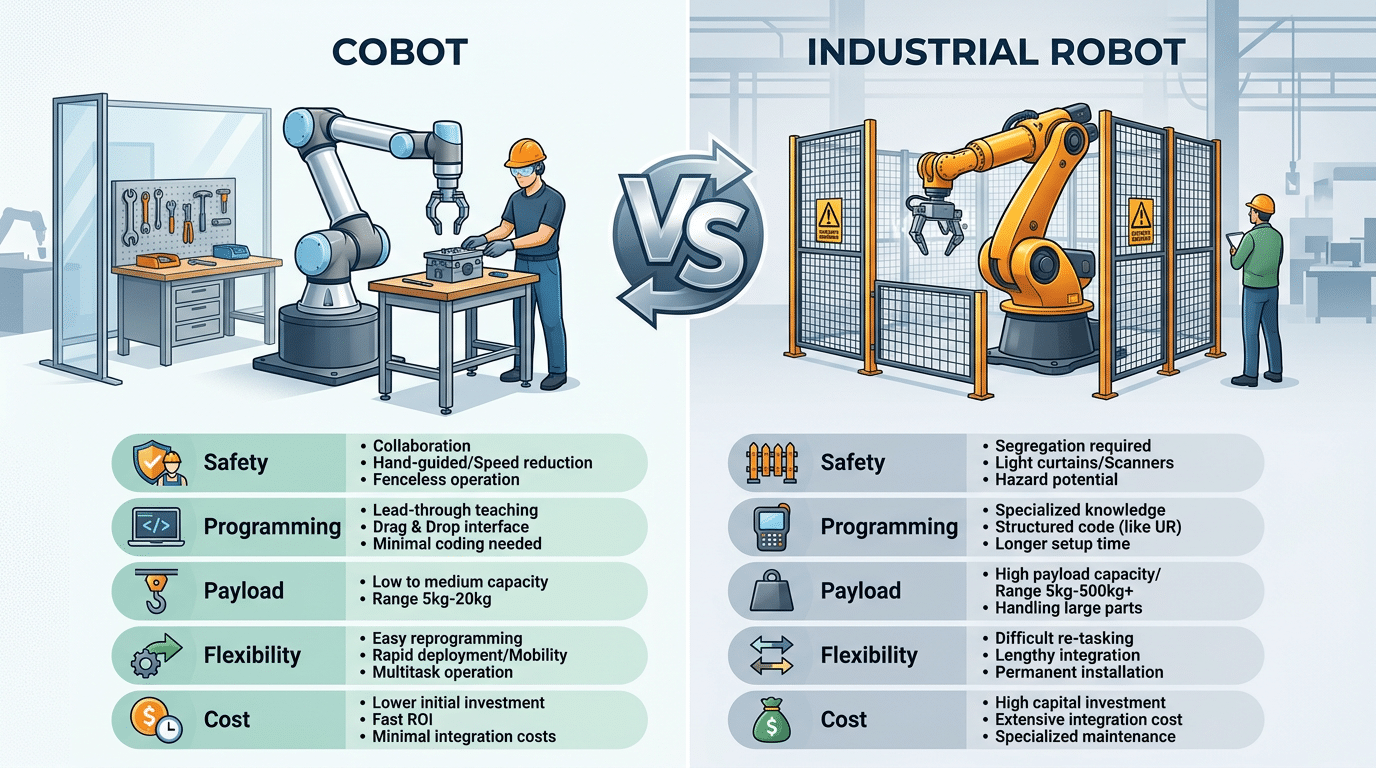
cobot vs robot difference infographic showing five key comparison categories
Safety Design and Human Interaction
The most fundamental cobot vs robot difference lives in their safety architectures. Industrial robots operate behind steel fencing, light curtains, and safety-rated interlocks because a single collision at full speed can exert thousands of newtons of force. Cobots flip that model entirely — they’re built to share space with human operators, no cage required.
Two ISO standards draw the line. ISO 10218 governs traditional industrial robots and mandates physical safeguarding — perimeter guards, emergency stops, and safety-rated monitored stops before a human enters the cell. ISO/TS 15066, published in 2016, defines the permissible force and pressure limits for collaborative operation. For example, a transient contact on a human hand must stay below 280 N of peak force to avoid injury.
How do cobots actually stay under those thresholds? Three mechanisms work in concert:
- Force/torque sensors embedded in every joint detect unexpected resistance and trigger a stop within milliseconds.
- Rounded, padded exteriors distribute impact energy across a wider area, reducing peak pressure on skin and tissue.
- Speed and separation monitoring dynamically slows the arm as a person moves closer, rather than halting production entirely.
Here’s a practical tip most integrators learn the hard way: a cobot is only “collaborative” within a validated risk assessment. Attach a sharp deburring tool to the end effector, and that same cobot may need guarding just like a traditional robot. The safety difference between cobots and robots isn’t absolute — it depends on the full application, not just the arm itself.
Programming Complexity and Ease of Deployment
Here’s where the cobot vs robot difference hits your project timeline hardest. Programming a traditional industrial robot typically requires a specialist who knows vendor-specific languages — RAPID for ABB, KRL for KUKA, Karel for FANUC. The workflow involves writing code on a teach pendant, testing in offline simulation software, and then painstakingly fine-tuning waypoints on the factory floor. Expect 6 to 16 weeks from concept to production-ready cell, once you factor in safety fencing, PLC integration, and risk assessments.
Cobots flip that model. Most modern collaborative robots use hand-guiding (also called “drag-to-teach”) — you physically move the arm through the desired path, and the controller records each waypoint. Universal Robots reports that first-time users can have a UR cobot running a basic pick-and-place task in under an hour. No robotics degree required.
Pro tip: Even with drag-to-teach, spend time tuning force thresholds and approach vectors. A “good enough” path recorded by hand often needs 10–15 waypoint refinements before cycle time is truly optimized.
Graphical, flowchart-style interfaces — like UR’s Polyscope or FANUC’s CRX tablet UI — replace hundreds of lines of code with drag-and-drop logic blocks. That accessibility slashes deployment from months to days, which matters enormously for small-batch manufacturers who retool frequently.
Traditional robots still win when the task demands microsecond-level synchronization across multiple axes or tight integration with vision systems and conveyors. Offline programming suites such as RoboDK or Dassault’s DELMIA let engineers simulate entire cells digitally before a single bolt is tightened — a necessity for automotive body-in-white lines where downtime costs roughly $22,000 per minute.
3. Payload Capacity and Speed Performance
This is the cobot vs robot difference that physics won’t let you negotiate away. Cobots must limit force and momentum to keep human operators safe — and that directly caps both how much they can lift and how fast they can move. Most cobots on the market handle between 3 kg and 35 kg, with maximum TCP (tool center point) speeds around 1–2 m/s. The moment a person enters the collaborative workspace, ISO/TS 15066 speed and separation monitoring often reduces that further to roughly 250 mm/s.
Industrial robots play in a completely different league. FANUC’s M-2000iA, for instance, manages a staggering 2,300 kg payload — roughly 65× the capacity of the largest Universal Robots cobot. Cycle times drop into sub-second territory for pick-and-place tasks, with joint speeds exceeding 200°/s. That raw throughput is why automotive body shops and heavy palletizing lines still depend entirely on caged industrial arms.
A practical rule of thumb: if your part weighs over 25 kg including the end-of-arm tooling, or your required cycle time is under 4 seconds, a cobot almost certainly won’t keep up. Factor in gripper mass — it’s the mistake most first-time integrators make.
The gap is narrowing, though. Universal Robots’ UR30 now reaches 30 kg payload in a cobot form factor, and FANUC’s CRX-25iA pushes collaborative payloads to 30 kg as well. Still, speed remains the hard constraint: safe collaborative operation and high-velocity motion are fundamentally at odds under current safety standards.
4. Flexibility and Redeployment
Can you move your automation to a different line by Friday? That question exposes a critical cobot vs robot difference in real production environments. A six-axis industrial robot bolted to a 500 kg steel pedestal, surrounded by safety fencing, and hardwired to a dedicated PLC rack isn’t going anywhere fast. Redeploying one typically requires 40–80 hours of mechanical teardown, electrical reconnection, and safety re-validation.
Cobots flip that equation. Most units weigh under 35 kg, mount on tabletops, mobile carts, or even ceilings, and connect through a single power cable plus an Ethernet line. A trained technician can unbolt a Universal Robots UR10e, wheel it to a new station, and have it running a different task in under a day — sometimes in under two hours when using saved waypoint programs. According to the International Federation of Robotics, this redeployment agility is a key driver behind the 46% compound annual growth rate of cobot installations between 2017 and 2021.
High-mix, low-volume shops — think contract electronics assemblers running 50+ SKUs per week — benefit most. Swap a gripper end-effector, load a stored program, and production resumes. Industrial robots still dominate fixed, high-volume lines where a single cell runs the same weld pattern millions of cycles without change. The practical rule: if your product mix changes more than once per shift, a cobot’s small footprint (often under 1 m²) and tool-free mounting will save you weeks of engineering time each year.
5. Cost Structure and Total Cost of Ownership
Sticker price is misleading. A Universal Robots UR10e cobot arm lists around $50,000, while a comparable-payload Fanuc industrial robot starts near $40,000 — seemingly cheaper. But the cobot vs robot difference in total cost of ownership (TCO) flips that math once you factor in everything surrounding the arm itself.
Integration expenses dominate traditional robot budgets. Safety fencing, light curtains, floor anchors, and a certified risk assessment can add $75,000–$150,000 to a single cell. A cobot deployed collaboratively often eliminates those line items entirely. According to the International Federation of Robotics, integration typically costs 3–5× the robot’s purchase price for traditional systems, versus 1–2× for cobots.
| Cost Category | Cobot Cell | Traditional Robot Cell |
|---|---|---|
| Hardware (arm + gripper) | $50K–$70K | $40K–$80K |
| Safety infrastructure | $0–$5K | $30K–$150K |
| Integration & programming | $10K–$30K | $60K–$200K |
| Annual maintenance | $1K–$3K | $5K–$15K |
| Typical 3-year TCO | $65K–$115K | $155K–$475K |
Where does the math reverse? High-volume, single-product lines running 24/7. A traditional robot’s superior cycle speed generates enough throughput gain to amortize that steep integration cost within 12–18 months. If your annual output exceeds roughly 500,000 identical units, the industrial cell almost always wins on per-part cost.
Pro tip: Request a “cost-per-pick” or “cost-per-cycle” analysis from integrators rather than comparing purchase prices. That single metric captures the real cobot vs robot difference in economic terms.
Real-World Applications for Cobots and Industrial Robots
Understanding the cobot vs robot difference becomes concrete when you map each technology to the tasks it dominates. The split isn’t arbitrary — it follows directly from the payload, speed, and safety constraints covered earlier.
Where Cobots Excel
- Machine tending: A UR5e loads and unloads CNC lathes in job shops where part numbers change daily. One operator supervises three machines instead of one.
- Quality inspection: In electronics, cobots equipped with vision systems inspect solder joints on PCBs at tolerances under 0.05 mm — tasks too repetitive for humans yet too variable for fixed automation.
- Lab automation (pharma): Cobots handle sample prep in ISO-classified cleanrooms, reducing contamination risk. Universal Robots reports over 75,000 cobots deployed globally across these use cases.
Where Industrial Robots Dominate
- Automotive welding: FANUC and ABB robots perform spot welding at cycle times under 2 seconds per joint — roughly 4× faster than any cobot alternative.
- Heavy palletizing (food & beverage): Stacking 50 kg cases of bottled water at 1,800 cycles per hour demands the 200+ kg payloads only industrial robots deliver.
- Spray painting: Explosive-atmosphere certifications (ATEX zones) require sealed industrial arms that cobots simply aren’t built for.
The practical rule: if a human needs to be within arm’s reach during the process, choose a cobot. If the process demands raw throughput or hazardous-environment ratings, an industrial robot is the only serious option.
How to Choose the Right Automation for Your Facility
Forget feature comparisons for a moment. The real cobot vs robot difference that matters is which one solves your bottleneck without creating new ones. Run through these five filters in order — each one narrows the field fast.
- Production volume and cycle time. Pushing above 60 units per minute? Traditional industrial robots dominate. Below that threshold, a cobot’s flexibility usually delivers better ROI.
- Payload and reach. If your heaviest part exceeds 25 kg, you’re in industrial robot territory. Cobots top out around 16–25 kg for most commercial models.
- Available floor space. Facilities under 5,000 sq ft benefit from cobots that skip safety fencing. According to the Association for Advancing Automation (A3), cage-free deployments can reclaim up to 40% of a workcell’s footprint.
- Workforce skill level. No in-house robotics engineer? Cobots with hand-guided teaching get operators productive in hours, not weeks.
- Budget reality. If your total first-year budget sits below $100,000 including integration, a cobot is almost always the pragmatic pick.
One decision that trips up first-time buyers: assuming the cobot vs robot difference is permanent. Many facilities start with a cobot for proof-of-concept, then graduate specific high-throughput stations to industrial robots once volume justifies the investment. Treat automation as a spectrum, not a binary choice.
Quick self-test: If you answered “cobot” on four or more filters above, start there. Two or fewer? Spec an industrial robot. A split result means a hybrid cell — cobot for loading, industrial robot for the heavy process — often wins.
Frequently Asked Questions About Cobots vs Robots
Can a cobot replace an industrial robot? Only if your application stays within cobot payload and speed limits. A cobot handling 5 kg parts at moderate cycle times works fine, but it cannot replicate the 400 kg lift capacity or 2 m/s joint speeds of a heavy-duty industrial arm. The cobot vs robot difference is engineering-driven, not marketing-driven — match the tool to the task.
Are cobots safe without fencing? Not automatically. Cobots require a thorough ISO 10218 / ISO/TS 15066 risk assessment before running fenceless. Sharp end-effectors, hazardous materials, or high-inertia loads can still injure operators even at reduced speeds. Skip the risk assessment, and you skip the safety.
What is the lifespan of a cobot vs a robot? Most industrial robots exceed 100,000 hours of operation — roughly 12–15 years of multi-shift use. Cobots typically reach 35,000–50,000 hours before major joint servicing, though harmonic drive replacements can extend that significantly.
Can cobots and industrial robots work on the same line? Absolutely. Hybrid cells are increasingly common: an industrial robot handles heavy welding while a cobot performs adjacent inspection or part loading outside the safety fence. This setup captures the best of each technology.
Do cobots eliminate jobs? Data says otherwise. A 2021 MIT study found that firms adopting cobots often redeploy workers to higher-value tasks, with net employment remaining stable or growing. The real cobot vs robot difference in workforce impact is that cobots augment human roles rather than fully automate them.
Making the Right Automation Investment
Every cobot vs robot difference outlined above — safety architecture, programming effort, payload limits, redeployment speed, and total cost of ownership — points to the same conclusion: there is no universal winner. The right choice is the one that fits your specific throughput target, workforce structure, and floor-space constraints.
Start with a 30-day pilot. According to the Association for Advancing Automation (A3), companies that run structured pilot programs before full deployment report 72% higher satisfaction with their automation ROI. A pilot forces you to measure real cycle times, operator adoption rates, and integration costs — data no spec sheet can provide.
Practical recommendation: Request a formal risk assessment (per ISO 12100) from your integrator before committing capital. This single document will clarify whether you need full safety fencing, a force-limited cobot cell, or a hybrid layout combining both.
Don’t overlook hybrid architectures. Pair a high-speed industrial robot for the heavy-payload station with a cobot handling the adjacent inspection or packaging task. This approach captures the speed of traditional automation and the flexibility of collaborative systems — without forcing an either/or decision.
Your next step is concrete: map your three highest-labor-cost processes, score each against the five differences covered in this guide, and request quotes for both cobot and industrial robot cells. That comparison — grounded in your own production data — will make the investment decision obvious.
See also
Are Cobots Replacing Human Workers (Real Industry Data)
Cobot Risk Assessment Checklist — 47 Points Covering ISO 15066 and Beyond
Can a Cobot Work Without a Safety Fence?