

Top 5 Weather-Resistant Metals for Exterior Projects
There is no single best metal for every exterior project. Start with aluminum for lightweight fabricated parts, stainless steel for strength and chloride-aware details, copper or zinc when natural patina is intentional, and weathering steel only in drainable, low-salt exposure. Stop selection until the exact alloy, water path, mixed-metal contacts, finish and maintenance plan are known.

Which weather-resistant metal should you review first?
Use the condition that most closely matches the project. This table creates a shortlist; it does not approve a grade, finish or service life.
| Project condition | Recommended starting point | Evidence required | Stop and resolve if |
|---|---|---|---|
| Lightweight frame, panel or enclosure | Specified aluminum alloy and finish. | Alloy, temper, product form, coating or anodizing system, fasteners and drainage drawing. | The RFQ says only “aluminum,” or water can remain inside folds and hollow sections. |
| High-touch rail, trim or chloride-aware exterior | Specified stainless steel grade and finish; often 316/316L when credible salt exposure exists. | Site salt exposure, finish roughness, weld-cleanup method, crevice details and cleaning access. | The supplier offers an unspecified “stainless,” or sheltered salt deposits cannot be removed. |
| Roof or façade designed to age naturally | Copper or an approved architectural zinc system. | Approved appearance sample, substrate, seam, rear ventilation, compatible fasteners and runoff path. | The owner expects fixed color and timing, or the rear face cannot drain and dry. |
| Open rust-colored structure in low-salt exposure | Weathering steel after site and detail review. | Chloride and wetness assessment, product grade, drainage, inspection access and staining control. | Marine aerosol, de-icing salt, persistent fog, water traps or hidden wet crevices are credible. |
| Persistent dampness or an unresolved water trap | Correct the assembly before selecting any of the five families. | Revised drainage, ventilation, sealing and inspection details reviewed by the responsible authority. | The design still depends on a coating or premium metal to survive standing water. |
What does “weather-resistant” actually mean?
Outdoor durability is not one corrosion number. A rain-washed façade, a shaded coastal handrail and the back of a folded equipment cover can face very different conditions—even on the same site.
Sea aerosol and road de-icing salts can concentrate under deposits and inside crevices. Distance alone does not define exposure; wind, orientation and cleaning matter.
A face that dries after rain behaves differently from a damp lap, hidden backing sheet, condensate path or hollow section that cannot drain.
Dust, industrial deposits and salt can form a conductive film when wet. Sheltered areas often miss the natural rinsing that exposed faces receive.
Electrical contact plus moisture can accelerate attack of the less noble material. Fasteners, washers, brackets and runoff routes all belong in the review.
Roughness, weld heat tint, embedded iron, damaged coatings and unsealed cut edges can matter more than the broad untouched sheet surface.
Patina, staining, gloss loss and color variation may be desirable, tolerable or unacceptable. Define appearance expectations before selecting the metal.
“Weather-resistant” does not mean corrosion-proof or maintenance-free. Use this guide to build a shortlist, then have the project’s qualified material, façade, marine or corrosion professional confirm the final system.
A sloped surface, open exit and drip edge shorten wet time and help remove deposits.
A flat overlap or sealed pocket can retain salt water after the exposed face looks dry.
Compare the five weather-resistant metals
Treat each row as a reason to investigate—not permission to release an unspecified material. Product form, exact grade, fabrication, finish and exposure still control the result.
| Metal family | Strong starting applications | Protection mechanism | Main limits to control | What the RFQ must name |
|---|---|---|---|---|
| 01 Aluminum | Frames, panels, covers, signs, louvers and lightweight housings. | Native oxide film plus a suitable anodized or coated finish where appearance control is needed. | Alloy choice, chloride crevices, alkaline contact, galvanic couples and coating damage. | Alloy, temper, product form, thickness, finish standard and isolation details. |
| 02 Stainless steel | Railings, trim, fixings, high-touch components and equipment enclosures. | Chromium-rich passive film; molybdenum in 316/316L improves resistance to localized chloride attack. | Wrong grade, rough finish, salt deposits, crevices, weld heat tint and insufficient cleaning. | Exact grade, finish, weld cleanup, cleaning access and acceptance criteria. |
| 03 Copper | Roofing, wall cladding, gutters and landmark details where ageing is intentional. | Adherent tarnish and patina that generally slow further atmospheric attack. | Color change, runoff staining, galvanic compatibility, substrates and cost. | Material designation, finish state, runoff path, fasteners and accepted color variation. |
| 04 Zinc / zinc-titanium | Roofs and rainscreens designed as ventilated, drained envelope systems. | Protective zinc-based patina on suitably exposed surfaces. | Backside moisture, condensation, wrong substrate, insufficient ventilation and non-rinsed staining. | Specific zinc system, backing build-up, ventilation, substrate and seam details. |
| 05 Weathering steel | Open screens, façades, bridges and landscape features in suitable low-chloride conditions. | A dense rust patina can reduce further corrosion when repeated wet–dry cycling is favorable. | Salt, long wet periods, crevices, sheltered geometry and runoff staining. | Applicable product grade, joint details, exposure assumptions, drainage and staining controls. |
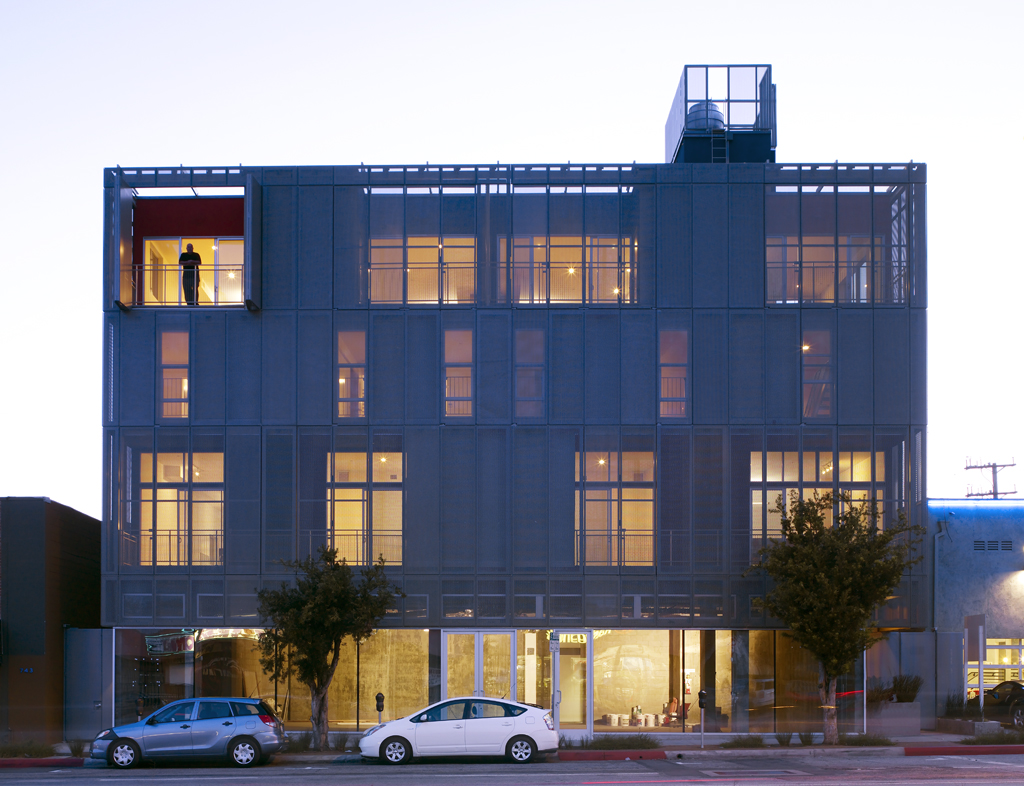
Aluminum: a broad starting point, not a complete specification
Aluminum naturally develops a thin oxide film and offers low weight, easy forming and powerful extrusion options. Those benefits make it a common candidate for sunshades, frames, signage, exterior housings and curtain-wall components.
The material family is wide. Many 6xxx alloys are used for architectural and structural extrusions. Selected 5xxx aluminum-magnesium alloys can be valuable where weldability and marine-oriented corrosion resistance matter. That does not make every 5xxx alloy, temper or product form interchangeable.
- Use extrusion to build drainage, ribs and gasket lands into the profile.
- Specify anodizing or a qualified coating system when appearance consistency matters.
- Drain hollow sections and folded returns instead of relying on sealant alone.
- Review stainless fasteners, steel brackets, copper runoff and wet concrete contact.

Stainless steel: grade, finish and cleaning decide the result
Stainless steel relies on a chromium-rich passive surface film. It is widely used for railings, doors, fixings, trim and outdoor equipment—but “stainless never rusts” is false. Salt deposits, crevices, rough finishes, weld heat tint and carbon-steel contamination can produce staining or localized corrosion.
Types 304/304L and 316/316L are common architectural grades. The molybdenum in 316/316L improves resistance to localized attack in chloride-bearing conditions. Yet a severe coastal, pool, industrial or road-salt detail may exceed 316 capability, especially where deposits remain and cleaning is difficult.
A common review starting point for many rural, urban and light-industrial exterior sites with suitable finish and cleaning.
A more common starting point where marine aerosol or de-icing salt is credible. It is not a universal “coastal approved” label.
Copper works best when weathering is part of the design
Copper is not chosen because it stays bright. It is chosen because its surface can move through brown tones and, in some environments, toward a green-gray patina that becomes part of the architecture.

Ask four questions before approving copper
- Can the owner accept different color and timing on rain-washed, vertical and sheltered faces?
- Where will runoff travel, and could it stain masonry, concrete, paving, membranes or another metal?
- Are the fasteners, flashings, sealants and supporting substrates compatible with copper?
- Is the required state natural, pre-patinated or coated—and is normal installed variation defined?
Copper patina at Manila Cathedral. Photo: Andrew Moore, CC BY-SA 2.0, via Wikimedia Commons.
Climate, moisture, atmospheric chemistry, orientation and alloy affect color and timing. Do not promise that every copper surface will turn the same green within a fixed number of years.

Zinc: design the front and the back of the sheet
Architectural zinc and zinc-titanium systems are used for roofs and façades because they can form a protective patina and can be shaped into seams, panels and cassettes. The exposed face is only half the durability story.
Persistent moisture behind zinc, unsuitable backing materials and poor ventilation can cause hidden damage. Warm-roof and underside-coated systems may use different manufacturer-approved build-ups, so general rules should not replace the selected system’s instructions.

Weathering steel is not simply “steel that needs no paint”
Weathering steel is formulated to develop a denser rust patina than ordinary carbon steel in suitable atmospheric exposure. The useful layer depends on repeated wet–dry cycles. Salt loading, high time of wetness, debris, shelter and crevices can prevent the patina from stabilizing.
Use it as a deliberate material for open screens, façades, bridges, public art and landscape structures—after the site and water paths are reviewed. ASTM A588 and related standards define material categories; they do not approve every coastal, roadside or hidden detail.
- Geometry is open, visible and drainable.
- The site has low chloride loading.
- Wet surfaces can fully dry.
- Color variation and runoff are accepted.
- Early patina can be inspected.
- Sea spray, splash or road salt is credible.
- Fog or condensation keeps surfaces wet.
- Water sits in folds, laps or cavities.
- Adjacent paving cannot accept staining.
- Surfaces are hidden or hard to inspect.
What FHWA guidance changes about the decision
The U.S. Federal Highway Administration’s Technical Advisory T 5140.22 reports poor performance where weathering steel was used in improper locations or with poor detailing. It calls for caution in marine coastal areas, persistent fog or high humidity, concentrated industrial exposure and details that trap water or debris. If serious doubt remains, the advisory says engineering judgment should lean toward coated steel. This highway guidance is not a universal building specification, but its failure conditions are useful screening evidence.
Choose by exposure—not by a generic “outdoor” label
A good candidate still needs project review. A sheltered, dirty component can be more aggressive than a rain-washed panel only a few meters away.
| Project condition | Strong first candidates | Usually needs extra caution | Decision reason |
|---|---|---|---|
| Dry inland façade or sign | Aluminum, 304 stainless, architectural zinc or copper. | Weathering steel where stains or uneven patina are unacceptable. | General exposure may be moderate, but water traps and the desired ageing still matter. |
| Coastal façade or rail | 316/316L or a higher-alloy stainless after site review; a suitable coated or anodized aluminum system. | 304 stainless, weathering steel, hidden zinc back faces and unisolated mixed metals. | Salt deposits and sheltered crevices raise localized-corrosion risk. |
| Roadside near de-icing salts | A stainless or protected aluminum system proven for the exact chloride exposure. | 304 in dirty crevices, weathering steel near splash, coating gaps and small aluminum parts around large stainless fasteners. | Repeated salt wetting can be more severe than the word “outdoor” suggests. |
| Roof or rainscreen | Zinc, copper, aluminum or stainless within a complete drained and ventilated assembly. | Any sheet over a persistently wet or incompatible backing. | Rear-side condensation, seams and water exits often decide service performance. |
| Public art or landscape screen | Copper, weathering steel, aluminum or stainless based on desired ageing and public contact. | Patina metals where runoff cannot be accepted or inspected. | Aesthetics must be balanced with sharp-edge control, cleaning and the surrounding pavement. |
| Outdoor equipment enclosure | Coated aluminum, suitable stainless or a qualified coated-steel system. | Water-trapping seams, finish damage around holes and vague “stainless” specifications. | Ingress paths, fasteners, field repairs and service access may matter more than the broad sheet face. |
Five rules often matter more than the metal name
Slope caps and covers, add drip edges, drain hollow sections and remove ledges that collect salt, leaves or dirt.
Use joints, gaskets, sealants and geometry that do not create a sealed pocket with no reliable exit.
Control wet electrical contact with compatible isolators, washers, coatings and runoff routes.
Sheltered soffits, rail undersides, corners and back faces may need intentional rinsing and inspection.
Protect finished aluminum, remove stainless contamination and heat tint where required, and define repairs.

Galvanic corrosion needs three conditions
Unlike metals do not automatically fail just because they touch. The risk rises when they are electrically connected, bridged by a conductive liquid and separated enough in electrochemical behavior for one material to become the anodic member.
Area ratio matters too: a small anodic part coupled to a large cathodic surface can be an unfavorable arrangement. Review the complete chain—sheet, weld, bracket, fastener, washer, flashing and deposited runoff.
A coating is useful—but it cannot rescue a bad water path
A finish can control color, add a barrier and make cleaning easier. It cannot reliably correct standing water, salt-loaded crevices, poor weld cleanup or the wrong base material.
Specify the finish as a process
- Pretreatment and surface preparation
- Performance standard and film build
- Edge, hole and weld coverage
- Color, gloss and texture sample
- Field-repair method and limits
- Pack-out and site-storage protection
Do not convert salt-spray hours directly into outdoor service years. Accelerated tests support comparison within a defined system; they do not recreate every field exposure.
Compare cost per accepted service result
- Material and fabrication
- Weight, shipping and lifting
- Fasteners and isolators
- Finish and touch-up
- Cleaning and access equipment
- Runoff and replacement risk
The lowest sheet price may not be the lowest project cost. Spend more specification effort where access is difficult, failure is visible, or corrosion can affect public safety.
Build a starting exterior-metal shortlist
Choose the closest exposure and design priority. The output is a review path—not material approval, a service-life promise or a replacement for site-specific engineering.
For a rain-washed inland exterior with a controlled finish, both families can be practical starting points. Compare weight, strength, forming, finish and cleaning access.
- Name the exact alloy or grade and product form.
- Eliminate wet crevices and map every mixed-metal interface.
- Define the finish, cleaning plan and first-article acceptance.
Planning aid only. Final selection must reflect the project drawing, current material/product standards, local environment, structural and fire requirements, and the responsible design authority.
What should an exterior-metal RFQ include?
“For outdoor use” is not enough information for a meaningful durability review. Give suppliers the conditions they need to identify a weak grade, finish or detail before production.
Airborne salt, de-icing salt, pollution, humidity, splash, condensation, shelter, rain washing, cleaning access and intended service.
Alloy or grade, temper/condition, product form, thickness and tolerance, current applicable product standard, MTR or CoC requirement.
Anodizing, coating, polish or patina state; pretreatment; performance standard; color sample; edge coverage; repair method.
Fasteners, washers, brackets, flashings, gaskets, sealants, adhesives, isolators and every possible wet runoff path.
Slopes, drain holes, drip edges, vent paths, closed-section drainage, backside drying and prohibited water traps.
First article, weld and finish checks, contamination control, touch-up limits, appearance sample, packaging and site-storage instructions.
Avoid these six selection mistakes
Without a grade, finish, weld cleanup and cleaning expectation, the requirement is open to incompatible interpretations.
Marine suitability depends on the exact alloy-temper, product form, fabrication route and applicable standard.
Coastal aerosol and de-icing salt can stop a protective patina from stabilizing.
Copper, zinc and weathering steel can affect adjoining surfaces, drainage routes and acceptance.
A barrier finish cannot reliably rescue a hidden wet pocket, incompatible contact or untreated cut edge.
Accelerated exposure data is useful evidence, but it is not a universal conversion to outdoor years.
What else should buyers ask before selecting an exterior metal?
What metal lasts the longest outside?
There is no universal winner. Long service depends on matching the exact grade or alloy to chlorides, wetness, pollution, drainage, mixed-metal contacts and maintenance access. A well-detailed moderate-cost system can outperform a premium metal in a water-trapping design.
Is aluminum better than stainless steel for outdoor use?
Neither is automatically better. Aluminum is lighter and highly flexible for panels, frames and housings. Stainless steel offers greater strength and can be valuable for high-touch or chloride-prone components when the correct grade, finish and cleaning plan are used.
Is 304 stainless steel good for exterior projects?
304/304L is widely reviewed for rural, urban and light-industrial exterior conditions. Where marine aerosol or de-icing salt is credible, 316/316L is a more common starting point. Severe chloride sites can require higher-alloy stainless, better detailing or another system.
Can weathering steel be used near the ocean?
Only after a specific exposure review. High airborne chlorides, splash, persistent fog and sheltered wet crevices can stop the protective patina from stabilizing. Weathering steel is not a general coastal default.
Does copper always turn green outside?
No fixed color or timetable applies everywhere. Copper often darkens toward brown and may later develop green-gray patina. Moisture, atmospheric chemistry, orientation, alloy and rain washing affect both color and timing.
Do I need to isolate aluminum from stainless steel?
Evaluate the actual wet interface. Where moisture or salt can bridge the metals, isolation, compatible coatings, washers or drainage controls may be needed. The answer depends on the materials, exposed area ratio, electrolyte, coating continuity and access.

Which sources define the engineering boundaries?
Sources were checked on September 2, 2026. They support the exposure factors and selection boundaries in this guide; none approves a specific project without reviewing its site, material and detailing.
- ISO 9223:2012 (confirmed current) — atmospheric corrosivity factors, including time of wetness, sulfur dioxide and airborne salinity.
- The Aluminum Association — alloy families, standards and common applications.
- Designing Aluminum Structures FAQs — moisture, masonry and dissimilar-metal interface guidance.
- Nickel Institute: Timeless Stainless Architecture — exterior grade and environmental selection context.
- IMOA Stainless Steel Selection System — grade, exposure, finish and cleaning considerations.
- Copper Development Association: Architectural Handbook — patina, runoff and compatible detailing.
- VMZINC and Water — ventilation, condensation and underside-moisture controls.
- Federal Highway Administration weathering-steel research — chlorides, wetness and patina behavior.
- FHWA Technical Advisory T 5140.22 — weathering-steel environment and detailing guidance.
- AMPP Galvanic Corrosion Basics — electrical coupling, electrolyte and area-ratio principles.
- ISO/TR 16335 — limits and suitability of accelerated atmospheric-corrosion testing.
Klaus-Dieter Braun, CC0 1.0; Calderoliver, CC BY-SA 3.0; Kai Kemmann, CC BY-SA 4.0; Andrew Moore, CC BY-SA 2.0; Pirje Mykkänen / Finnish National Gallery, CC BY 2.0; D3j4vu, CC BY-SA 3.0. Source pages are linked beside each image.
Oceanplayer Laser can help fabricators assess laser welding, cleaning, marking or surface-preparation trials for a defined metal and production need. A useful review starts with the real material and acceptance requirement—not only the metal family name.
- Exact grade, alloy and condition
- Thickness and product form
- Joint drawing or surface condition
- Finish and exterior exposure
- Required appearance and evidence
- Batch and annual production volume