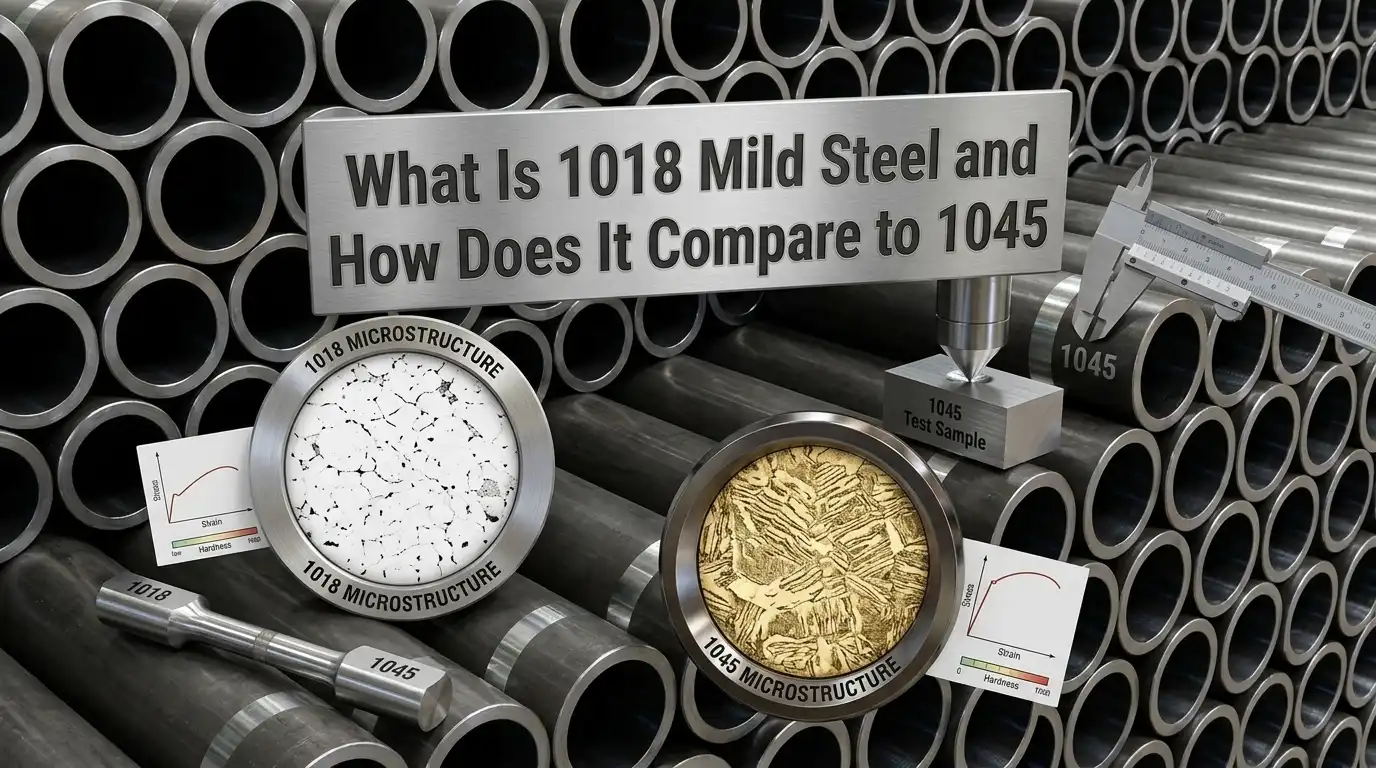
With a carbon content of just 0.14–0.20%, 1018 steel sits squarely in the low-carbon range — which is exactly why it has become the default spec for shafts, pins, and machined fixtures across American machine shops. It delivers roughly 70% of the tensile strength of 1045 at a fraction of the machining headache, making it the go-to when you need predictable cuts, clean welds, and case-hardenable surfaces without paying for alloy steel.
This guide breaks down the chemistry, mechanical numbers, processing forms, and head-to-head comparisons you need before writing 1018 on a drawing — plus the mistakes I’ve watched engineers repeat for fifteen years.
What Is 1018 Mild Steel in Plain Terms
1018 steel is a low-carbon, non-resulfurized mild steel classified under the AISI/SAE 10xx carbon steel system, containing roughly 0.18% carbon, 0.60–0.90% manganese, and tightly controlled phosphorus and sulfur. It is one of the most widely stocked general-purpose carbon steels in North America and ships in two primary mill forms: cold drawn (CD) and hot rolled (HR).
Decoding the designation tells you almost everything at a glance. In the four-digit AISI/SAE naming convention, the first digit “1” identifies it as a plain carbon steel, the second “0” signals that it is non-resulfurized (no free-machining sulfur additions, unlike 1118 or 12L14), and the last two digits “18” indicate a nominal carbon content of 0.18% by weight. See the SAE steel grades reference for the full coding system.
In my shop, when a print calls out “1018 CRS” without a temper note, I default to ASTM A108 cold-drawn bar — the bright, dimensionally tight stock you see in 12-foot lengths at any service center. Hot-rolled 1018 (ASTM A29) has a darker mill scale, looser tolerances (typically ±0.010″ over 1″ dia versus ±0.002″ for CD), and sells for roughly 15–20% less per pound.
Think of 1018 as the “default” mild steel: cheap, predictable, easy to weld, and forgiving to machine — but not hardenable through conventional heat treatment without carburizing.

1018 steel cold drawn and hot rolled round bar comparison on machinist workbench
Chemical Composition of 1018 Steel Broken Down Element by Element
The SAE/AISI spec for 1018 steel pins down four intentional elements plus iron. Here are the exact ranges every mill certifies to:
| Element | Range (wt%) | Primary Role |
|---|---|---|
| Carbon (C) | 0.15 – 0.20 | Strength via ferrite/pearlite balance |
| Manganese (Mn) | 0.60 – 0.90 | Deoxidizer, sulfur scavenger, hardenability |
| Phosphorus (P) | ≤ 0.040 (max) | Residual — capped for toughness |
| Sulfur (S) | ≤ 0.050 (max) | Residual — capped for ductility |
| Iron (Fe) | Balance (~98.8%) | Matrix |
Carbon at 0.18% average keeps the microstructure roughly 75% ferrite and 25% pearlite after normalizing. That ratio is why 1018 bends instead of snapping — push carbon to 0.45% (hello, 1045) and the pearlite fraction doubles, hardness jumps, and cold formability drops off a cliff.
Manganese does double duty. It locks up residual sulfur as MnS inclusions (preventing hot-shortness during rolling) and strengthens the ferrite via solid-solution hardening. The 0.60–0.90% window is deliberate: below 0.60%, you get red-short cracking at the mill; above 0.90%, you drift toward 1022 territory and lose the “easy to cold-head” behavior fastener shops rely on.
Phosphorus and sulfur are tramp elements from ore and scrap. I’ve pulled mill test reports on dozens of 1018 heats — typical actuals run P around 0.010–0.020% and S around 0.015–0.030%, well under the ceiling. Higher P embrittles at low temps; higher S tanks transverse ductility and weldability. The ASTM A108 specification governing cold-finished 1018 bar enforces these caps on every heat.

1018 steel chemical composition breakdown showing carbon, manganese, phosphorus, sulfur percentages
Mechanical and Physical Properties You Can Design With
Before you size a shaft or a bracket, anchor your math to these numbers: cold-drawn 1018 steel delivers roughly 440 MPa (64 ksi) ultimate tensile strength and 370 MPa (54 ksi) yield, while hot-rolled 1018 drops to about 400 MPa UTS and 220 MPa yield. Brinell hardness sits between 126 and 163 HB, elongation in 50 mm runs 15–25%, Young’s modulus is 200 GPa, and density is 7.87 g/cm³. Cold work is what buys you that extra ~70% yield strength — nothing else changes chemically.
| Property | Cold Drawn (CD) | Hot Rolled (HR) |
|---|---|---|
| Tensile strength | 440 MPa | 400 MPa |
| Yield strength (0.2%) | 370 MPa | 220 MPa |
| Elongation in 50 mm | ~15% | ~25% |
| Brinell hardness | ~126–163 HB | ~116 HB |
| Reduction in area | ~40% | ~50% |
How those numbers drive decisions: deflection is governed by the 200 GPa modulus — identical for CD and HR — so if your part is stiffness-limited (a guide rail, a fixture plate), paying for cold drawn buys you nothing. It’s only when yield or surface finish drives the design that CD earns its premium.
I learned this the expensive way on a conveyor pin that I spec’d in CD 1018 at 55 HRB-equivalent: it galled against a bronze bushing within 400 hours. Swapping to case-hardened 1018 (carburized to ~58 HRC surface, tough 1018 core) pushed service life past 6,000 hours.

1018 steel mechanical properties comparison chart showing tensile yield hardness cold drawn versus hot rolled
Cold Drawn vs Hot Rolled 1018 and When to Specify Each
Short answer: Specify cold drawn (CD) 1018 steel when you need tight tolerances, a clean surface, and higher yield for machined or load-bearing parts. Specify hot rolled (HR) when the part will be welded, flame-cut, or hidden inside a weldment where mill scale gets blasted off anyway — and you want to save 15–25% on material cost.
| Criterion | Hot Rolled 1018 | Cold Drawn 1018 |
|---|---|---|
| Yield strength | ~32 ksi | ~54 ksi |
| Surface | Mill scale, rough | Bright, smooth |
| Tolerance (1″ bar) | ±0.031″ | ±0.002″ |
| Residual stress | Low | High — can warp |
| Relative cost | 1.0× | 1.15–1.25× |
One trap from my own shop: I once specified CD 1018 for a keyed shaft and milled a deep keyway on only one side — the bar bowed 0.015″ over 18″ because the drawing stresses relaxed unevenly. Fix: stress-relieve at 1100°F for one hour before finish machining.
Quick decision matrix:
- Shafts, pins, bushings, dowels: CD — you need the surface and straightness.
- Welded frames, base plates, gussets: HR — scale grinds off, and HR weldments distort less.
- Flame-cut brackets: HR — no point paying for tolerances the torch will destroy.
- Parts with deep one-sided cuts: HR, or CD with a stress-relief step.

Cold drawn vs hot rolled 1018 steel bar surface finish comparison
Machinability, Weldability, and Case Hardening Behavior
1018 steel machines at roughly 70% of the B1112 free-machining baseline — decent but not outstanding. Welds with any common process without preheat. Carburizes to a 0.5–1.5 mm case at 58–62 HRC over a soft 20–30 HRC core.
Machinability: dial in the right SFM
For HSS tooling on cold-drawn 1018, start around 90–110 SFM; carbide inserts happily run 350–500 SFM. Chips come off stringy because there’s no sulfur to break them — use a chipbreaker geometry.
When I ran a production job turning 1.25 in 1018 CD shafts, swapping from a generic CNMG turning insert to a medium-chipbreaker grade cut tool changes by about 40% and killed the bird’s-nest problem on the bar feeder.
Weldability and Carburizing
With 0.18% carbon, 1018 sits well below the 0.30% carbon-equivalent threshold where cold cracking becomes a concern. For hardening, pack- or gas-carburize at 900–925 °C for 4–8 hours. You get a wear-resistant case but the core stays tough.
1018 vs 1045 vs A36 vs 12L14 Head-to-Head Comparison
Quick verdict: Pick 1018 steel for general machined parts needing a case-hardened skin. Pick 1045 when you need to through-harden a shaft to 55 HRC. Pick A36 for welded structural plate.
| Property | 1018 | 1045 | A36 | 12L14 |
|---|---|---|---|---|
| Carbon (%) | 0.15–0.20 | 0.43–0.50 | ≤0.26 | 0.15 max |
| Tensile (ksi, CD) | 64 | 91 | 58–80 | 78 |
| Machinability | 70% | 57% | ~72% | 170% |
| Weldability | Excellent | Poor | Excellent | Not Rec. |
| Relative cost | 1.0x | 1.15x | 0.85x | 1.3x |
Real-World Applications and a Shop-Floor Case Study
Short answer: 1018 steel dominates parts that need good machinability, a clean surface, and a case-hardened wear skin — think light-duty shafts, dowel pins, spindles, jig plates, fixture bases, and bushings.
Case study: identical pinion, 1018 CD vs 1045 CD
| Metric | 1018 CD | 1045 CD |
|---|---|---|
| Turning cycle (per part) | 2:10 | 2:48 |
| Inserts consumed (500 pcs) | 6 edges | 11 edges |
| Loaded cost per part | $11.80 | $15.20 |
The 1018 pinion won on cost by ~22%, but only because the duty cycle allowed a carburized case instead of through-hardening.
Common Mistakes Engineers Make When Specifying 1018
Short answer: The five costliest mistakes I see on shop floors are assuming through-hardening works, over-specifying cold drawn, ignoring grain anisotropy, welding across a carburized case, and typo-swapping 1018 for 1020.
- Expecting through-hardening: A full quench gives you maybe 30-40 HRC in the first 0.5 mm. If you need a 40+ HRC core, switch to 1045 or 4140.
- Over-specifying CD when HR + grind is cheaper: I had a customer calling out CD 3″ round for a pin that finished at 2.750″. The HR bar was $0.42/lb cheaper.
- Ignoring cold-drawn anisotropy: CD bar has residual stress. Machine one flat deeply on a long shaft and it will bow 0.005-0.015″ per foot.
- Welding a carburized part: The hardened case is effectively high-carbon steel — it cracks under weld thermal cycles.
Frequently Asked Questions About 1018 Steel
Is 1018 the same as mild steel?
1018 is a specific grade within the “mild steel” family. “Mild steel” is a loose commercial term for any low-carbon steel under ~0.25% C. 1018 pins down a tighter spec.
What are the European and Japanese equivalents?
Closest crosses per MatWeb and EN 10277: DIN C15 / EN 1.0401, JIS S15C, and BS 080A15. They’re close — not identical.
Can 1018 steel rust, and is it magnetic?
Yes to both. With under 0.1% chromium, 1018 has zero corrosion resistance — bare bar will flash-rust within 24 hours. It’s strongly ferromagnetic.
Choosing 1018 for Your Next Project — Summary and Next Steps
Before you release the drawing, run through this five-point checklist:
- Budget check: If tolerances are loose, hot-rolled 1018 or A36 wins.
- Machinability: 1018 steel sits at ~70%. If cycling thousands of parts, consider 12L14.
- Strength target: Design around 54 ksi yield (CD) or 32 ksi yield (HR).
- Welding: No preheat under 1 in. thickness. Use ER70S-6 filler.
- Hardening: Case-harden via carburizing — never specify through-hardening.
For procurement, pull the supplier’s mill test report (MTR) and confirm conformance to ASTM A108 or ASTM A1011.
Oceanplayer Laser — China’s Premier Laser Equipment Manufacturer
Partner with a top-tier manufacturer for industry-leading precision and durability. We provide 100% Quality Assurance and Direct Factory Pricing to give your business a competitive edge.
- ✔ ISO & CE Certified Quality
- ✔ Competitive Factory Price
- ✔ 24/7 Professional Support
- ✔ OEM/ODM Solutions

See also
- How to Meet Weld Cleaning Standards and Specifications
- Why cold cracks are more likely to occur during welding in winter
- Analysis of the causes of cracks in laser welded carbon steel
- A Complete Guide to Low-Carbon Steel Properties and Uses
- Top Portable Laser Welding Machines for Stainless Steel and Their Prices