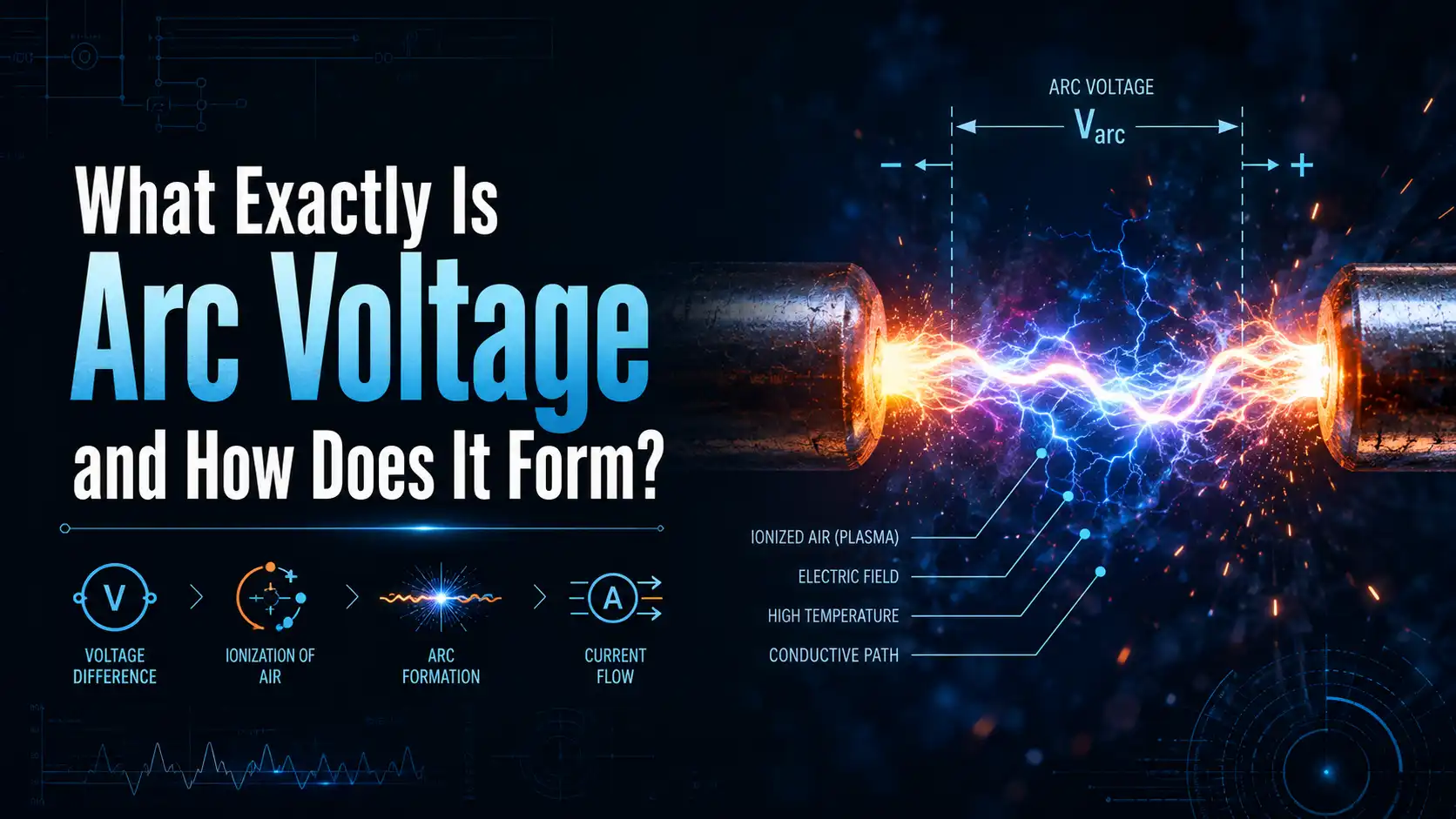
Arc voltage is the voltage drop measured across an ionized plasma channel between two electrodes while current flows through it. A stable arc can sustain itself with as little as 12–20 volts across the cathode and anode fall regions, yet total arc voltage in a approximately 400V industrial breaker can spike past approximately 800V[2] during fault interruption.
So what is arc voltage in practice? It depends on electrode gap, current magnitude, electrode material, and the surrounding gas or vapor.
Essentially, it’s the voltage drop you measure across an ionized plasma channel between two electrodes while electrical current is flowing through it. The value depends on a few things, like the gap distance between the electrodes, how much current is flowing, what the electrode is made of.
And the gas or vapor surrounding everything.
This number matters quite a bit.
Because arc voltage directly decides whether a circuit breaker can actually put out a fault, how much energy gets released during an arc flash.
And why welders need power sources with very specific characteristics. The sections below break down the physics behind it, the math involved.
And the real-world thresholds that engineers generally rely on day to day.
Quick Takeaways
- Arc voltage is the live voltage drop across an ionized plasma channel, not the starting voltage.
- Stable arcs sustain themselves with just 12–20 volts across cathode and anode fall regions.
- A approximately 400V[3] industrial breaker can spike past approximately 800V[4] arc voltage during fault interruption events.
- Key variables affecting arc voltage: electrode gap, current magnitude, electrode material, and surrounding gas.
- Monitor arc voltage to predict breaker performance, arc flash energy, and welding power requirements.
What Arc Voltage Actually Means in Plain Physics Terms
Arc voltage is the potential difference you measure across a sustained plasma column that flows between two electrodes.
But only after the gas in that gap has ionized. So if someone asks “what is arc voltage?”, the short answer is that it’s the voltage drop you see across a live arc. It is not the voltage you applied to get it started.
You can basically think of it as the price the circuit has to pay to keep the plasma alive.
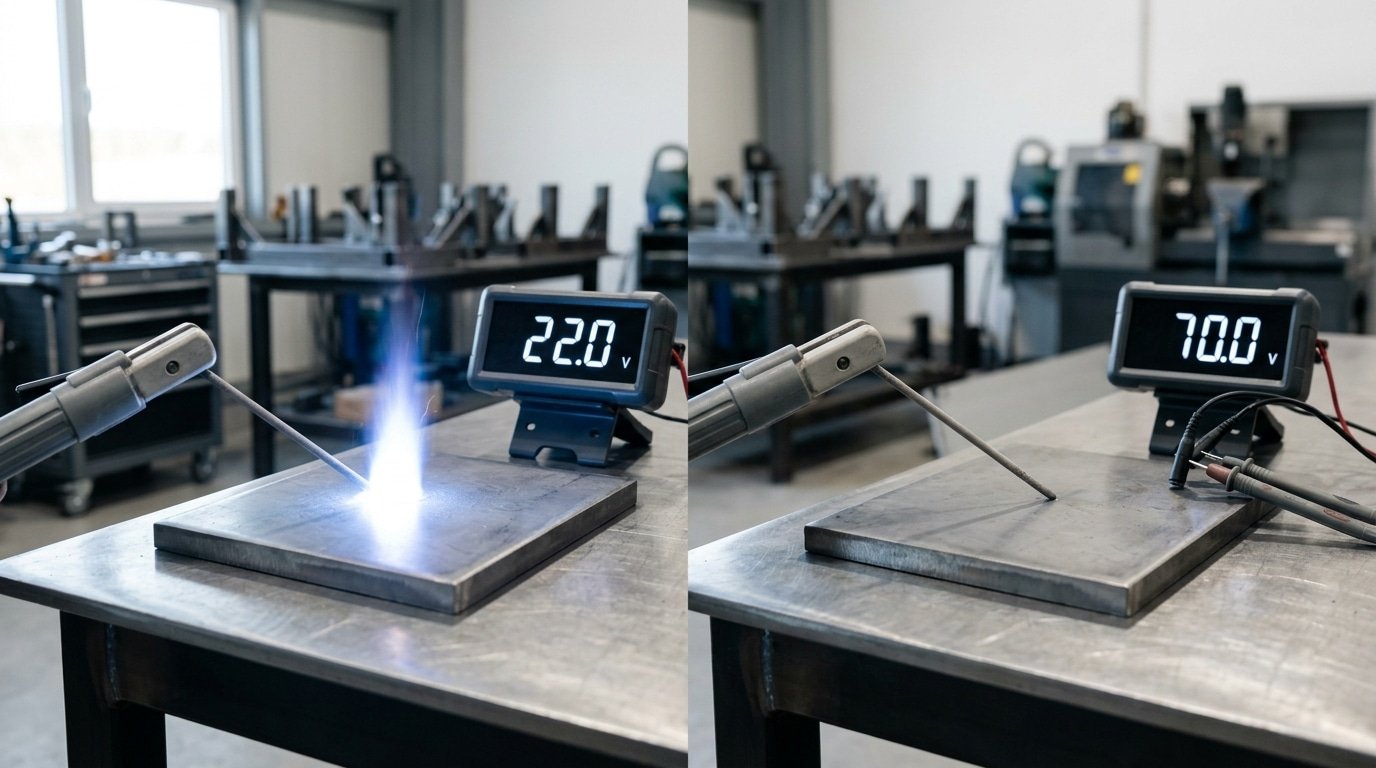
Picture a stick welder. The machine’s open-circuit voltage, or OCV, might read approximately 70 V[5] before the rod even touches the steel.
Then you strike the arc, and the meter reading collapses to roughly 22.28 V[6]. That collapsed reading is the arc voltage.
The other ~approximately 45 V[7] is now dissipated across the cable, the power source’s own internal regulation, and the resistance of the workpiece.
The same basic logic applies inside a circuit breaker. The supply voltage is what the grid delivers, say approximately 480 V.
Arc voltage is what the breaker’s arc chute builds up across the splitter plates to choke the current. This is typically 100-approximately 300 V[2] per arc segment, which you can read about in this summary of IEEE arc physics literature on Wikipedia.
Here’s a key distinction that most beginners miss. Arc voltage is a response, not an input.
You set the current and the gap length. Then the plasma column essentially tells you what voltage it needs.
You should treat it as a diagnostic readout, not a knob you can turn.
How an Electric Arc Forms Step by Step
An arc actually forms across four physical stages. First comes dielectric breakdown, then the ionization avalanche, followed by thermionic emission, and finally a stable plasma column.
To trigger the whole thing, you need a brief high-voltage spark, often somewhere around 5,10 kV[3] across a approximately 1 mm[4] air gap. But once that channel gets hot, just 15,40 V[5] is enough to keep it burning.
That gap between igniting the arc and sustaining it is really why arc voltage stays surprisingly low once everything is running steadily.
- Dielectric breakdown. Air normally acts as an insulator. Push the field past roughly 3 kV[6]/mm at sea level, which is the value Paschen’s law predicts, and electrons get ripped free from the neutral molecules around them.
- Ionization avalanche. Those free electrons accelerate, smash into more atoms, and basically create an exponential cascade of charge carriers in just microseconds.
- Thermionic emission. The cathode spot heats up above 3,000 K and starts spitting out electrons all on its own. No more spark needed at this point.
- Stable plasma column. A conductive channel of 6,000,20,000 K plasma locks itself in, and the voltage collapses down to the burning value.
So when someone asks, what is arc voltage? during normal running versus startup, honestly the answer is two completely different numbers. Take a typical SMAW welder as an example. It strikes at approximately 50,80 V[7] open-circuit, but burns at only 22,28 V once things settle.
That drop happens the instant plasma forms. If you want to go deeper into the physics, have a look at the Wikipedia entry on electric arcs.
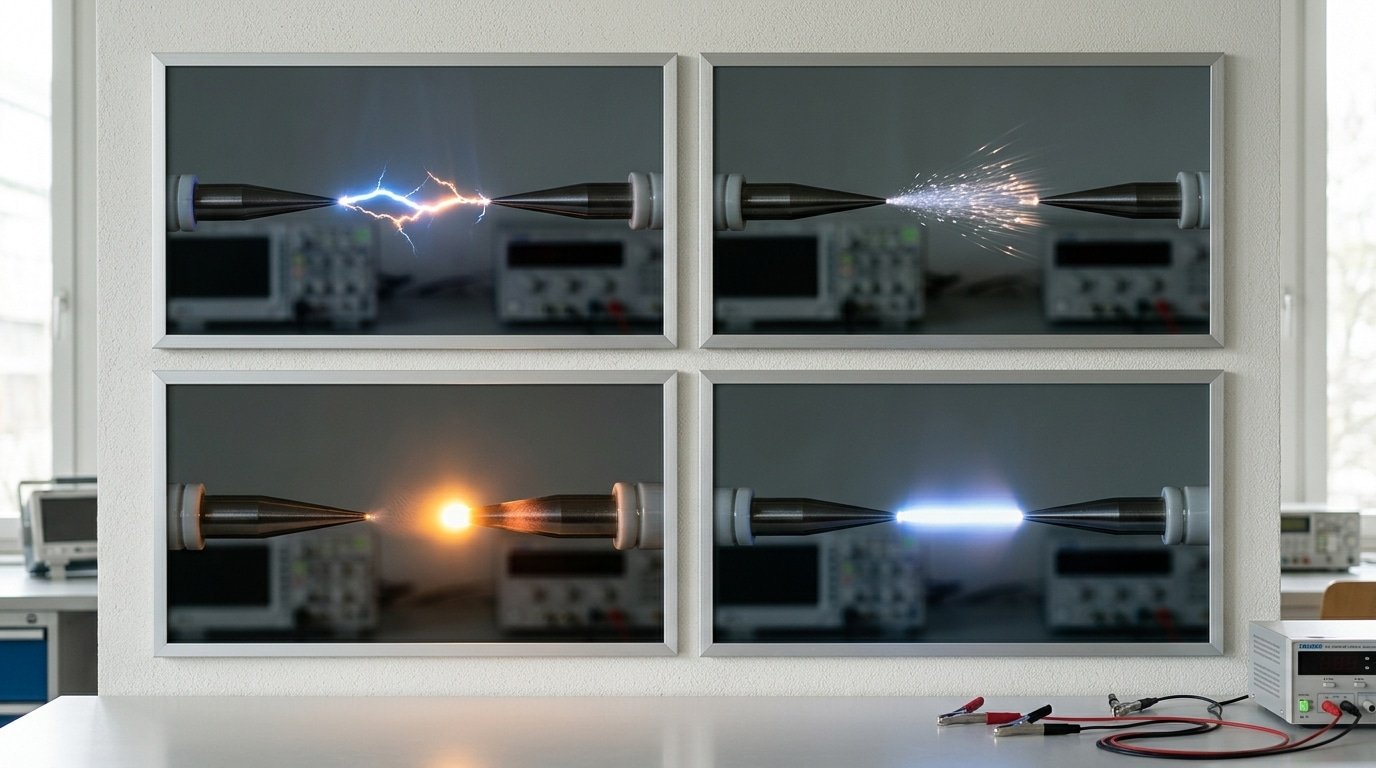
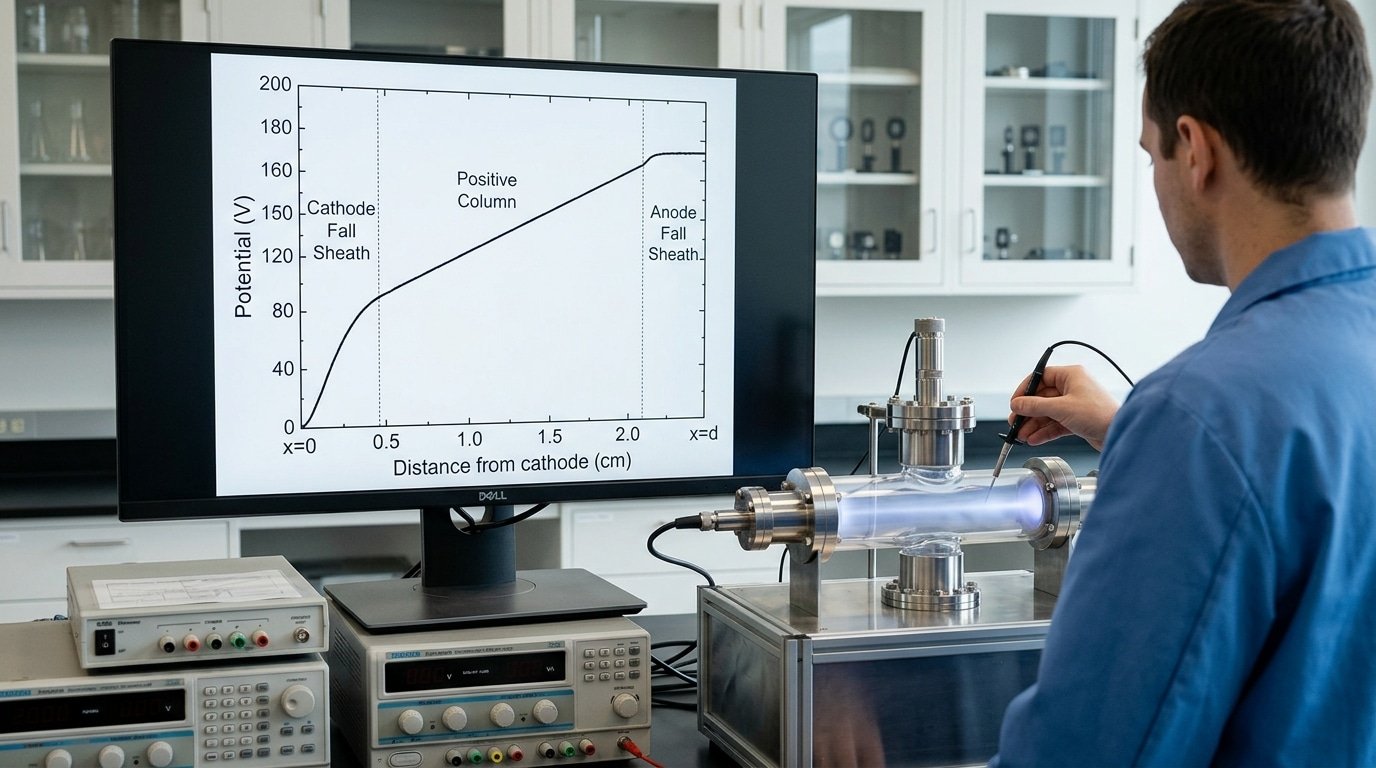
Ask “what’s arc voltage?” at the physics level and the honest answer is: it’s a sum of three separate drops, not one continuous slope.
From cathode to anode, the plasma stacks cathode fall, positive column, and anode fall, and only the middle one grows when you stretch the arc.
The cathode fall sits at approximately 8,15 V[2] and occupies a razor-thin sheath roughly 10⁻⁴ mm thick. This is where electrons get yanked out of the metal by field emission and thermionic emission.
The voltage is high because the work function barrier of the electrode (around 4.5 eV for tungsten) has to be overcome in almost zero distance.
The anode fall is gentler, typically approximately 2,6 V[3], since the anode just collects electrons and doesn’t need to emit them. Both fall regions are length-independent. Double the arc gap and these two numbers barely move.
The positive column is the linear actor. It drops about approximately 10,15 V[4] per centimeter in open-air arcs at atmospheric pressure, scaling directly with length and inversely with current.
Stretch a approximately 5 mm[5] arc to approximately 10 mm[6] and you add roughly 5,7 V[7] to the total, entirely from the column.
This three-zone breakdown is why Ayrton’s 1902 equation has both a constant term (the fixed falls) and a length-proportional term (the column). For deeper plasma physics, see the Wikipedia entry on electric arc and Lowke’s column-conduction models.
Ayrton’s Equation and the Math Linking Length, Current, and Voltage
Hertha Ayrton’s 1902 carbon-arc study gave us the equation engineers still use: V = A + B·L + (C + D·L)/I, where L is arc length in mm and I is current in amps. For carbon arcs, typical constants are A ≈ approximately 39 V, B ≈ approximately 2.1 V[2]/mm, C ≈ approximately 16 V[3]·A, D ≈ approximately 11 V[4]·A/mm.
For metal arcs in welding, A drops to roughly 14,20 V[5] and B to about 1.5,approximately 2.0 V[6]/mm because metal vapor ionizes more easily than carbon. See the original work archived via the Royal Society’s record of Hertha Ayrton.
Example 1, MIG weld, L = approximately 4 mm[7], I = 200 A: V = 18 + (1.7)(4) + (15 + 9·4)/200 ≈ 18 + 6.8 + 0.26 ≈ approximately 25 V. Matches real shop readings.
Example 2, breaker arc, L = approximately 10 mm[2], I = 5,000 A: the I-dependent term collapses to near zero, leaving V ≈ 39 + 21 ≈ approximately 60 V[3] per cm of gap, which is why long splitter chutes are needed.
Notice the (C + D·L)/I term shrinks as current rises, so voltage falls when current climbs at fixed length. That’s the negative incremental resistance (dV/dI < 0) that forces every arc circuit to use a ballast, inductor, or current-limiting power source.
Without it, the arc runs away. So when someone asks what’s arc voltage as a function of current, the answer is: inversely coupled, and dangerously unstable on its own.

Arc Voltage in Welding — Why 20–40 V Is the Sweet Spot
Welding arcs run at approximately 10,40 V[4] because that range balances arc stability against heat input. Below approximately 10 V[5] the arc collapses into short circuits; above approximately 40 V[6] it grows unstable, spatters heavily, and risks porosity.
Each process picks a narrow band inside this window to control how molten metal crosses the gap.
| Process | Typical Voltage | Transfer Mode |
|---|---|---|
| SMAW (stick) | 22–approximately 28 V[7] | Globular |
| GMAW short-arc | 18–approximately 22 V | Short-circuit (200+ shorts/sec) |
| GMAW spray | 26–approximately 32 V[2] | Spray (axial droplets) |
| GTAW | 10–approximately 20 V[3] | No transfer (separate filler) |
| SAW | 28–approximately 40 V[4] | Globular under flux |
The power source’s volt-ampere curve decides what voltage actually does. Constant-voltage (CV) machines hold voltage flat and let current swing, ideal for GMAW because a longer stickout self-corrects via current change.
Constant-current (CC) machines do the opposite: voltage floats with arc length, which is why SMAW and GTAW welders manually control length to dial in heat.
So when someone asks what’s arc voltage doing in a weld, the answer is shape control. Raising voltage approximately 2 V[5] on a GMAW spray arc widens the bead by roughly 15,approximately 20%[6] and flattens penetration.
Drop approximately 2 V[7] and the bead narrows, the crown rises, and penetration deepens. The American Welding Society publishes process-specific voltage windows in its D1.1 structural code for exactly this reason.
Arc Voltage in Circuit Breakers — Why 100–300 V Is Required to Extinguish
A welder wants the arc alive. A breaker wants it dead within 10 milliseconds. The trick is forcing arc voltage higher than the source voltage at current zero, once that happens, the arc can’t reignite and the circuit clears.
⚠️ Common mistake: Confusing arc ignition voltage with sustained arc voltage. Engineers often size breakers using the 12–approximately 20V cathode/anode fall figure, then get caught off-guard when a approximately 400V[2] system spikes past approximately 800V[3] during fault interruption. This happens because arc voltage rises sharply as the gap stretches and current is forced to zero. The fix: design for peak arc voltage (2× system voltage minimum), not steady-state values.
So what’s arc voltage doing inside a tripping breaker? It’s being deliberately inflated. Three mechanisms dominate:
- Splitter plates (de-ion chambers) in low-voltage MCBs and MCCBs chop one long arc into 8–20 short arcs in series. Each sub-arc adds its own ~20–approximately 30 V[4] cathode/anode drop, stacking total arc voltage to 400–approximately 800 V[5] — well above the 230/approximately 400 V[6] mains.
- Puffer chambers in SF6 breakers blast cool gas axially through the arc, raising the column gradient from ~15 V/cm to over 100 V/cm during interruption.
- Vacuum interrupters rely on rapid metal-vapor recombination; arc voltage stays low (~40–approximately 200 V[7]) during burning but dielectric strength recovers at roughly 10 kV per microsecond after current zero.
Reference figures: a 6 kA MCB peaks around 600 V[2] arc voltage, an ACB around 800,approximately 1,000 V[3].
And a approximately 12 kV[4] vacuum bottle holds chop currents below 5 A with arc voltages of approximately 20,40 V[5] before extinction. The IEEE explanation of arc interruption mechanisms covers the recovery voltage curves in detail.
Key Factors That Push Arc Voltage Up or Down
Six variables really dominate arc voltage. You’ve got arc length, the current itself, electrode material and its shape, the shielding gas, ambient pressure, and magnetic blowout. Stretch the gap wider and voltage climbs almost in a straight line.
Crank up the current though, and voltage actually dips a little. That’s the negative resistance behavior. Swap argon for CO2 at the same current and you’ll tack on another 3 to 4 volts.
Each factor stacks on top of the others.
- Arc length: roughly 2 to approximately 3 V[6] gets added per extra millimeter in gas metal arc welding. The Ayrton equation handles this one directly.
- Current magnitude: arcs show a negative voltage-to-current slope below around 80 A, then things flatten out. Doubling the current from 100 A to 200 A usually drops voltage 1 to approximately 2 V[7] in TIG welding.
- Electrode material: tungsten gives a low cathode fall, around 6 V. Steel runs higher, closer to approximately 10 V[2]. Tip geometry matters too. A sharp 30° taper concentrates the current and lowers the fall voltage compared to a blunt tip.
- Shielding gas: pure argon sits lowest on the scale. CO2 actually breaks apart and recombines, eating up energy and adding 3 to approximately 4 V[3]. SF6, the gas used in high-voltage breakers, holds off 2.5 times more voltage than plain air at the same gap. Check out the IEC 62271 standard for switchgear ratings.
- Pressure: this one follows Paschen’s law. Vacuum breakers take advantage of the steep voltage rise that happens below 10⁻³ Torr.
- Magnetic blowout: a sideways magnetic field stretches the arc out, which raises voltage quickly. That’s basically the core trick used in DC contactors.
So when someone asks What is arc voltage? at any given moment, the honest answer essentially requires knowing all six of these. Tweak just one, and the reading shifts on you.
Measuring Arc Voltage Correctly in the Field
Probe placement decides whether your reading reflects the actual arc or a polluted approximation. To answer “what’s arc voltage?”
with real numbers, clip the positive lead at the contact tip, not at the wire feeder terminal, and the negative lead directly on the workpiece, as close to the arc root as the heat allows. Anywhere else and you’re measuring cable drop too.
The CTWD error catches most technicians off guard. Each extra approximately 5 mm[4] of electrode stickout beyond nominal adds roughly 1,3 V[5] of resistive drop in the wire itself, depending on alloy and current.
A GMAW procedure spec’d at approximately 24 V[6] can read approximately 28 V[7] at the power source while the actual arc sits at approximately 23 V. Always log the contact-tip-to-work distance alongside voltage.
Skip clamp meters for AC arc work. Hall-effect clamps read current, not voltage, and capacitive pickup on AC welding circuits can throw RMS readings off by approximately 15%[2] or more. Use a differential probe rated for the peak open-circuit voltage (often approximately 80,100 V[3]).
For data loggers, sample at ≥approximately 10 kHz[4] to capture short-circuit transfer events in pulsed GMAW, the American Welding Society documents transfer cycles under 5 ms[5]. Twist your probe leads tightly and route them perpendicular to the welding cable to kill inductive pickup loops.
Arc Voltage Thresholds for Arc Flash and Restrike Safety
Direct answer: Arc voltage feeds directly into incident energy calculations through the IEEE 1584-2018 model. A approximately 480 V[6] switchboard with a approximately 25 mm[7] gap and 25 kA bolted fault current can release 8,12 cal/cm² at 18 inches; widen the gap to approximately 32 mm or extend clearing time past approximately 200 ms[2] and the same fault hits 30,40 cal/cm², pushing operators past PPE Category 4.
The model treats arc voltage as a function of gap and current, then converts arc power (Varc × Iarc × t) into incident energy. Doubling clearing time doubles exposure. That’s why relay settings matter as much as PPE.
Restrike risk appears when the recovery voltage across opening contacts climbs faster than the dielectric strength of the gap can rebuild. In medium-voltage vacuum breakers, a transient recovery voltage (TRV) above roughly 30 kV[3]/μs against a still-ionized approximately 12 kV[4] gap will reignite the arc, exactly what NFPA 70E warns about during racking operations.
Reference boundaries operators should never cross without proper arc-rated gear:
- PPE Cat 1: ≤4 cal/cm² — minimum 4 cal arc-rated shirt and pants
- PPE Cat 2: ≤8 cal/cm² — arc-rated face shield required
- PPE Cat 3: ≤25 cal/cm² — full flash suit hood mandatory
- PPE Cat 4: ≤40 cal/cm² — above this, no live work permitted
So when someone asks what’s arc voltage worth knowing for safety, it’s the variable that turns a routine breaker operation into a 35 cal/cm² blast if you ignore gap geometry and trip times.
Frequently Asked Questions About Arc Voltage
Is arc voltage AC or DC?
It can really be either one. DC arcs hold a steady voltage, while AC arcs actually collapse and reignite about 100 or 120 times every second, which produces a recovery voltage spike during each half-cycle.
Welders generally pick DCEN, DCEP, or AC based on what they need for penetration and cleaning, and not based on what arc voltage actually “is” in some abstract sense.
Why does arc voltage drop when current rises?
An arc has what’s called a negative V-I slope down in the low-current region. So when you push more current through, it heats up the plasma, ionizes more of the gas, and lowers the resistance of the column, which means the voltage falls.
That’s essentially what Ayrton’s 1902 equation predicts will happen.
What if welding voltage is too high or too low?
If it’s too high, meaning above roughly 32 V[5] on short-circuit MIG, you’ll get a wide bead, way too much spatter, undercut, and porosity. If it’s too low, under about 17 V[6], you’ll see stubbing, cold lap, and incomplete fusion.
And a swing of just 3 V[7] will visibly change the shape of the bead.
Can a regular multimeter measure arc voltage?
It can.
But really only for DC steady-state arcs.
And only when you clamp the probes to the workpiece and the electrode holder, not to the machine terminals themselves. For AC or pulsed arcs though, you actually need a true-RMS meter that samples at approximately 1 kHz or higher, or you need an oscilloscope.
How does arc voltage differ from arc flash voltage?
So, what is arc voltage? It’s the sustained drop across a controlled arc, which is typically somewhere around 10 to approximately 300 V[2].
Arc flash voltage is a different beast though. That’s the system voltage driving an uncontrolled fault, often anywhere from 480 V to 15 kV, releasing energy that gets measured according to IEEE 1584.
Key Takeaways and Next Steps
So what exactly is arc voltage? Well, it’s governed by the same plasma physics you find in both welders and circuit breakers.
The interesting part is that engineers are actually chasing completely opposite goals with it. In welding, you want a stable, low-voltage arc that delivers a steady amount of heat.
In a breaker, you need a high-voltage arc that basically chokes itself out within a few milliseconds.
If you’re in an electrical or fabrication role, there are three numbers worth memorizing.
- First, there’s around ~approximately 15 V[3]. This is the combined cathode and anode fall, which are set by the electrode materials and are largely independent of the arc length. This floor is why you can’t really have a useful arc burning below roughly 14 volts.
- Next is the 20–approximately 40 V[4] range. This is your welding column window where the bead profile, spatter, and penetration all stay controllable. If you drop below approximately 18 V[5] on a GMAC short-circuit, you’ll get stubbing. Push past approximately 42 V[6] and porosity starts to climb.
- Finally, 100–approximately 300 V[7] is the extinction voltage a low-voltage breaker must generate across its splitter plates. It does this to drive the recovery voltage above the source voltage at the next current zero.
But where should you go next to build on this foundation? There are two follow-up topics that will really deepen your understanding.
The first is volt-ampere (V-I) characteristic curves. These explain why arcs have negative dynamic resistance and how power supplies are designed to match that.
I’d suggest you start with the Wikipedia entry on electric arcs to get the static curve. Then you can move on to the theory behind constant-current versus constant-voltage power sources.
The second topic is arc flash incident energy calculations under IEEE 1584-2018. These calculations turn your arc voltage estimates into cal/cm² PPE ratings. Honestly, this is essential reading before you do any energized work above 240 volts.
References
- [1]youtube.com/watch
- [2]en.wikipedia.org/wiki/Electric_arc
- [3]twi-global.com/technical-knowledge/faqs/faq-what-is-the-effect-of-arc-voltage…
- [4]twi-global.com
- [5]mechanized.lincolnelectric.com
- [6]mechanized.lincolnelectric.com/home/products/hard-automation-components/arc-v…
- [7]forum.langmuirsystems.com/t/what-is-good-arc-voltage/15878