Tungsten Size and Type for Aluminum TIG Welding
For a modern AC inverter, 2% lanthanated tungsten is the most useful all-around starting type, and 3/32 inch is the most versatile shop size. Final selection must still follow peak AC current, waveform, EN/EP balance, torch cooling and the electrode manufacturer’s rating. Legacy transformer machines may favor a rounded pure or zirconiated electrode instead.
A dependable AC/DC electrode with clean starts and a tip that can remain pointed or lightly truncated on suitable inverter waveforms.
It is a practical stock size for many medium-current jobs, but do not choose it by material thickness alone. Size it against peak AC current.
White-band zirconiated is designed to hold a smooth rounded end and offers better stability and current capacity than pure tungsten.
Waveform, balance definition and electrode ratings vary. A manufacturer chart outranks a generic internet rule or material-thickness shortcut.
The tungsten does not become filler—but it shapes the entire arc.
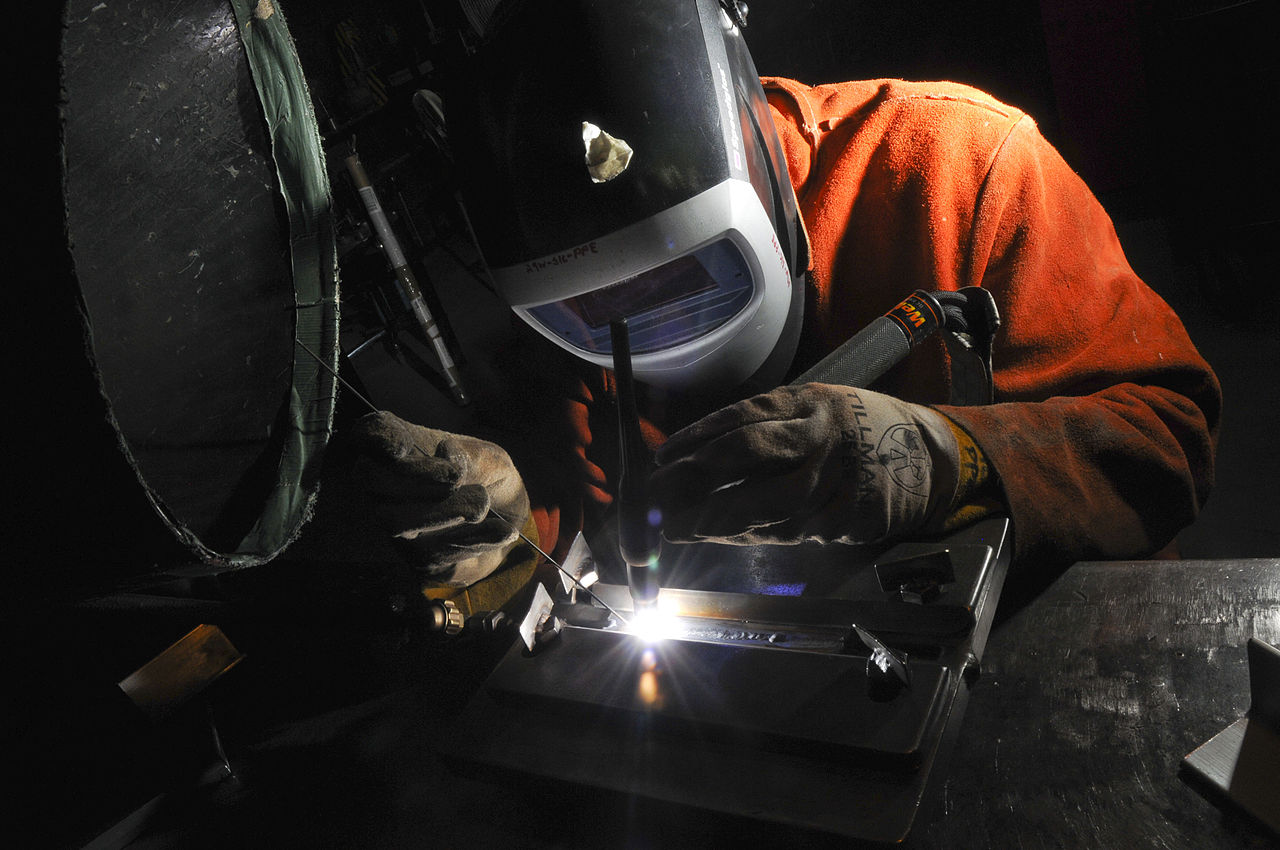
Gas tungsten arc welding uses a nonconsumable tungsten electrode to carry current and establish an arc between the torch and the work. A separate filler rod may be added, but the tungsten should remain outside the molten puddle. Its alloy, diameter and tip geometry influence ignition, arc concentration, current capacity, heat at the electrode and the probability of contamination.
Aluminum makes that selection more sensitive because most shop GTAW uses alternating current. During the electrode-negative portion of the cycle, more heat is directed into the work. During the electrode-positive portion, the process contributes cathodic cleaning but places more thermal load on the electrode. The exact labels and control logic differ among manufacturers, so the percentage shown on one machine may not mean the same thing on another.
The practical rule: choose diameter from the highest current the electrode must carry, not from the average current on the display and not from aluminum thickness alone. Then choose the electrode alloy and tip preparation that suit the power source.
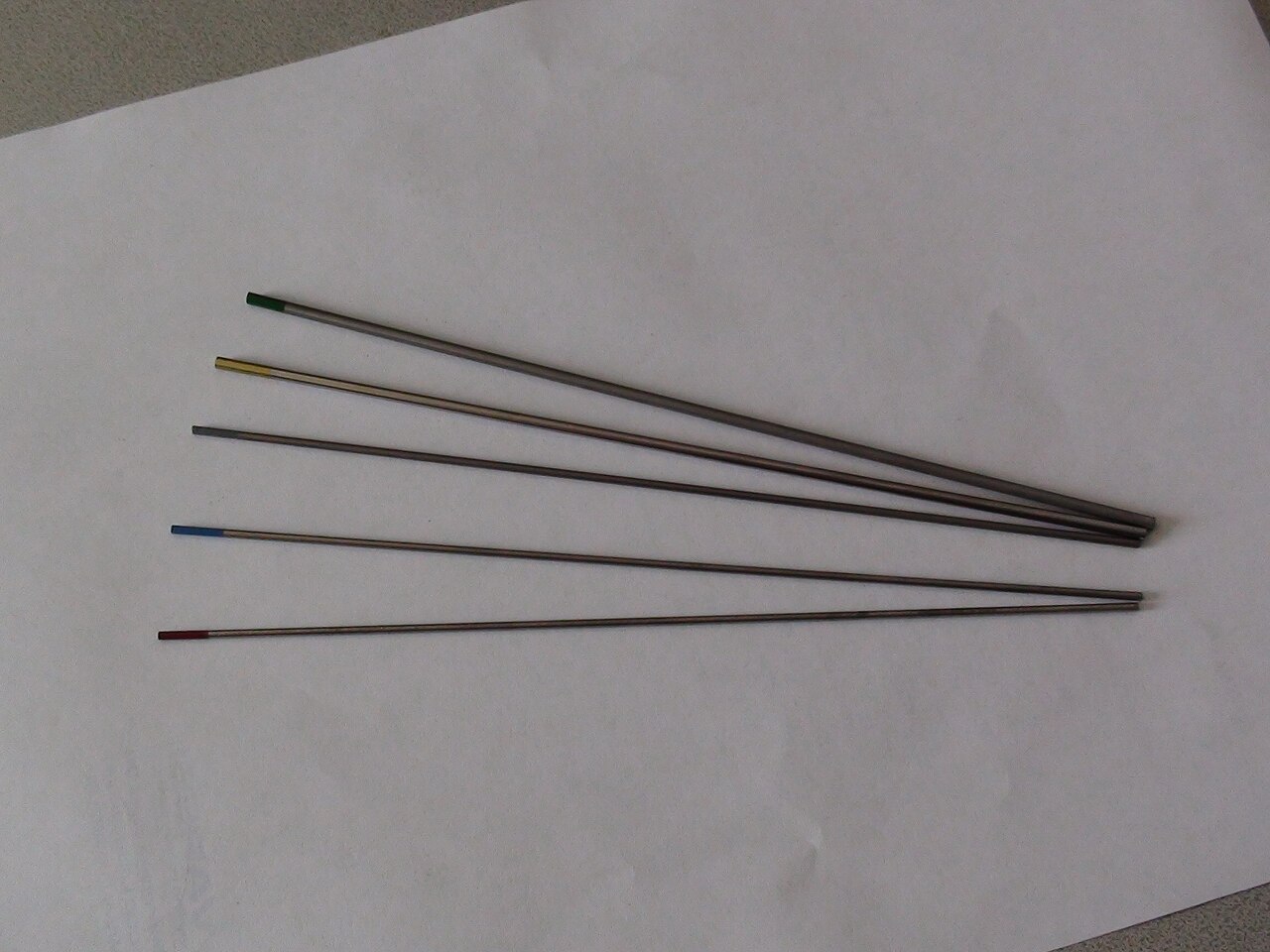
Five common electrode types—and where each one actually belongs.
Color identifies composition, not diameter. Check the package because manufacturers and older standards can create confusion. The following colors follow current, commonly sold AWS/ISO classifications described by Miller and CK Worldwide.
2% Lanthanated — Blue
Works on AC and DC, starts reliably and tolerates a broad current range. On a modern AC inverter it can hold a pointed or truncated tip instead of forming the large ball associated with pure tungsten.
2% Ceriated — Gray
A versatile AC/DC option with good low-current starting behavior. It is often useful for thin material and precise work, although its usable current range must still be checked against the supplier’s chart.
0.8% Zirconiated — White
A strong aluminum and magnesium choice when a smooth rounded tip is desired. It generally carries more current and resists contamination better than pure tungsten while retaining good AC stability.
Pure Tungsten — Green
The historical AC aluminum electrode. It forms a ball easily, but has lower current capacity and can start poorly on modern inverters. Use it only when the power-source manual or a qualified legacy procedure calls for it.
2% Thoriated — Red
Known for DC performance, not the preferred modern AC aluminum choice. It contains thorium; grinding can create contaminated dust, so a non-thoriated alternative avoids an unnecessary exposure-control burden.
Additional alloys exist, including 1.5% lanthanated (gold) and proprietary rare-earth blends. “Best” means best for the specific machine, waveform, current and procedure—not a universal ranking.
Use peak AC amperage as the first sizing input.
This planning table is adapted from a Miller inverter-machine manual for 2% ceriated or 1.5% lanthanated tungsten, argon shielding and unbalanced AC at 75% EN. It is a useful starting point—not a substitute for the chart supplied with your welder and electrode.
| Tungsten diameter | Metric diameter | Typical AC range | Practical aluminum use | Selection caution |
|---|---|---|---|---|
| .020 in. | 0.5 mm | 5–20 A | Micro work and exceptionally low-current starts. | Fragile; not a general aluminum fabrication size. |
| .040 in. | 1.0 mm | 15–80 A | Thin sheet, edge work and low-amperage precision welding. | Can overheat rapidly if current or EP time rises. |
| 1/16 in. | 1.6 mm | 70–150 A | Light fabrication and thin-to-medium aluminum. | Near the top of the range, watch tip growth and arc stability. |
| 3/32 in. | 2.4 mm | 140–235 A | The most versatile general shop size for many AC inverter jobs. | May feel less responsive at very low current than a smaller electrode. |
| 1/8 in. | 3.2 mm | 225–325 A | Higher-current plate, large fillets and sustained heat load. | Requires matching collet, collet body and torch capacity. |
| 5/32 in. | 4.0 mm | 300–400 A | Heavy industrial AC applications with water cooling. | Not commonly needed on handheld light-fabrication equipment. |
| 3/16 in. | 4.8 mm | 400–500 A | Specialized high-current systems. | Verify torch, cable, cooler and duty cycle before use. |
The cited manual also lists 1/4 in. tungsten at 500–630 A AC. Current ranges change with alloy, waveform, balance, shielding gas, tip shape and cooling. Do not extrapolate this table to a different machine without checking its manual.
Aluminum TIG tungsten selector
Enter your machine family and planned peak AC current. The result provides a conservative starting route. Confirm it against the power-source manual, tungsten supplier data and a weld test before production.
3/32 in. 2% lanthanated
A strong general starting point for a modern AC inverter at 180 A, provided the manufacturer permits this current and tip preparation.
- Grind longitudinally with a dedicated wheel.
- Confirm AC balance terminology before copying a percentage.
- Re-dress after any puddle contact or visible contamination.
The machine changes the electrode decision more than the aluminum grade does.
Modern AC inverter
Modern inverters switch through the zero crossing rapidly and usually provide adjustable AC balance and output frequency. A longer electrode-negative portion can direct more heat into the work and less into the tungsten. Higher output frequency can narrow and stiffen the arc cone. Those capabilities let many alloyed electrodes retain a pointed or lightly truncated form.
That is why lanthanated and ceriated electrodes have displaced pure tungsten for much inverter work. The operator gains tighter arc placement, better low-current starts and less time rebuilding an oversized ball. However, the machine may define “balance” as EN percentage, cleaning percentage or another manufacturer-specific quantity. Copying a number without checking that definition can produce the opposite result from what you intended.
Conventional transformer AC
Older sine-wave and conventional square-wave equipment places different thermal demands on the electrode and often assumes a rounded end. Pure tungsten was the historic choice, but zirconiated tungsten commonly offers improved current capacity and stability while maintaining a clean hemispherical tip.
Do not force a needle point into a procedure designed around a ball, and do not deliberately create a large ball on a modern inverter unless the manufacturer says to. If the end grows beyond the electrode diameter, develops nodules or splits, stop and correct the underlying current, balance, gas or sizing problem.
Balance and frequency can change tip temperature, arc width and cleaning action.
Balance: increasing electrode-negative time typically moves more heat into the work and reduces heating of the tungsten. Increasing the cleaning or electrode-positive share can help disrupt oxide but raises electrode heat. Because control labels vary, read the manual before adjusting.
Output frequency: lower AC frequency generally produces a broader, softer arc. Higher frequency usually creates a tighter, more forceful arc that can improve directional control. It is not the same as high frequency used for arc starting.
Independent amplitude: some advanced systems let the operator set EN and EP amperage separately. This can reduce unnecessary electrode heating while preserving sufficient cleaning action, but it must be qualified with the joint and surface condition.
- Do not use balance to compensate for oil, moisture or poor mechanical cleaning.
- Do not assume a narrow etched band proves adequate fusion.
- Record waveform settings in the procedure, not only peak amperage.
Prepare the tip for the power source—not for a shop myth.
Pointed with a small truncation
For inverter AC, a longitudinally ground point with a small flat is a common starting shape. A wider included angle supports more current; a slender point improves low-current starting but is easier to overheat. Follow the machine and electrode supplier guidance.
Smooth hemispherical end
When the procedure calls for a rounded end, form a smooth, centered hemisphere. Re-prepare it if the ball grows to the diameter of the tungsten, becomes lopsided, develops nodules or shows contamination.
Lines along the electrode
Grind lengthwise, not around the circumference. Use a dedicated grinding surface so steel, abrasive debris or other metals are not embedded into the electrode and later transferred into the weld.
Do not simply grind over a contaminated tip. If the tungsten touched the molten aluminum or filler, remove the affected section back to clean material and prepare a new tip. A shiny outside surface does not prove contamination has been removed internally.
Diameter errors show up as heat damage or poor control.
When the tungsten is undersized
The end can round excessively, split, shed particles or retreat into the cup. Arc starting may become erratic and the arc can widen or wander. Raising EP time, losing shielding or using an air-cooled torch beyond its rating can make the same symptoms worse, so do not blame diameter without checking the complete system.
When the tungsten is oversized
Very low-current starting can become less responsive and the arc may feel broad or difficult to place. An unnecessarily large electrode also requires different torch consumables and may reduce access around small joints. Oversizing does provide thermal headroom, but it does not fix unstable settings, poor gas coverage or contamination.
The sensible selection method
Choose the smallest diameter that carries the planned peak current with stable starts and acceptable tip life on the actual machine. If production operates near the top of a published range for long periods, compare the next size up on representative coupons rather than waiting for electrode failure.
Six checks before the first production weld.
A correct tungsten cannot rescue dirty aluminum, a leaking torch or a poorly defined waveform. Treat electrode selection as one part of the full process.
Identify the machine
Confirm inverter or transformer architecture, balance definition, AC frequency range, torch rating and the manual’s electrode table.
Define peak current
Use the maximum current expected during starts, corners, tacks and full-pedal operation—not a guessed average.
Select type and size
Start with lanthanated on a modern inverter or zirconiated for an approved rounded-tip AC route, then size by current.
Prepare cleanly
Use a dedicated grinder, longitudinal marks and the tip shape specified for the electrode and waveform.
Control gas and surface
Check pure argon supply, fittings, cup condition and flow. Remove oil and oxide with an approved aluminum procedure.
Prove the window
Run coupons at the center and edges of the proposed settings; inspect fusion, porosity, tip condition and repeatability.
Read the symptom, then test the likely causes in order.
Check diameter, current, EP share, electrode type and shielding. On an inverter, verify that the machine is not set for excessive cleaning action and that the selected tungsten is approved for AC.
Re-dress an off-center tip, remove a tungsten section that touched the puddle, inspect collet alignment and reduce an oversized rounded end. Confirm work clamp and gas coverage.
Inspect gas leaks, cup damage, flow turbulence, drafts, surface contamination and torch angle. Aluminum soot is often a shielding or cleaning problem, although a contaminated tungsten can contribute.
The electrode may be undersized, overheated, poorly ground or incompatible with the waveform. Replace damaged material and inspect the weld for possible tungsten inclusion before continuing.
Compare a smaller ceriated or lanthanated electrode, inspect the point, verify high-frequency starting and confirm that the torch-to-work distance is controlled.
Increase clearance between electrode and filler, improve torch support, shorten excessive stickout and train operators to stop immediately after contact instead of welding through contamination.
Record the variables that make the result repeatable.
Electrode and torch record
- AWS/ISO classification and manufacturer
- Color band, diameter and lot if critical
- Tip angle, truncation or rounded-end requirement
- Stickout, cup size, lens or collet-body arrangement
- Air- or water-cooled torch and rated duty cycle
Electrical and gas record
- Machine model and AC waveform
- Peak, background and pulse settings when applicable
- Balance value plus the manufacturer’s definition
- AC output frequency and arc-start method
- Shielding-gas composition, flow and postflow
Material and joint record
- Aluminum alloy, temper and actual thickness
- Joint type, gap, root condition and backing
- Cleaning solvent, brush and time between prep and weld
- Filler classification, diameter and storage condition
- Fixture, tack sequence and heat-sink condition
Acceptance evidence
- Arc-start consistency and visible tip condition
- Bead profile, cleaning zone and surface appearance
- Fusion and penetration from sectioned coupons
- Porosity or discontinuity inspection as required
- Mechanical testing for code or critical joints
A visually attractive “stack of dimes” does not prove adequate penetration, fusion, strength or fatigue performance. Qualify critical aluminum welds to the applicable code, drawing and engineering acceptance criteria.
Collet, cup, cooling and gas delivery must match the tungsten.
Changing electrode diameter often means changing the collet and possibly the collet body. A loose or mismatched collet can misalign the tungsten, overheat the torch and produce an unstable electrical connection. The cup must provide adequate gas coverage without creating excessive turbulence.
High-current aluminum work can exceed the practical limits of an air-cooled torch even when the tungsten itself survives. Water cooling protects the torch, cable and consumables during sustained work, but it does not increase the machine’s rated output or excuse an undersized electrode.
- Inspect O-rings, cup threads and gas connections for leakage.
- Use only the stickout needed for visibility and access.
- Keep filler wire out of the electrode and inside the shielding envelope.
- Replace distorted collets that cannot hold the electrode concentrically.
Grinding is a process—not a casual bench task.
All tungsten grinding produces fine particulate and presents normal abrasive-wheel hazards. Use a guarded, maintained grinder; eye protection; appropriate local capture; and housekeeping methods that do not spread dust. A dedicated tungsten grinder also reduces cross-contamination from carbon steel, stainless steel and other shop metals.
Thoriated tungsten contains thorium. The U.S. Nuclear Regulatory Commission notes that thorium contained in welding rods is exempt from specific NRC licensing requirements, but that exemption is not a statement that grinding dust is harmless. Facilities that use thoriated electrodes should assess grinding, storage and waste handling under their applicable occupational and environmental requirements.
For aluminum AC on modern equipment, lanthanated, ceriated and zirconiated choices generally make thoriated tungsten unnecessary. This article does not replace the equipment manual, safety data sheet, local regulations, ventilation assessment or a qualified welding procedure.
Stock a small, controlled system instead of a drawer of mystery electrodes.
Blue lanthanated in three sizes
For a shop centered on modern AC/DC inverters, .040, 1/16 and 3/32 in. 2% lanthanated covers a wide span of work. Add 1/8 in. when higher-current aluminum is routine.
Gray or white for defined needs
Keep ceriated for validated low-current work and zirconiated for machines or procedures built around a rounded AC tip. Label storage by type and diameter.
Do not mix bands or lots
Retain packaging, verify classifications, prevent ground electrodes from being returned to the wrong tube and segregate contaminated pieces for proper disposal.
Continue from TIG fundamentals to production process selection.
Validate whether handheld laser welding fits your aluminum parts.
TIG remains valuable for precision, repair and controlled fabrication. When cycle time, operator consistency or distortion becomes the bottleneck, Oceanplayer can test your actual joint with a fiber laser welding system and document the result before machine configuration.
Aluminum TIG tungsten FAQ
These are planning answers. The welder manual and a qualified procedure remain the final authority.
What is the best tungsten for aluminum TIG welding?
For most modern AC inverter welders, 2% lanthanated tungsten is the best all-around starting choice because it works on AC and DC, starts cleanly and can retain a controlled point. Zirconiated is a strong choice when the machine or procedure calls for a rounded AC tip. Pure tungsten is mainly a legacy transformer option.
What size tungsten should I use for aluminum?
Choose from peak AC current and the chart supplied with the power source and electrode. One Miller inverter guide lists .040 in. for 15–80 A, 1/16 in. for 70–150 A, 3/32 in. for 140–235 A and 1/8 in. for 225–325 A under its stated conditions. Overlap is normal because waveform and application matter.
Is 3/32 inch tungsten good for aluminum?
Yes. It is a versatile general-fabrication size and Miller identifies 3/32 in. 2% lanthanated as a useful all-purpose starting point. It is not ideal for every job: .040 or 1/16 in. may start better at low current, while 1/8 in. may provide more thermal margin above roughly 225 A.
Should aluminum TIG tungsten be pointed or balled?
Modern inverter AC commonly uses ceriated or lanthanated tungsten ground lengthwise to a point with a small truncation. Conventional transformer procedures may call for pure or zirconiated tungsten with a smooth rounded end. Follow the power-source manual rather than applying one shape to every machine.
Can I use red thoriated tungsten for aluminum?
It may carry an arc, but it is not the preferred modern aluminum AC choice. Lanthanated, ceriated and zirconiated electrodes provide suitable non-thoriated alternatives. Because thoriated tungsten contains thorium, grinding and waste handling require an exposure assessment and appropriate controls.
Why does my tungsten ball up on aluminum?
The electrode may be too small, the current or EP share may be too high, the tungsten type may not suit the inverter, or shielding may be inadequate. A small controlled rounding can be normal, but an oversized, lopsided or splitting end indicates that the setup needs correction.
Why does the arc wander after I sharpen the tungsten?
Common causes include circumferential grind marks, an off-center flat, embedded contamination, a loose or distorted collet, excessive stickout, a damaged tip or a rounded end that has grown too large. Cut back contaminated material and grind longitudinally with a dedicated wheel.
Does thicker aluminum always require larger tungsten?
Not directly. Thicker material often drives higher current, and higher current can require a larger electrode, but joint geometry, preheat, helium addition, machine output, duty cycle and torch cooling also affect the process. Size tungsten from the actual peak-current plan.
How often should tungsten be re-ground?
There is no universal arc-time interval. Re-dress it after any puddle or filler contact, visible contamination, splitting, off-center tip growth, unstable starts or unexplained arc wander. Production intervals should be established from observed tip condition and weld quality.
What gas is normally used for aluminum TIG?
Pure argon is the most common shielding gas for aluminum TIG because it supports stable starting and good coverage. Argon-helium mixtures can add heat for some thick sections, but they change arc behavior and must be qualified. Set flow by cup, joint, position and environment—not by one universal number.
Sources used to verify this guide
- AWS A5.12M/A5.12:2024 — classification, composition, dimensions, identification and color coding for tungsten and oxide-dispersed tungsten electrodes.
- Miller: All About Tungsten in TIG Welding — electrode-type behavior, modern inverter selection and the 3/32 in. lanthanated general starting point.
- Miller: How to Choose the Best Tungsten for AC TIG Welding — inverter AC balance, output frequency and why alloyed electrodes outperform pure tungsten on modern machines.
- Miller OM-291634A Owner’s Manual — approximate AC current ranges by electrode diameter for inverter machines; the basis of the planning chart above.
- CK Worldwide Tungsten Specifications — electrode classifications, commonly used color codes and manufacturer performance descriptions.
- U.S. NRC: Airborne Thorium From Welding Rods — regulatory context and cited exposure information for thoriated welding electrodes.
Editorial note: current ranges are intentionally presented as manufacturer-specific planning values. Welding parameters must be verified on representative material and qualified to the applicable code, specification and acceptance criteria.