Magnesium alloy is the lightest structural metal available to engineers, with a density of just 1.74 g/cm³—about 33% lighter than aluminum and 77% lighter than steel. Manufacturers like Porsche, Tesla, and Boeing use it for weight-critical components such as laptop chassis, steering wheel armatures, camera bodies, and aerospace brackets.
Pure magnesium is alloyed with aluminum (3–approximately 9%), zinc (0.5–3%), or rare earth metals to improve tensile strength, corrosion resistance, and heat tolerance, producing common grades like AZ91 for load-bearing applications.
So what exactly is a magnesium alloy? It’s essentially pure magnesium mixed with other elements like aluminum, zinc, or rare earth metals. Those additions help boost the strength, improve the resistance to corrosion, and let it handle heat better.
You’d want to pick it when every single gram counts and your part isn’t going to be sitting in salt water. Think about things like laptop bodies, steering wheels, camera bodies, and aerospace brackets.
Quick Takeaways
- Choose magnesium alloy when weight savings outweigh strength needs in non-marine environments.
- Specify AZ91 grade for load-bearing castings requiring balanced strength and corrosion resistance.
- Add 3–approximately 9% aluminum to boost tensile strength and improve casting fluidity.
- Include approximately 0.2% manganese to neutralize iron impurities causing salt-water corrosion.
- Target magnesium alloy for laptop chassis, steering armatures, and aerospace brackets.
What Magnesium Alloy Actually Is and Why Engineers Choose It
Magnesium alloy is a metal mixture built around magnesium, which is the lightest structural metal you can commonly buy. It has a density of just 1.74 g/cm³. That makes it roughly 33% lighter than aluminum and a full approximately 77% lighter than steel.
Engineers reach for it when shaving grams matters more than pure strength. You see it in laptop chassis, steering wheel armatures, camera bodies, and transmission cases.
Now, pure magnesium is too soft and too reactive for parts that have to bear a load. Alloying fixes that. Each element you add does a specific job.
- Aluminum (3–approximately 9%) — This boosts tensile strength and makes the metal easier to cast. It’s the “A” in the common grade AZ91.
- Zinc (0.5–approximately 3%) — It improves strength and helps fight corrosion that can be caused by iron and nickel impurities.
- Manganese (~approximately 0.2%) — Essentially, it locks up iron contamination, which is the number one cause of salt-water corrosion.
- Rare earths (Nd, Y, Gd) — These push the metal’s resistance to creeping deformation above approximately 150 °C. A grade called WE43, used in Formula 1 gearboxes and Airbus A400M parts, holds its strength up to 250 °C.
- Zirconium — This acts as a grain refiner for high-purity grades that contain those rare earth elements.
So what’s the trade-off engineers actually weigh? A magnesium alloy gives you a higher strength-to-weight ratio than 6061 aluminum.
But it has lower absolute strength. And worse fatigue life.
There’s also a galvanic corrosion risk when you bolt it directly to steel. According to the International Magnesium Association, automotive use grew sharply through the 2010s. That’s because OEMs needed a 10-approximately 15% mass reduction to hit their CAFE fuel-economy targets.
This guide is a decision tool, not a full metallurgy textbook. The next nine sections will help you decide whether magnesium alloy fits your part, and which grade to pick if it does.
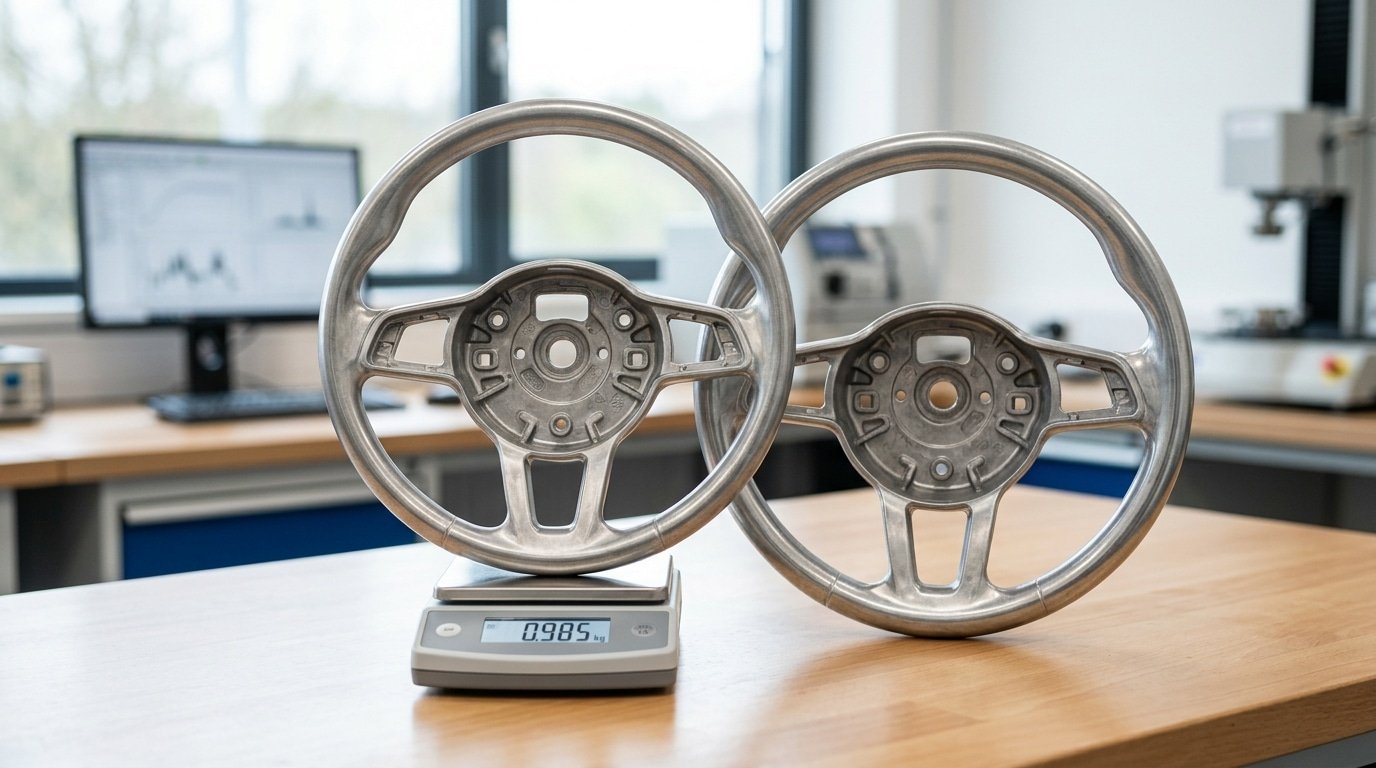
Magnesium Alloy vs Aluminum vs Steel — A Hard-Number Comparison
Short answer: Magnesium alloy only beats aluminum when the weight you save actually justifies paying about 2.4 times more for the raw material, when operating temperatures stay under 120°C.
And when the part won’t see salt spray or touch dissimilar metals. For pretty much everything else, aluminum 6061 or A380 wins on cost, fatigue resistance.
And corrosion.
And steel? Steel still rules anything running above approximately 250°C or sitting under heavy repeated loading.
| Property | AZ91D Mg | A380 Aluminum | 1045 Steel |
|---|---|---|---|
| Density (g/cm³) | 1.81 | 2.74 | 7.85 |
| Tensile strength (MPa) | 230 | 317 | 625 |
| Specific stiffness (E/ρ, GPa·cm³/g) | 25 | 26 | 27 |
| Fatigue limit @ 10⁷ cycles (MPa) | ~70 | ~140 | ~280 |
| Damping capacity (% SDC) | 20–25 | 0.3 | 0.4 |
| Cost per kg (2025, USD) | approximately $3.80–4.50 | approximately $2.20–2.80 | approximately $0.90–1.20 |
Now look at that one weird row. Specific stiffness is basically identical across all three materials. So that old claim about magnesium being “stiffer pound for pound” is really just a myth. It only actually wins on raw weight, nothing more.
Where it genuinely dominates, though, is in Damping. AZ91 soaks up vibration roughly 60 times better than aluminum does, which is exactly why camera bodies and power tool housings tend to pick it. Have a look at the USGS Magnesium Statistics and Information page for current pricing trends.
Here’s the honest tradeoff though, fatigue limit. Magnesium alloy gives out at roughly half the stress aluminum can handle, so anything that spins or vibrates needs a generous safety factor. We’re talking 1.8 to 2.0, versus about 1.4 for aluminum.

The Main Magnesium Alloy Grades and How to Read Their Designations
Quick answer: ASTM B275 names magnesium alloys by their two main alloying elements plus their rounded weight percentages. AZ91 means Aluminum approximately 9%, Zinc approximately 1%. The letter codes: A=Aluminum, Z=Zinc, M=Manganese, E=Rare Earths, K=Zirconium, W=Yttrium, J=Strontium, Q=Silver.
So WE43 reads as Yttrium approximately 4%, Rare earths approximately 3%, a high-temperature aerospace grade. A trailing letter (AZ91D) marks the alloy revision; D is the modern high-purity version with iron, nickel, and copper capped to slash corrosion rates by roughly 100× versus older AZ91A.
See the ASTM B275 standard for the full code table.
Cast vs wrought workhorses
| Grade | Form | Typical Use |
|---|---|---|
| AZ91D | Die cast | ~approximately 90% of all cast magnesium alloy parts — gearbox housings, brackets |
| AM60B | Die cast | Steering wheels, seat frames (higher ductility than AZ91) |
| AJ62 | Die cast | BMW inline-6 engine block — creep-resistant to approximately 150°C |
| AZ31B | Wrought sheet/extrusion | Laptop shells, drone frames |
| AZ80 | Wrought (forged) | Wheels, high-stress structural parts |
| ZK60A | Wrought extrusion | Bicycle frames, sporting goods (zirconium grain refinement) |
| WE43 | Cast/wrought | Helicopter gearboxes, bioresorbable bone screws — stable to approximately 250°C |
| EV31 (Elektron 21) | Sand/investment cast | F1 and aerospace housings, replaces WE43 at lower cost |
One field tip: never expected level AZ91A or AZ91B for anything touching salt spray. The legacy purity limits let galvanic corrosion eat the part. Always insist on the D suffix or move to AM60B.
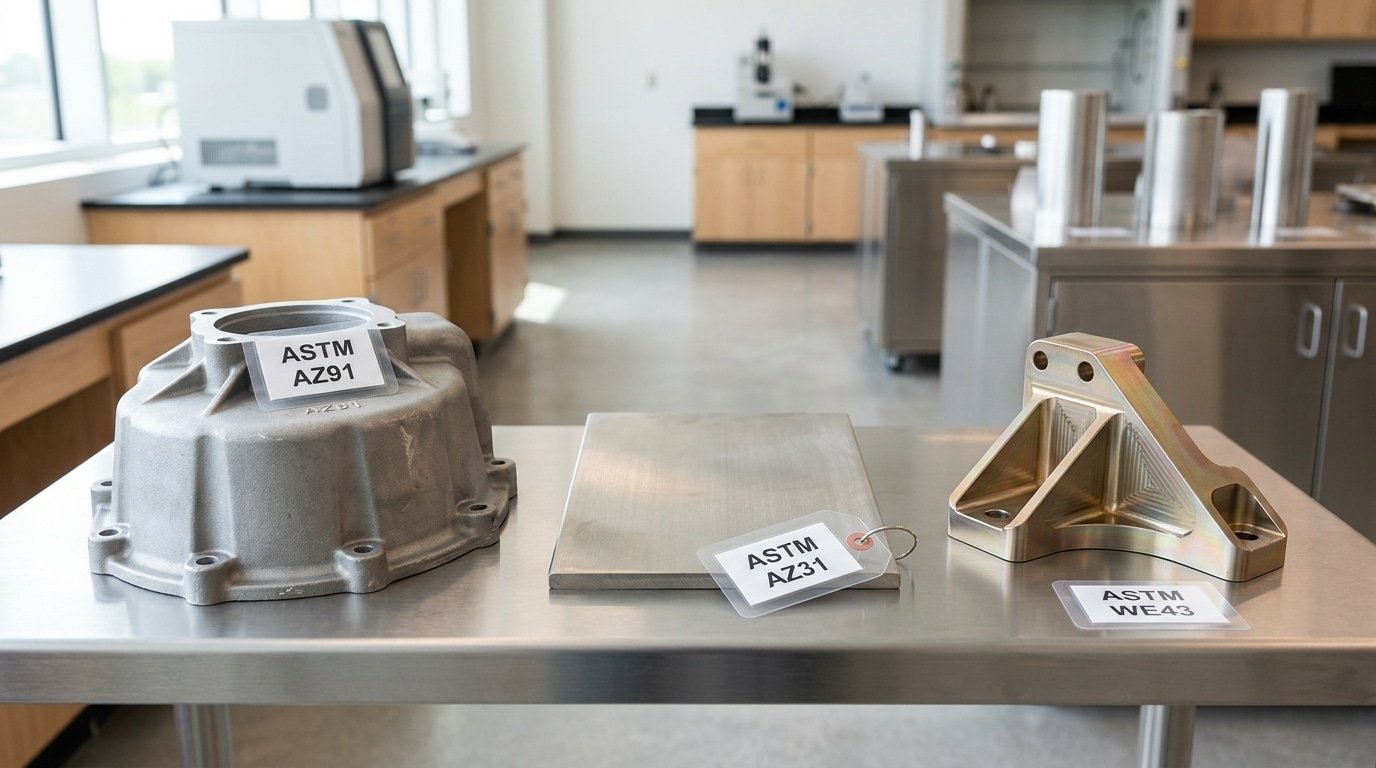
A Decision Framework for Picking the Right Grade
Quick answer: Match the grade to your dominant constraint, operating temperature first, then manufacturing process, then corrosion exposure. Get the temperature wrong and the part creeps; get the process wrong and it cracks in the mold.
| If your requirement is… | Then pick… | Why |
|---|---|---|
| Powertrain or transmission case, 150–approximately 200°C continuous | AJ62 or AE44 | Strontium/RE additions cut creep at approximately 150°C by roughly 60% vs AZ91D |
| Aerospace bracket, 250°C+ service | WE43 (Y + Nd) | Retains ~approximately 75% of room-temp strength at approximately 250°C; flight-qualified per ASTM B80 |
| Thin-wall die-cast electronics housing (0.6–approximately 1.2 mm) | AZ91D | Best fluidity, <approximately 0.005% Fe/Ni/Cu for corrosion control |
| Structural sheet, formed at room temp | AZ31B-O | Only common Magnesium alloy with usable cold formability |
| Extruded tube or profile, moderate strength | AZ61 or AZ80 | AZ80-T5 reaches ~approximately 340 MPa UTS after aging |
| Biomedical implant (resorbable) | WE43 MEO or pure Mg | Controlled degradation; RE content is biocompatible at these levels |
Two pitfalls I see repeatedly in design reviews: picking AZ91D for a part that runs above approximately 120°C (it will creep at bolt joints within months).
And specifying AZ31B for die casting (it’s a wrought grade, your caster will quote it and quietly substitute AM60). Confirm the grade matches the process before you release drawings.

Corrosion, Galvanic Coupling, and Fire — The Real Failure Modes
Direct answer: Magnesium alloy rusts and breaks down faster than aluminum when there’s salt in the air.
⚠️ Common mistake: Specifying pure magnesium or low-manganese alloy for parts exposed to humidity or road salt, then watching them pit and corrode within months. This happens because iron impurities above 50 ppm create galvanic cells that accelerate salt-water corrosion. The fix: specify AZ91 with at least 0.2% manganese to neutralize iron contamination and reserve magnesium for dry, interior applications.
And it actually attacks itself electrically when you bolt it directly to steel without something separating the two. The fire risk people worry about is really overblown for solid parts.
But the tiny shavings under 500µm that come off during machining are genuinely dangerous.
Both of these problems have been solved, though, not by avoiding the metal entirely, but through coatings (things like PEO and e-coat) and good shop-floor habits.
Galvanic corrosion: the steel-fastener trap
Magnesium sits at roughly −approximately 1.65 V on the standard electrode potential scale, which essentially makes it the most reactive structural metal you’d commonly use. So if you bolt a magnesium bracket straight onto a steel chassis in a humid place, the magnesium basically sacrifices itself to protect the steel.
Pitting can actually go deeper than approximately 1 mm within 12 months of salt-spray exposure.
Here’s the stack of fixes engineers really do use:
- Isolation washers and sleeves, made of nylon or phenolic, which break the electrical path between the fastener and the part underneath
- Aluminum-coated or coated stainless fasteners, and you never want to use bare steel or zinc-plated screws in magnesium
- Sealants right at the joint interface, generally polyurethane or butyl tape, to keep moisture from sneaking in
Coatings that actually work in 2026
The old hexavalent chromate conversion coatings (the classic Dow 7 process) are basically dead now under REACH restrictions in Europe. So here’s what’s being used as of 2026:
| Coating | Salt-spray hours (ASTM B117) | Typical use |
|---|---|---|
| Plasma Electrolytic Oxidation (PEO / Keronite) | 500–1,000+ | Aerospace brackets, EV battery trays |
| Chromate-free conversion (Magpass, Gardobond) | 96–240 | Pre-treatment before paint |
| Cathodic e-coat over conversion layer | 720+ | Automotive structural castings |
PEO is really the standout here. It grows a ceramic-like oxide layer about 20 to 50µm thick directly from the metal itself, which gives you wear resistance along with corrosion protection.
It does cost 3 to 5 times more than a simple conversion coating, though, which is why it tends to be reserved for higher-value parts.
The fire myth — and the real hazard
Bulk magnesium alloy actually ignites at roughly 473°C and needs sustained heat to keep burning. So a cast wheel or a laptop chassis isn’t going to catch fire in a normal vehicle accident, because the metal itself pulls heat away faster than ignition can really take hold.
FAA cabin-fire testing on WE43 seat frames basically confirmed this for aviation use.
The real hazard shows up during machining. Chips, dust, and fines below 500µm have a huge amount of surface area for their weight, and they ignite pretty easily.
Water-based coolants are completely forbidden, since magnesium reacts with water and releases hydrogen gas. Shops generally use mineral-oil flood coolant, non-sparking tools, dedicated chip bins, and Class D extinguishers. Never water, CO₂, or the standard ABC dry chemical type.
The OSHA combustible metals standard and NFPA 484 cover all of these protocols in detail.
Get the coating right and respect the pile of chips on the floor, and honestly, magnesium alloy is no riskier in service than aluminum is.
Where Magnesium Alloys Earn Their Place — Automotive, Aerospace, Electronics
Direct answer: Magnesium alloy wins when shaving grams pays back more than the material premium, rotating parts, handheld devices, and weight-sensitive aerospace structures. Below are the parts that actually ship, the grades they use, and why aluminum lost the bid.
Automotive: cutting unsprung and reciprocating mass
- Porsche 911 crankcase (997 Turbo era): the original air-cooled flat-six used an AS41-style magnesium crankcase to drop roughly 10 kg versus aluminum. Magnesium’s higher damping capacity (logarithmic decrement ~5× aluminum) also softened combustion harshness — a side benefit aluminum can’t replicate.
- Ford F-150 radiator support (AM60B die casting): a single thin-wall casting replaces a 20-piece steel weldment, saving about 5 kg and one assembly station. AM60B was chosen over AZ91D because the radiator support sees crash-load energy absorption — AM60B’s higher elongation (~8–approximately 15%) prevents brittle fracture.
- Steering wheel armatures and instrument panel beams: nearly every premium sedan uses AM50/AM60 here. Aluminum can’t match the thin-wall die-castability at approximately 2 mm sections needed to package airbag modules.
Aerospace: WE43 where heat and creep matter
Airbus A350 economy seat frames use WE43 (Mg-Y-Nd-Zr), the yttrium addition keeps creep strength stable up to 250 °C, satisfying FAA flammability rules under FAA 14 CFR Part 25 after the 2015 ban was lifted for tested magnesium alloys. Each seat saves roughly 0.7 kg; across 350 seats, that’s approximately 245 kg per aircraft, about approximately $30,000 in fuel per year at current jet-A prices.
Bell and Sikorsky also use WEapproximately 43 in helicopter gearbox housings, where creep at approximately 200 °C kills standard AZ91.
Electronics: thixomolded AZ91D is the quiet winner
The MacBook unibody is aluminum, but the ThinkPad X1 Carbon’s internal roll cage, Fujitsu LIFEBOOK lids, and most DSLR bodies (Nikon Z-series, Canon R5) use thixomolded AZ91D. Thixomolding, injecting semi-solid magnesium slurry like plastic, produces approximately 0.6 mm walls impossible in aluminum die casting.
The Logitech G Pro X Superlight gaming mouse and Sony α7 IV both rely on this process. EMI shielding is the unsung reason: magnesium alloy attenuates RF interference natively, eliminating the conductive paint step required for plastic enclosures.
See IMA application data for the full electronics roster.
The Cost and Supply Chain Reality Check
Direct answer: Magnesium ingot has been trading somewhere between roughly $2.50 and $4.50/kg through 2023 to 2025, sitting about 15 to 30% above aluminum on a per-kg basis. Though it’s actually cheaper per-volume because magnesium is approximately 36% less dense.
The real risk isn’t really the sticker price. It’s that China produces around 85% of the world’s primary magnesium.
And a single 2021 supply shock pushed spot prices to roughly $14/kg in a matter of weeks.
That 2021 spike wasn’t some anomaly you can just wave off. When Shaanxi province cut power to smelters under energy-consumption controls, European die-casters were hit with six-week lead-time blowouts and force-majeure notices landing on their desks.
The USGS Mineral Commodity Summaries tracks this concentration risk every year. Outside of China, only Israel, Brazil, Russia, Kazakhstan, and one small US operation produce primary metal at any real scale.
Total cost per part — the comparison that matters
Honestly, the ingot price misleads people. The real question is landed cost per finished part compared against aluminum die casting:
| Cost driver | Magnesium (AZ91D) | Aluminum (A380) |
|---|---|---|
| Ingot, $/kg (2024 avg) | ~approximately $3.20 | ~$2.60 |
| Part weight (same volume) | 1.0× ref | 1.57× ref |
| Die life (shots) | 150k–250k | 80k–120k |
| Cycle time | ~approximately 30% faster | baseline |
| Scrap rate, in-house remelt | good (closed loop) | good |
| Finishing (chromate/anodize) | +approximately $0.40–$1.20/part | +approximately $0.15–$0.50/part |
Magnesium alloy basically pencils out when your annual volume runs past about 50,000 parts, and when weight savings unlock downstream value like fuel economy credits, lower shipping, or better ergonomics.
You can also hedge supply with a dual-source contract. Typically one Chinese mill paired with one Israeli or Brazilian supplier. Below 20,000 parts a year though, aluminum almost always wins on landed cost.
One operational tip buyers tend to learn the hard way: lock your pricing quarterly with a published-index escalator built in. The London Metal Exchange doesn’t actually list magnesium, so most contracts reference either Fastmarkets or Asian Metal indices instead.
Fixed annual pricing got a lot of OEMs completely burned in Q4 2021.
Sustainability, Recyclability, and Carbon Footprint
Direct answer: Primary magnesium alloy carries a heavy carbon load, about 28 kg of CO₂ for every kilogram when it comes from China’s Pidgeon process, compared to roughly 10 kg from electrolytic methods and as low as approximately 1 kg for recycled secondary metal. The sustainability case really stands or falls on your specific sourcing mix, not on the magnesium metal itself.
Production route matters more than the metal
The Pidgeon process, which is basically a silicothermic reduction done in coal-fired retorts, still makes over 80% of the world’s primary magnesium. Independent lifecycle work, which includes the International Magnesium Association’s LCA guidance, puts the cradle-to-gate emissions at 25 to approximately 30 kg of CO₂ equivalent per kilogram for Pidgeon ingot.
Electrolytic production, the kind from places like Dead Sea Magnesium or US Magnesium, lands near 10 to approximately 14 kg per kilogram. And solar-powered electrolytic routes, which are still in a pilot stage, are targeting under 5 kg per kilogram by the year 2027.
Closed-loop die casting is the real win
High-pressure die casting generates a lot of scrap, think 40 to 60 percent from runners, biscuits, and overflow. Tier-1 casters like Meridian and Georg Fischer remelt this scrap right in-house, and the energy needed to recycle magnesium is essentially about 5% of what it takes for primary production.
So when you count it against an in-house remelt loop, your effective footprint drops toward just 1 or approximately 2 kg of CO₂ per kilogram.
The lifecycle math vs aluminum and CFRP
- End-of-life recovery: automotive magnesium parts get recovered at around 50% globally, which is below aluminum’s approximately 90% plus rate, mainly because mixed shredder streams send the magnesium to slag.
- Use-phase getting your money back: a approximately 1 kg weight reduction in a vehicle saves about 20 kg of CO₂ over 200,000 km, so Pidgeon magnesium still breaks even against steel at around the approximately 150,000 km mark.
- CFRP comparison: carbon fiber sits at 25 to approximately 35 kg of CO₂ per kilogram with near-zero recyclability, so recycled magnesium alloy wins clearly in that matchup.
You should expect a level of recycled-content magnesium and always demand a supplier LCA. Without that document, the lightweight story you’re hearing is really only half the truth.
Frequently Asked Questions About Magnesium Alloy
Is magnesium alloy better than aluminum?
Only when weight savings pay for themselves. Magnesium alloy is approximately 33% lighter than 6061 aluminum but costs 2,4× more per finished part and corrodes faster. For a laptop chassis or steering wheel armature, that trade works. For a generic bracket, aluminum wins.
Does magnesium alloy rust?
It doesn’t rust, rust is iron oxide. It corrodes, forming a loose white magnesium hydroxide layer. In salt spray, untreated AZ91D loses material 5,10× faster than 6061. Chromate-free conversion coatings (per ASTM B893) plus an epoxy primer cut that rate dramatically.
Is magnesium alloy safe to machine?
Yes, with discipline. Use sharp carbide tools, feed rates above approximately 0.05 mm/tooth, and dry or mineral-oil cutting, never water-based coolant. Fine chips below approximately 0.5 mm are the fire risk. Keep a Class D extinguisher on the floor, not a CO₂ unit.
Why are magnesium alloy laptops and mice popular?
Stiffness-to-weight. A approximately 0.6 mm thixomolded AZ91 lid resists flex better than a approximately 1.0 mm aluminum lid while weighing less. Logitech’s MX Master 3S and ThinkPad X1 Carbon internals use this trick.
Can magnesium alloy parts be welded?
Yes, TIG and laser welding work well on AZ31B and WE43. Avoid welding high-zinc grades like ZK60; they crack. Preheat to approximately 150°C and use argon shielding.
What does magnesium alloy cost per kg?
Ingot runs approximately $2.50,$4.50/kg; finished die-cast parts land at approximately $8,$15/kg depending on geometry and surface treatment.
Choosing Magnesium Alloy With Confidence — Next Steps
Quick answer: Run your project through three checkpoints, weight criticality, exposure to corrosion, and production volume, then build a prototype in AZ31B or AZ91D before you commit to the more exotic grades like WE43 or Elektron 21.
The Three-Checkpoint Decision Filter
- Weight criticality: Does shaving off 30–approximately 35% of the mass compared to aluminum actually unlock real value for you (things like fuel burn, battery range, or how a handheld device feels in your hand)? If the answer is no, just stop right here and pick aluminum.
- Corrosion environment: Are you dealing with salt spray, marine air, or neighboring parts that cause galvanic reactions (steel fasteners, copper traces, that sort of thing)? You will need to budget for a chromate-free conversion coating (something like Henkel Bonderite M-NT), plus an epoxy primer on top. That adds roughly $0.40–$1.20 per part once you’re at volume.
- Production volume: If you’re under 5,000 units a year, just machine the parts from AZ31B plate. Above that number, high-pressure die-casting with AZ91D drops your per-part cost by 40–approximately 60% once the tooling pays for itself (the typical break-even sits around 15,000–25,000 units on a die that runs approximately $80K–$150K).
Your Next Three Moves
Ask for certified datasheets, not marketing PDFs. Request material certifications from suppliers that trace back to ASTM B93/B93M (for ingot) or ASTM B94 (for die-cast alloys). And verify the chemistry on a lot-specific basis, because iron content above approximately 0.005% really wrecks how the part holds up against corrosion.
Prototype with AZ31B (wrought) or AZ91D (cast) first. Both are stocked all over the world, they cost roughly half of what WE43 costs, and they behave predictably. Save the rare-earth grades for your second iteration, once the geometry is actually locked in.
Bring your foundry into the conversation during CAD, not after. Die-casters will routinely catch draft-angle problems, thin-wall hotspots (you generally want to target a 1.5–approximately 4 mm wall).
And gating issues that can add 8–12 weeks to the schedule if they get caught after tooling is already cut. The International Magnesium Association publishes free design-for-die-casting guidelines.
And they’re genuinely worth reading before your first design review.
Get those three steps right and Magnesium alloy stops being a gamble. It really becomes a measured engineering choice instead.