
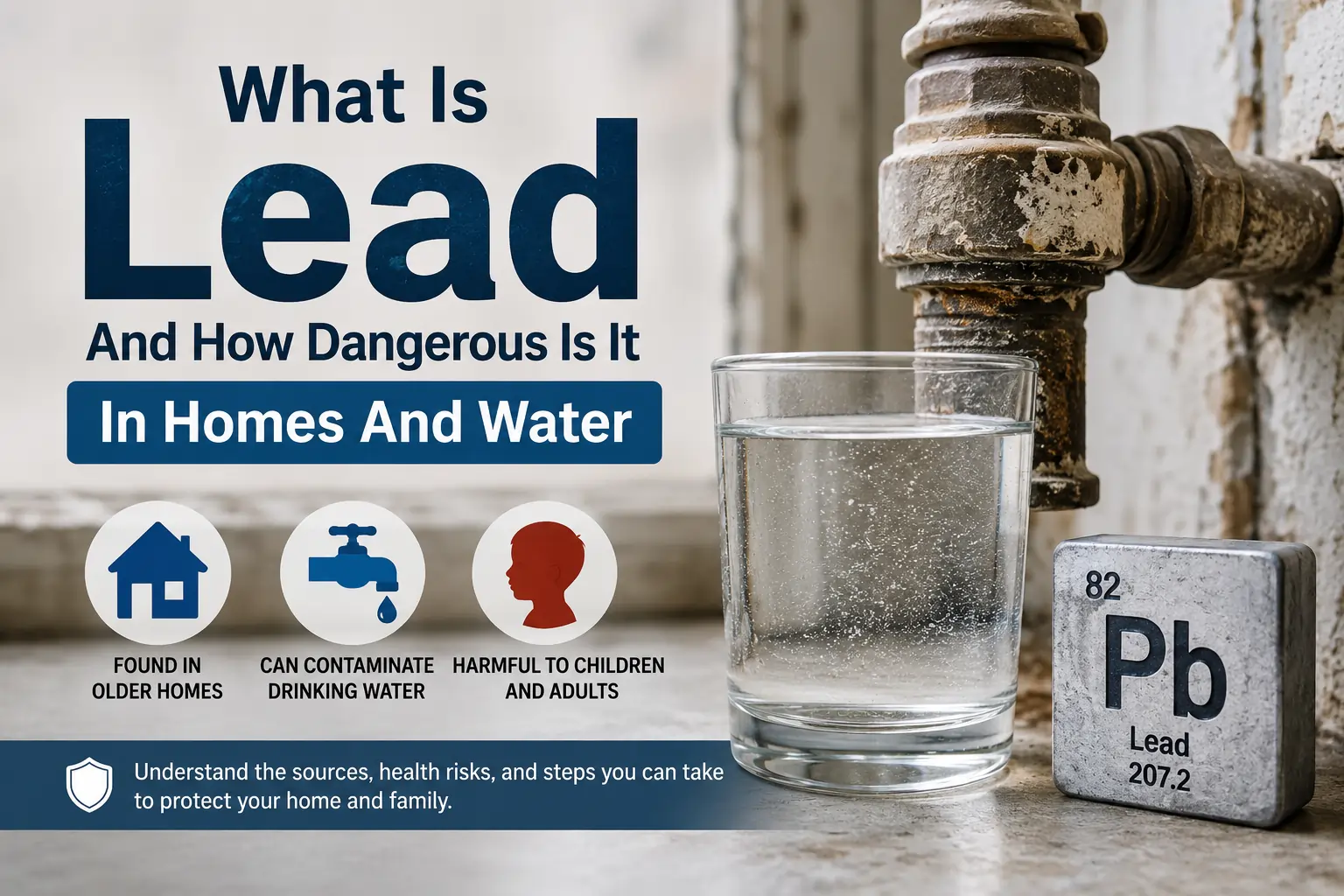
Lead is a toxic heavy metal (chemical symbol Pb, atomic number 82) that accumulates in the human body with no safe exposure threshold, commonly entering homes through corroded plumbing, deteriorating paint, and contaminated soil. The CDC lowered its blood lead reference value from 5 to 3.5 µg/dL in 2021, yet harm occurs below that level.
Roughly 9.2 million U.S. homes still receive water through lead service lines, and about 24 million housing units contain deteriorating lead-based paint hazards.
Roughly 9.2 million homes in the U.S.
still get their water delivered through lead service lines, and somewhere around 24 million housing units have lead-based paint hazards that have started to break down over time.
This guide walks through where Lead tends to hide inside older homes, how it actually moves into drinking water by way of corroded plumbing, the specific kinds of health damage it causes at different exposure levels, and which testing and cleanup steps will really reduce the risk.
Quick Takeaways
- Test tap water for lead using EPA-certified labs, especially in pre-1986 homes.
- Replace lead service lines completely; partial replacements can actually increase contamination.
- Run cold water 30-120 seconds before drinking if pipes may contain lead.
- Check pre-1978 paint for deterioration and hire EPA-certified RRP contractors for removal.
- Request blood lead testing for children under six, targeting levels below 3.5 µg/dL.
What Lead Is — A Quick Answer Before We Go Deeper
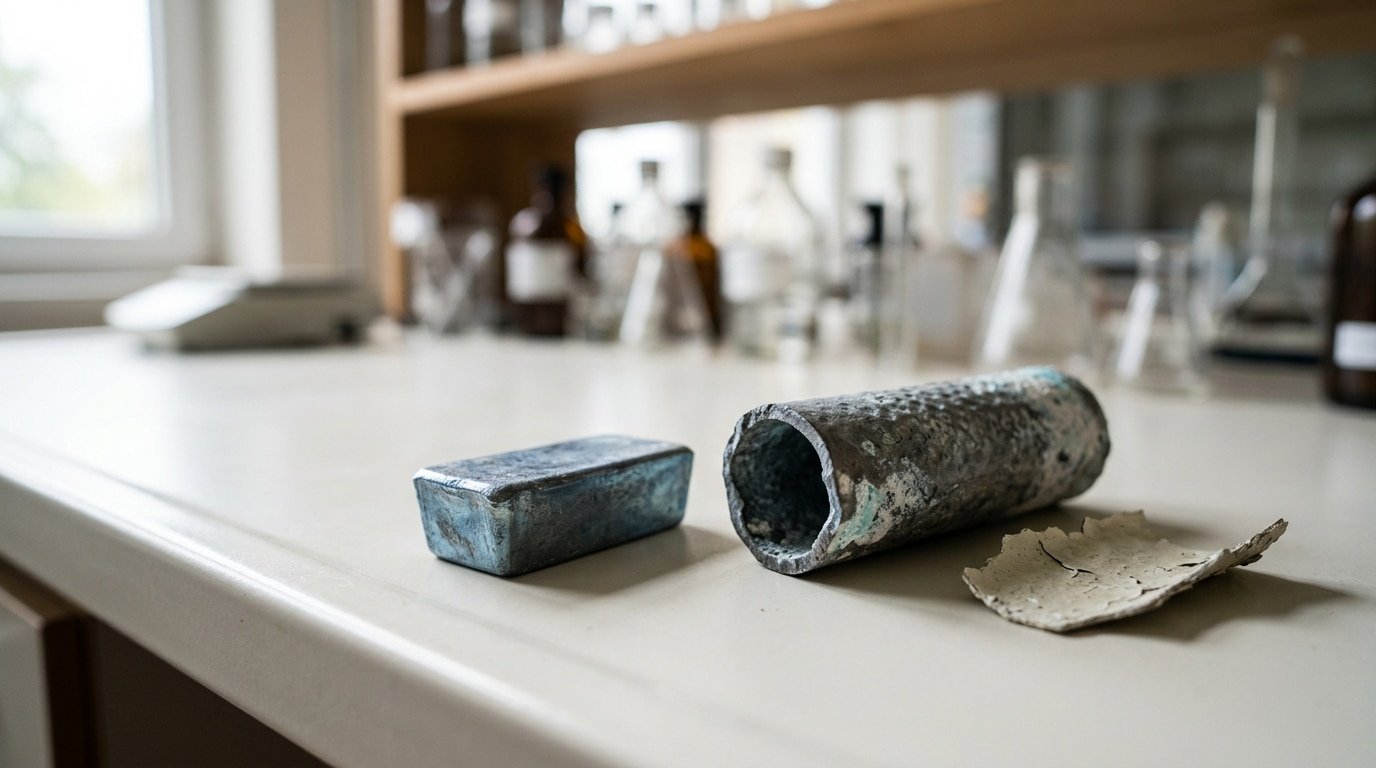
Lead, which has the chemical symbol Pb and atomic number 82, is a soft, dense, bluish-gray heavy metal that’s toxic to people at any measurable level in the blood. It melts at a relatively low temperature of approximately 327.5°C[1] and it weighs 11.34 g/cm³, which is about 1.5 times denser than iron.
It also doesn’t rust easily, and that’s exactly why industry loved using it for 5,000 years.
And it’s exactly why it now sits in your pipes and your paint.
And in your soil.
Here’s the part that most articles tend to bury: there is no safe threshold. In 2021, the CDC lowered its blood lead reference value from 5 to 3.5 µg/dL, but even that number is basically a population screening tool, not a “safe” line.
Actually, damage to a child’s developing brain has been measured at levels below 2 µg/dL.
This guide is meant to cut through the noise by using three main lenses:
- Chemistry — we’ll look at why Pb²⁺ mimics calcium and hijacks your nervous system
- Health — we’ll cover what specific exposure levels do to specific organs
- Environment — we’ll explore where lead hides in 2026 homes, and it’s not just pre-1978 paint
You can skip to the section that matches you best: parents should go to sections 5, 6, and 8. DIY renovators should check sections 3, 4, and 7.
Water-quality worriers should look at sections 3 and 7. Students will find sections 2 and 5 useful.
The decision matrix in section 6 tells you when “elevated” becomes “call your doctor today.”
The Chemistry And Metallurgy Behind Lead’s Toxicity
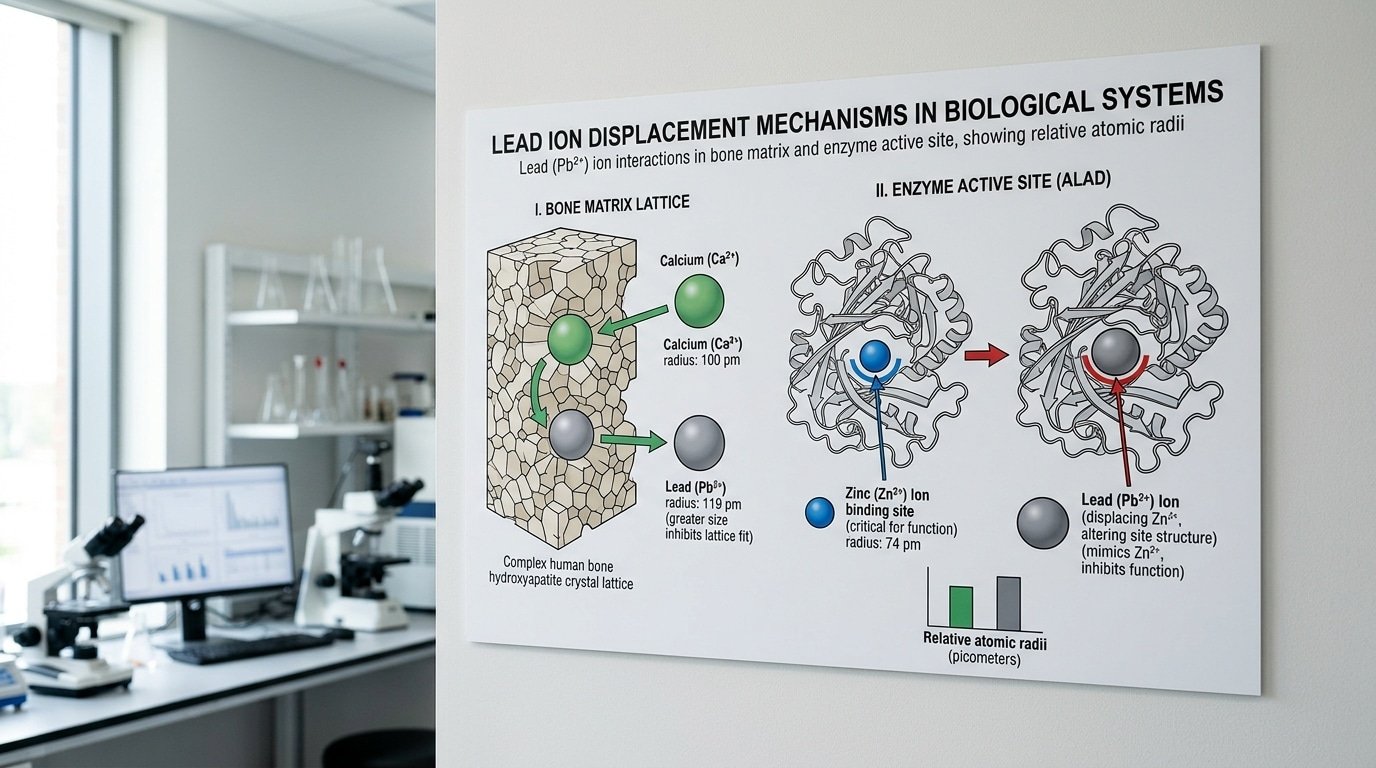
Direct answer: Lead is toxic because its Pb²⁺ ion has almost the same size and charge behavior as calcium (Ca²⁺) and zinc (Zn²⁺). Your body honestly can’t tell them apart.
So lead slips into bones, nerves.
And the enzymes that were built for those essential metals.
And it basically breaks them.
The physics actually explain why industry loved the stuff. Pb has a density of 11.34 g/cm³, which makes it heavier than iron. It melts at just 327.5 °C[2], and it stays soft enough to shape with hand tools.
Plumbers could bend it into pipe joints, and the Latin word for lead, plumbum, is literally where the word “plumbing” comes from. Soldiers, meanwhile, could cast it into musket balls over a campfire.
Painters were really fond of lead white (basic lead carbonate) because it covered in just one coat and held up against moisture.
Here’s the trade-off that made lead useful and dangerous in the same breath:
| Property | Why industry wanted it | Why your body suffers |
|---|---|---|
| Ionic radius of Pb²⁺ (~119 pm) | Forms stable pigments and alloys | Mimics Ca²⁺ (~100 pm), hijacks bone deposition |
| Soft, malleable (Mohs 1.5) | Easy to roll into sheet and pipe | Wears off as dust into household air |
| Low melting point (approximately 327 °C[3]) | Cheap solder for cans and pipe joints | Leaches into hot or acidic water |
The molecular damage kicks in when Pb²⁺ latches onto enzymes that were supposed to hold zinc. The most famous one is ALAD (delta-aminolevulinic acid dehydratase), which is a key step in making hemoglobin. The U.S.
ATSDR Toxicological Profile for Lead documents ALAD being shut down at blood levels as low as 5 µg/dL. Inside neurons, lead jams the calcium channels and sets off misfired signals. That’s why children show learning deficits long before any visible symptom shows up.
Where Lead Hides In Modern Homes And Drinking Water
Direct answer: From what I’ve been learning, lead in US homes usually shows up in four main spots. First, there’s the paint used before 1978.
Then you have brass plumbing parts, which were legally allowed to have up to 8%[4] lead until 2014. You’ve also got the actual lead service lines that bring water to roughly 9 million homes.
Finally, all of those sources can create dust that settles on floors and windowsills.
Most people know about the 1978 paint ban. What’s less known is the rule for water pipes. The Reduction of Lead in Drinking Water Act only really got strict in 2014, lowering the allowed amount of lead to approximately 0.25%[5].
So, anything installed before that, even a shiny “chrome” bathroom faucet, can actually leach lead into your first glass of water in the morning, especially after it’s been sitting in the pipes all night.
But the bigger issue is often the service lines themselves. The EPA’s 2023 count found an estimated 9.2 million lead service lines still in the ground across the country. They’re really concentrated in states like Illinois, Ohio, Michigan, and New York.
And here’s something I didn’t know: even galvanized pipes that were connected to an old lead line can hang onto lead particles. They can slowly release them for years, even after the main lead service line gets swapped out.
Typical Lead Content By Source
| Source | Typical lead content | Why it matters |
|---|---|---|
| Pre-1978 interior paint | 1,000–10,000+ ppm | Chipping and sanding create toxic dust |
| Pre-1986 solder on copper pipes | Up to 50%[6] lead | Leaches at every soldered joint |
| Pre-2014 brass faucet | Up to 80,000 ppm (approximately 8%[7]) | First-draw water at the tap |
| Lead service line | Solid lead pipe | Entire incoming supply at risk |
| Household dust (older home) | 40–400+ μg/ft² | Main exposure route for toddlers |
Here’s a handy tip that most plumbers probably won’t just offer up for free. If a tap hasn’t been used for over six hours, you should let it run for 30 to 60 seconds before you drink from it or use it for cooking.
It uses about a gallon of water, but it clears out that first slug of water that’s been sitting and picking up lead.

Emerging And Overlooked Lead Sources Most Articles Skip
Here is the short answer. As old paint and leaded gasoline keep fading into history, six newer or quietly ignored sources are now driving a growing share of exposure.
Those are leaded aviation fuel, imported spices, traditional pottery, Lead ammunition that ends up in wild game meat, informal recycling of electronic waste, and certain artificial turf fields. The EPA and NIEHS pages barely mention any of them.
Why do they matter so much now? Basically, the older well-known sources are on the way down, which means these “tail” sources end up dominating the actual risk picture for a lot of households today.
Leaded avgas (100LL): Roughly 170,000 small piston-engine aircraft in the United States are still burning leaded aviation gasoline every day. The EPA’s 2023 endangerment finding confirmed this is the single largest remaining airborne lead source we have.
Children who live within 500 meters of general aviation airports show measurably higher levels of lead in their blood.
See the EPA endangerment finding.
Imported spices: The FDA recalled multiple lots of turmeric and chili powder between 2019 and 2024 after lead chromate was deliberately added as a yellow brightener to make the color pop. Bangladeshi turmeric samples have tested above 1,000 ppm.
That is more than 10 times the action level set for candy.
Other overlooked sources:
- Glazed pottery and ceramics coming in from Mexico, Morocco, and rural China. Acidic foods like tomato sauce or citrus actually pull the lead right out of the glaze when it has been fired poorly.
- Lead bullet fragments hiding in venison and other game meat. The CDC found detectable lead in approximately 80%[8] of the ground venison packages tested during a North Dakota study.
- Informal e-waste recycling, where burning old circuit boards in the backyard releases lead into the surrounding soil. This is fairly common as a small side business in some immigrant households.
- Crumb-rubber artificial turf infill. Older fields tested by Disease Control labs showed lead above 400 ppm sitting in the surface dust kids touch.
So if you hunt, or you cook with imported spices, or you live near a small airport, these channels probably outrank your home’s plumbing as the main way exposure is reaching you.

How Lead Enters The Body And What It Does Inside You
Direct answer: Lead gets into your body through three different doors, swallowing it (which is by far the biggest one), breathing in dust or fumes.
And contact with your skin (which is pretty minor). Once it’s inside, it hitches a ride on your red blood cells.
And then it settles into your bones for decades on end.
⚠️ Common mistake: Replacing only the homeowner’s portion of a lead service line while leaving the utility-side section intact. This partial replacement can actually spike lead levels in tap water for weeks or months, because cutting the pipe disturbs protective mineral scale and galvanic corrosion between old and new metals releases more lead particles. The fix: insist on full line replacement from main to meter to faucet, coordinated with your utility.
The damage really hits your brain, your kidneys, and the system that makes your blood.
The three entry routes ranked by real-world risk
| Pathway | Adult absorption | Child absorption | Typical scenario |
|---|---|---|---|
| Swallowing it (through dust, water, soil, paint chips) | 10–approximately 15%[9] | 40–approximately 50% | A toddler putting their hands in their mouth, tap water running through old lead pipes |
| Breathing it in (fumes, really fine dust) | 30–approximately 50%[10] of what’s inhaled | Higher per kg of body weight | Soldering, sanding down old paint, indoor shooting ranges |
| Through the skin | <approximately 0.3%[11] for regular inorganic lead | Same | Pretty much negligible, except for organic forms like tetraethyl lead |
Kids actually absorb about 4 to 5 times more swallowed lead than adults do, basically because their digestive systems are still developing. And a diet that’s low in calcium or iron makes the body grab onto lead in place of those minerals.
Having an empty stomach roughly doubles how much gets taken up, which is exactly why children who skip breakfast and then go chew on a windowsill are the classic textbook case for being at high risk.
What happens after lead gets in
Within just a few hours, about 99%[12] of the lead circulating in your blood binds itself to your red blood cells. Then within a few weeks, the rest of it moves around, going into soft tissue first, and then eventually into your bones.
Your bones end up storing 90 to approximately 95%[13] of an adult’s total body burden, and the half-life in your cortical bone is something like 25 to 30 years. That’s really the bioaccumulation trap right there.
A 60-year-old who worked with leaded solder back in their 20s is still carrying it around.
Pregnancy and menopause are both danger windows, though. The body’s demand for calcium during those times mobilizes the lead stored in bone back into the bloodstream.
So a mother who hasn’t had any recent exposure at all can still pass lead across the placenta to her baby. The fetus actually ends up with blood lead levels really close to the mother’s own.
The cascade of damage essentially runs on three fronts. Nervous system: lead blocks what are called NMDA receptors and messes with calcium signaling, which impairs how synapses form. That’s basically the mechanism behind IQ loss in children.
Blood production: it shuts down the ALAD and ferrochelatase enzymes that are needed to make heme, which causes a kind of small-cell anemia called microcytic anemia. Kidneys: damage to the proximal tubule drives high blood pressure and chronic kidney disease when exposure goes on long-term.
The ATSDR Toxicological Profile for Lead actually documents each of these pathways with full dose-response data.
Health Effects By Exposure Tier — A Blood Lead Level Decision Matrix
Direct answer: The CDC’s blood lead reference value (BLRV) is 3.5 µg/dL for children, the top approximately 2.5%[14] of US kids ages 1-5. There’s no safe lead level. Effects scale with the dose, but the steepest IQ damage actually happens at the lowest exposures.
| Blood Lead (µg/dL) | Children: effects & action | Adults: effects & action |
|---|---|---|
| < 3.5 | No symptoms, but IQ loss already measurable — about 1 IQ point per µg/dL at the low end (Lanphear et al., EHP 2005). Identify source. | Considered background. CDC adult reference: 3.5 µg/dL. |
| 3.5 – 5 | Home investigation, nutrition (iron, calcium, vitamin C), retest in 1-3 months per CDC schedule. | Counsel on workplace hygiene; pregnant adults should be removed from exposure. |
| 5 – 15 | Confirm with venous draw; environmental inspection; developmental screening. | OSHA medical surveillance triggered at 25 µg/dL, but symptoms (fatigue, headache, hypertension) can start here. |
| 15 – 45 | Anemia, abdominal pain, attention deficits. Confirm and treat the source aggressively. | OSHA mandatory removal from lead work at ≥ 50 µg/dL (general industry); kidney and reproductive effects rise. |
| > 45 | Chelation therapy (succimer/DMSA) considered at ≥45; encephalopathy risk above 70. | Chelation at ≥80, or symptomatic ≥50. Seizures, peripheral neuropathy possible. |
Key insight most articles miss: OSHA’s 1978 occupational limits (40 µg/dL trigger, 50 µg/dL removal) are 15-30× higher than what we now know causes harm. NIOSH has petitioned for a 20 µg/dL removal level.
See the CDC blood lead reference value page and OSHA lead standard for the current rules.
At-Home Vs Lab Testing Compared For Blood, Water, Paint, And Soil
Direct answer: The at-home kits are quick and cheap tools for an initial check, basically useful when you’re asking yourself “should I actually worry about this?” But every elevated reading really needs lab confirmation before you start throwing money at fixing the problem.
The four sample types each have their own benchmark for accuracy, and mixing them up will waste hundreds of dollars.
| Sample | Screening Option | Lab Gold Standard | Cost | Turnaround | Detection Limit |
|---|---|---|---|---|---|
| Blood | LeadCare II fingerstick (point-of-care) | Venous draw + ICP-MS | approximately $10[15]–35 vs approximately $40[16]–100 | approximately 3 min[1] vs 2–5 days | 3.3 µg/dL vs 0.2 µg/dL |
| Water | 3M / First Alert swab strip | EPA Method 200.8 (ICP-MS) | approximately $15[2] vs approximately $25[3]–60 | approximately 10 min[4] vs 5–10 days | ~15 ppb vs 1 ppb |
| Paint | D-Lead / 3M LeadCheck swab | XRF gun or AAS chip analysis | approximately $10[5]–25 vs approximately $25[6]/chip, approximately $400/day XRF | 30 sec vs 3–7 days | ~600 ppm vs approximately 1 mg[7]/cm² |
| Soil | Home colorimetric kit | University extension lab (e.g., UMass Amherst) | approximately $20[8] vs approximately $15[9]–50 | approximately 15 min[10] vs 2–3 weeks | ~1000 ppm vs 1 ppm |
The screening trap: Here’s where people get burned. LeadCheck swabs completely miss the Lead sitting under an intact topcoat, and they tend to throw false negatives on darker pigmented paint.
The CDC actually pulled LeadCare II from being used on venous samples back in 2021, after a string of recalls.
For water, the swab strips simply can’t see the 10 ppb action level the EPA has proposed. They only really flag readings of 15 ppb or higher.
If you have a kid under 6 at home, or someone is pregnant, honestly just skip the screening step. Go straight to a certified lab.
Pro tip on this one. Water samples have to be “first-draw” after the water has been sitting still for approximately 6 hours[11], so request the kit ahead of time and don’t run the tap that morning before collecting.
Practical Steps To Reduce Exposure Based On Who You Are
Direct answer: Your highest-use action depends on your role. Pick the branch below, do the top two items this week, and you’ll cut most realistic lead exposure pathways within 30 days.
If You Parent A Child Under 6
- Wet-wipe windowsills and floors weekly with a disposable microfiber cloth — dry sweeping resuspends lead dust.
- Feed iron, calcium, and vitamin C at every meal. Deficient kids absorb up to 50%[12] of ingested lead; replete kids absorb closer to approximately 10% (CDC nutrition guidance).
- Wash hands and pacifiers before eating. Request a capillary screen at the 12- and 24-month well-child visit.
If You’re Renovating Pre-1978 Housing
Hire an EPA RRP-certified contractor, DIY sanding can spike dust lead 100×. Demand HEPA shrouded tools, 6-mil poly containment, and a post-job dust wipe clearance test (target: <10 µg/ft² floors).
If You Drink Tap Water
Check your address in the EPA Lead Service Line inventory (utilities had to publish theirs by October 2024). Flush any tap unused for 6+ hours for 30,120 seconds. For cooking and infant formula, use an NSF/ANSI 53 certified filter, not a basic carbon pitcher.
If You Work With Lead
Battery, demo, radiator, and indoor range workers: change clothes and shower on-site, never launder work clothes with family laundry (take-home dust caused approximately 52%[13] of pediatric cases in one Rhode Island cohort), and request OSHA-mandated biannual blood lead monitoring above the 30 µg/m³ action level.
Frequently Asked Questions About Lead
Where can I find lead in everyday life?
Pre-1978 paint, brass faucets, old solder joints, imported ceramic glazes, vinyl mini-blinds, some kohl eyeliners, gun ranges, leaded aviation fuel (still legal for piston aircraft), cheap costume jewelry, and certain Ayurvedic supplements. The CDC has recalled over 20 imported spice brands since 2020 for lead contamination above 1 ppm.
Is any level of lead safe?
No. The CDC states there’s no safe blood lead level in children. The 3.5 µg/dL reference value is a statistical cutoff (top approximately 2.5%[14] of US kids), not a safety threshold. IQ losses are documented even below 2 µg/dL.
Can lead leave the body naturally?
Partly. Blood lead has a half-life of about 30 days, but lead stored in bone persists 20,30 years. During pregnancy or menopause, bone lead remobilizes into blood. Chelation (EDTA, succimer) is reserved for blood levels above 45 µg/dL, it doesn’t reverse prior neurological damage.
Does boiling water remove lead?
No, boiling concentrates it. Water evaporates, lead stays. Use NSF/ANSI 53-certified filters instead.
Is lead the same as the “lead” in pencils?
No. Pencil “lead” is graphite (pure carbon) mixed with clay, used since 1795. No actual lead metal.
How is lead different from “leading” or “led”?
The metal Lead (Pb) rhymes with “bed.” The verb “to lead” (guide) rhymes with “seed”; its past tense is “led.” Typography “leading” (line spacing) comes from real lead strips printers once inserted between type rows.
Key Takeaways And Your Next Action
The three-lens framework in one breath: Lead is really a chemistry problem (Pb²⁺ basically mimics calcium and zinc, hijacking enzymes in your body), and it’s also a housing problem (about 87%[15] of US homes built before 1940 still contain lead paint, according to HUD surveys).
And it’s a plumbing problem too. An estimated 9.2 million lead service lines are still in the ground, according to the EPA’s 2024 LCRI inventory.
There’s one non-negotiable fact you should anchor every decision around: no safe blood lead level actually exists. The CDC lowered its reference value down to 3.5 µg/dL back in 2021.
But here’s the thing, measurable IQ loss happens below 2 µg/dL. So the goal isn’t really “under the threshold,” it’s getting as close to zero as your budget will allow.
Your 72-Hour Action Plan
- Today (free, 10 minutes): Go look up your address in your water utility’s lead service line inventory, which is now public thanks to the EPA’s Lead and Copper Rule Revisions. If the material listed is “lead,” “galvanized requiring replacement,” or “unknown,” then go ahead and move on to step 2.
- This week (approximately $15[16]–30): Order an EPA-certified lab water test (you want a first-draw sample and a flushed sample). Skip those approximately $10[1] dipstick kits, because they generally miss sub-20 ppb contamination that can still harm toddlers.
- This month (often free): If a child under 6 is living in a pre-1978 home, ask for a capillary or venous blood lead screening at their next pediatric visit. Medicaid actually covers it at 12 and 24 months because of a federal mandate.
Lead exposure is genuinely one of the few environmental health risks where individual action really does close the gap. So run through the three steps. Then forward this along to one neighbor who lives in an older home.
References
- [1]osha.gov
- [2]epa.gov
- [3]en.wikipedia.org
- [4]britannica.com
- [5]niehs.nih.gov
- [6]unep.org
- [7]osha.gov/lead
- [8]en.wikipedia.org/wiki/Lead
- [9]pureearth.org/lead101-2/
- [10]britannica.com/science/lead-chemical-element
- [11]dictionary.cambridge.org/us/dictionary/english/lead
- [12]merriam-webster.com/dictionary/lead
- [13]epa.gov/lead/learn-about-lead
- [14]unep.org/topics/chemicals-and-pollution-action/chemicals-management/pollution…
- [15]study.com/learn/lesson/video/lead-element-properties-facts-discovery.html
- [16]niehs.nih.gov/health/topics/agents/lead