

H13 Tool Steel: Composition, Properties, Heat Treatment & Uses
H13 is an air-hardening chromium-molybdenum-vanadium hot-work tool steel chosen when a tool must balance thermal-fatigue resistance, hot strength, toughness and moderate wear resistance. It is widely used for die-casting dies, hot-forging tooling, extrusion components, hot punches and demanding mould inserts—but the grade name alone does not determine performance. Steel cleanliness, section size, heat treatment, surface condition and the actual failure mode matter just as much.

H13 combines chromium hardenability with molybdenum hot strength and vanadium carbide/grain control. It is designed for cyclic heat, not simply for maximum room-temperature hardness.
The useful window depends on tool geometry, alloy being processed, impact loading and the supplier’s heat-treatment curve. Higher hardness improves wear resistance but reduces toughness margin.
H13 is a common starting point for aluminium and magnesium die-casting dies, hot-forging dies, extrusion tooling, hot punches, cores, inserts and high-stress mould parts.
For large, critical or high-volume dies, ask about melt route, remelting, cleanliness, test orientation, ultrasonic inspection and heat-treatment certification—not chemistry alone.
Find the decision you need
What is H13 tool steel?
H13 is a wrought alloy tool steel standardized in the United States under the H-series of hot-work steels. Its common identifiers include AISI H13 and UNS T20813. ASTM A681 covers wrought alloy tool-steel products and states that grade selection must consider tool design, service conditions and desired properties—not just nominal chemistry.
The grade became a workhorse because it occupies a useful middle ground. It is tougher than many high-wear tool steels, retains strength better at elevated temperature than ordinary alloy steel, and tolerates repeated heating and cooling better than many general-purpose mould steels. That makes it valuable where a die surface repeatedly meets hot metal while the tool body must resist both crack initiation and gross fracture.
H13 is not automatically the best choice for every hot tool. A tool dominated by severe impact may need a tougher H11-type steel. A high-temperature extrusion component may benefit from a higher-molybdenum hot-work grade. A large plastic mould that never sees hot metal may be more economical in prehardened P20. The correct question is therefore: which failure mode must the material delay?
Each alloying element solves a different hot-work problem
The ranges below are a practical summary commonly associated with wrought H13 under ASTM A681. The purchased edition of the governing standard and the supplier’s certified analysis control the order.
| Element | Common H13 range, wt.% | Primary contribution | What changes if control is poor? |
|---|---|---|---|
| Carbon | 0.32–0.45 | Enables martensitic hardness and carbide formation. | Too much hardness without toughness margin can increase cracking sensitivity; too little can limit attainable hardness. |
| Chromium | 4.75–5.50 | Provides hardenability, oxidation resistance and tempering support. | Segregation or nonuniform processing can weaken transverse performance even when average chemistry passes. |
| Molybdenum | 1.10–1.75 | Supports hot strength, secondary hardening and resistance to temper softening. | Actual hot performance still depends on carbide distribution and heat treatment—not Mo percentage alone. |
| Vanadium | 0.80–1.20 | Forms hard carbides and helps control austenite grain growth. | Undissolved or coarse carbide networks can reduce toughness if steelmaking and thermal processing are poor. |
| Silicon | 0.80–1.25 | Contributes to temper resistance and deoxidation. | Cross-referenced grades may use different silicon strategies, so grade names should not replace heat analysis. |
| Manganese | 0.20–0.60 | Assists hardenability and steelmaking control. | It is a supporting element rather than the main reason H13 survives hot-work service. |
| Phosphorus / sulfur | Typically limited to 0.030 max each in general specifications | Residual elements controlled to protect ductility and cleanliness. | Premium die-steel programs often impose substantially tighter limits, especially on sulfur. |
Ranges shown for decision support; verify the current ASTM A681 edition, purchase order and certified material test report (CMTR/MTR). Powder-bed or metal-injection H13 data are not automatically interchangeable with wrought bar or block data.
Performance is a heat-treatment condition, not a single datasheet number
Mechanical values for H13 move sharply with hardness, test temperature, specimen orientation, section size, remelting route and tempering cycle. Use the figures below as specification landmarks, then request data for the exact product and condition.
A useful planning value for tool mass and handling. Small supplier-to-supplier differences are not normally a selection driver.
Stiffness is broadly steel-like. Hardness changes do not create a proportionate change in elastic modulus.
Delivery hardness varies by product and quality program. A properly spheroidized structure supports predictable machining.
Die casting often favors the lower part of the range for toughness; wear-driven inserts may use the upper part when geometry permits.
Published values vary with temperature and condition. H13 does not remove heat as quickly as high-conductivity copper alloys.
Hot strength and temper resistance are central advantages, but long exposure near or above the tempering temperature can still soften the tool.
Hardness is a trade-off, not a quality score
Raising hardness usually improves resistance to wear, indentation and plastic deformation. It also reduces the margin against cracking, especially at sharp corners, deep engraving, EDM recast layers, weld repairs and large section transitions. The best hardness is the lowest-risk value that still resists the dominant surface damage.
H13 specification starting-point planner
Choose the application conditions that most closely describe the tool. The result is an RFQ direction—not a substitute for the current material standard, die design review, steelmaker data sheet or qualified heat-treatment procedure.
For large tools, the “controlling section” is the thickest region that governs cooling rate—not the overall outside dimension.
Premium or superior-quality H13
Start with a remelted, cleanliness-controlled H13 route. Repeat production and a medium section make toughness consistency and heat-treatment control more valuable than buying chemistry alone.
- Material: Ask for melt route, cleanliness and test orientation.
- Heat treatment: Qualify cooling rate through the controlling section.
- Validation: Confirm hardness, microstructure and dimensional change on the finished tool.
A qualified H13 cycle controls gradients, not just furnace setpoints
A successful cycle must dissolve the intended carbides, achieve uniform austenitizing, cool fast enough to obtain the target structure, avoid cracking and distortion, then temper to the required hardness and stability. Exact temperatures, holds and quench severity must come from the selected steelmaker and heat treater.
Rough machine & stress relieve
Leave finishing allowance, remove severe section changes where possible, and stress-relieve after heavy roughing or EDM planning. This reduces movement during hardening.
Preheat in stages
Use staged preheating to reduce the thermal gradient between the surface and core. Large or intricate dies need tighter control than small, simple inserts.
Austenitize to the supplier window
Generic H13 guidance often falls near 1010–1050°C, but the correct setpoint and soak depend on grade, section, furnace, atmosphere and desired hardness.
Quench with measured cooling
Cooling must be fast enough to limit undesirable transformation products yet controlled enough to manage thermal stress. Record load thermocouples or an approved equivalent.
Temper, cool and temper again
H13 is normally tempered at least twice, with cooling to room temperature between cycles. Some quality programs or tool conditions require a third temper.
What the heat treater should document
- Steel grade, supplier, heat number and delivery condition
- Furnace class, atmosphere and calibration status
- Preheat, austenitize, quench and temper records
- Load thermocouple location or validated load practice
- Final hardness map, dimensional result and any test coupon data
Common reasons a “correct” cycle fails
- Measured tool temperature does not match furnace display
- Thick sections cool too slowly through the transformation range
- Sharp corners, EDM layers or welds concentrate stress
- Tempering is delayed or the tool is not cooled fully between tempers
- The selected hardness is too high for the geometry and service shock
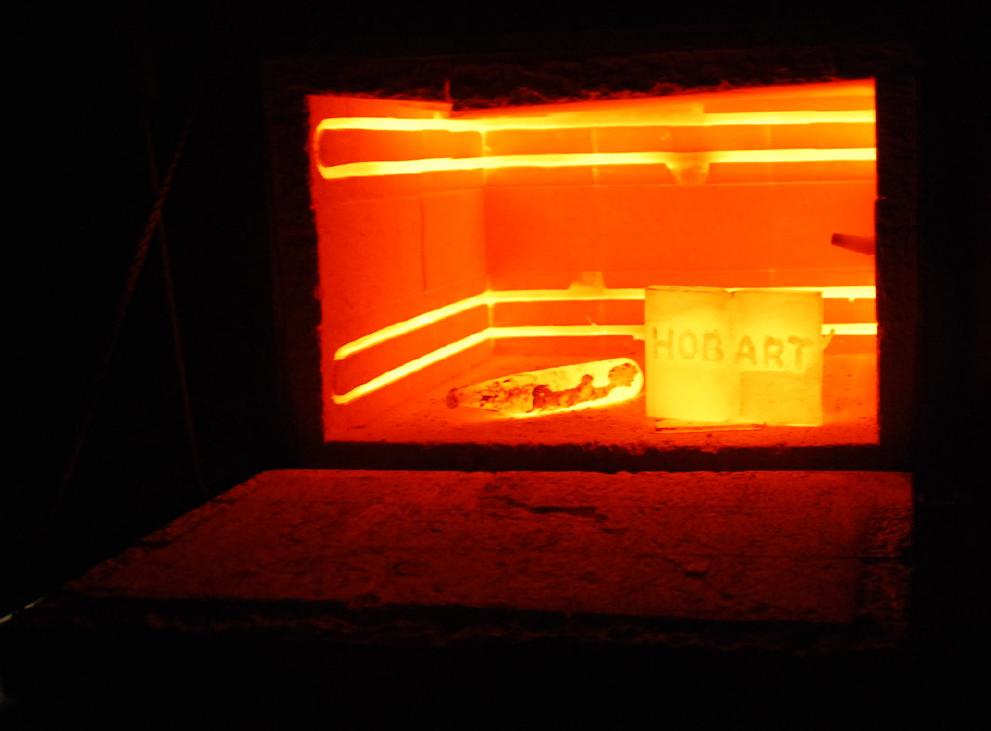
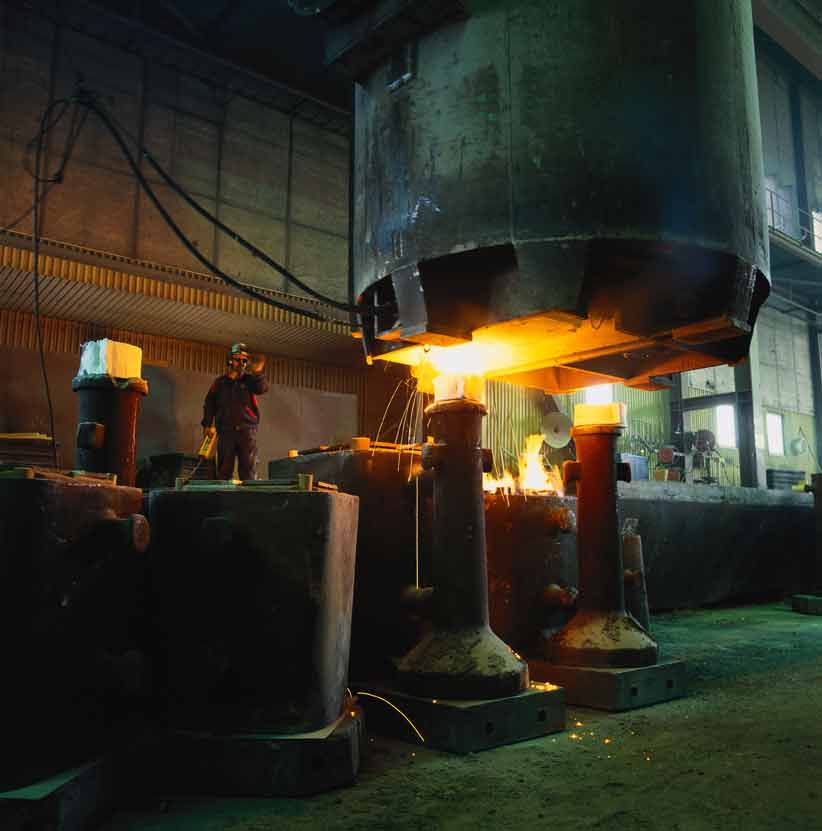

Choose H13 when cyclic heat and mechanical load arrive together
H13 is most convincing when the tool repeatedly contacts hot material, then cools, while still carrying pressure, impact or sliding wear. Typical examples include:
- High-pressure die casting: cavity blocks, inserts, cores, slides, shot sleeves, plungers and ejector pins for aluminium, magnesium or zinc systems.
- Hot forging: press dies, inserts, punches, gripper dies and hot-heading tools exposed to impact plus scale abrasion.
- Hot extrusion: dies, mandrels, stems, liners, dummy blocks and support tooling for aluminium and other alloys.
- Hot cutting and forming: shear blades, hot punches, hot-stamping details and tooling that must resist softening.
- Plastic moulding: high-stress inserts, hot-runner parts and mould components that benefit from through hardness, polishability or nitriding.
The same application name can produce different failure modes. An aluminium die may fail from heat checking, gross cracking, erosion, soldering, washout or softening. Diagnose the failed surface and fracture before automatically ordering harder H13.
Match the material decision to the damage you actually see
Review thermal gradients, preheating of the die, cooling layout, hardness, surface finish and steel toughness. Cleaner/remelted H13 and controlled heat treatment may improve consistency, but operating practice remains critical.
Prioritize toughness, geometry, radii, EDM removal, weld condition and cooling rate. A lower working hardness or an H11-type/higher-toughness grade may be safer than harder H13.
Check hot hardness, temper resistance, support under the insert and actual surface temperature. A higher-hot-strength grade may outperform standard H13 when temperature is the controlling factor.
Steel chemistry alone rarely solves it. Review surface temperature, lubricant, release angle, finish, nitriding, PVD compatibility and the casting alloy/process window.
Review metal velocity, impingement, hardness and surface engineering. A nitrided or coated H13 system may help, but brittle compound layers can create a new failure if poorly specified.
H13 is the baseline—not the automatic winner
| Grade / family | Relative strength | Relative limitation | When to consider it |
|---|---|---|---|
| H13 / 1.2344 type | Balanced toughness, thermal-fatigue resistance, hardenability and hot strength. | Not the maximum in toughness, hot hardness, wear or thermal conductivity. | General die casting, hot forging, extrusion and versatile hot-work tooling. |
| H11 / 1.2343 type | Lower vanadium generally supports toughness and shock resistance. | Usually gives up some wear resistance compared with H13. | Tools where gross cracking or impact is more critical than surface wear. |
| 1.2367 / high-Mo hot-work type | Higher temper resistance and hot strength with carefully engineered toughness. | More expensive and must be heat treated to the supplier’s own curve. | High-thermal-load extrusion, forging or die-casting details where H13 softens or deforms. |
| H21 / tungsten hot-work type | High hot hardness and resistance to softening. | Lower toughness and narrower modern availability/application base. | Special high-temperature wear conditions after supplier review. |
| P20 / prehardened mould steel | Delivered machinable at moderate hardness; economical for large plastic moulds. | Not designed for the same cyclic hot-work duty as H13. | Large mould bases or cavities where high polishability/machining economy matters more than hot strength. |
Comparisons are qualitative. Proprietary grades can be compositionally modified and processed far beyond the generic family baseline; use the supplier’s product data and test method.

Nitriding and PVD can improve the surface without changing the whole tool
Nitriding diffuses nitrogen into the surface to create a hard case over the tougher H13 core. It is commonly used to resist wear, erosion and adhesion on dies, cores, ejector pins and extrusion tooling. The useful case depth, compound-layer condition and hardness must be chosen for the geometry and loading.
A case that is too brittle or too deep for a thin section may crack or spall. Nitriding also cannot repair decarburization, coarse EDM damage, grinding burns, poor polishing or a soft core. The substrate must be correctly hardened and tempered first.
- Gas or plasma nitriding: select by case control, masking, geometry and supplier capability.
- PVD coatings: CrN or AlCrN-type systems may reduce adhesion and improve hot wear, but coating success depends on substrate support, finish and process temperature.
- Duplex treatment: nitriding under a compatible PVD coating can support load, but the two processes must be qualified together.
- Re-treatment: inspect the existing case and crack network before stripping or adding another cycle.
Machining, EDM and weld repair can create the crack that service later reveals
Machining and EDM
Most H13 tooling is rough machined in the soft-annealed condition, stress relieved when needed, hardened and tempered, then finish machined, ground, polished or EDM-finished. Cutting parameters must be adapted to hardness, rigidity, tool overhang, coolant strategy and local machine capability.
EDM can leave a resolidified “white layer,” microcracks and tensile residual stress. On hardened tools, remove the affected layer by controlled grinding, stoning or polishing and follow the steelmaker’s recommended post-EDM tempering practice. A visually smooth cavity is not proof that the damaged layer is gone.
Grinding burns are equally dangerous. Use a suitable wheel, controlled dressing, coolant delivery and inspection method. Sharp transitions, thin fins and deep slots deserve extra stock allowance and thermal-control planning.
Weld repair
H13 can be repaired by TIG, laser welding or other qualified processes, but the procedure must match the tool’s condition. Joint preparation, crack removal, filler compatibility, preheat/interpass control, slow cooling and post-weld heat treatment determine whether the repair becomes a durable restoration or a new HAZ crack.
Uddeholm’s published guidance for an H13-equivalent product distinguishes TIG/MIG/MMA procedures from laser repair and gives grade-specific preheat, filler and post-treatment recommendations. Those values belong to that product and procedure; do not copy them blindly to unknown H13.
Before repair: identify the exact steel, hardness, prior tempering temperature, coating or nitride case, crack depth and reason for failure. Repairing the symptom without removing the cause usually shortens the next service interval.
H13, 1.2344 and SKD61 are commonly cross-referenced—not automatically interchangeable
| System | Common designation | What a buyer should verify |
|---|---|---|
| United States | AISI H13 / UNS T20813 / ASTM A681 H13 | Current ASTM revision, product form, delivery hardness, heat analysis and any supplementary quality requirements. |
| Europe / Germany | 1.2344 / X40CrMoV5-1 | Applicable EN/ISO specification, actual chemistry, melting route and supplier-specific heat-treatment data. |
| Japan | JIS SKD61 | Current JIS specification and whether the supplier’s chemistry/process is intended as a direct H13 substitute. |
| China | GB/T 4Cr5MoSiV1 | Current GB/T standard, quality level, remelting route, dimensional/product standard and certification scope. |
| Proprietary grades | Supplier-specific H13, superior H13 or modified hot-work steel | Do not infer properties from the marketing name. Compare chemistry, toughness method, cleanliness, hardenability and validated heat-treatment response. |
“Equivalent” normally means similar grade intent. It does not guarantee identical allowable chemistry, cleanliness, mechanical response, test method, stock condition or heat-treatment curve.
What to put on an H13 tool steel RFQ
Material and inspection requirements
- Grade & standardASTM A681-24 H13, or the exact governing alternative
- Quality levelConventional, premium, superior, NADCA grade/class or proprietary product
- Product formForged block, plate, round, bar or pre-machined insert
- DimensionsFinal size, machining allowance and grain-flow/orientation requirement
- Melt routePrimary melting, secondary refining and ESR/VAR where required
- Delivery conditionSoft annealed hardness and microstructure acceptance
- CertificationHeat chemistry, heat number, origin and EN 10204/CMTR requirement
- NDTUltrasonic method, scanning coverage, reference standard and acceptance level
- CleanlinessTest method, specimen location/orientation and acceptance limits
- Heat treatmentSteelmaker cycle, target hardness, records, coupons and final inspection
Planning to weld, clean or recondition H13 tooling?
Send the tool grade, hardness, photos, crack or wear location, coating history and desired result. Oceanplayer can help determine whether laser cleaning, laser weld repair trials or another process route should be evaluated before production.
Questions buyers and toolmakers ask
These answers are planning guidance. The drawing, current material standard, supplier data sheet and qualified heat-treatment procedure control production.
What is H13 tool steel used for?
H13 is widely used for aluminium and magnesium die-casting dies, hot-forging dies, hot-extrusion tooling, hot punches, cores, inserts, shot sleeves, plungers, ejector pins and demanding mould components. It is most attractive where cyclic heating, pressure and wear occur together.
What is the typical hardness of H13?
Soft-annealed stock is commonly supplied around 180–235 HB, depending on the product and specification. Hardened and tempered tools often work around 44–52 HRC. The correct target depends on section size, geometry, toughness demand, service temperature and failure mode.
Is H13 stainless steel?
No. H13 contains roughly 5% chromium, far below the chromium level normally associated with stainless steels. It has useful oxidation resistance for hot-work service but can rust in ordinary environments and is not selected as a corrosion-resistant stainless grade.
Is H13 the same as 1.2344 or SKD61?
They are commonly cross-referenced hot-work grades, but “same” is too strong for purchasing. Check the current governing standard, actual heat chemistry, residual limits, delivery condition, melt route, cleanliness and supplier heat-treatment curve.
Can H13 be welded?
Yes, but repair welding must be qualified. The procedure should define crack removal, joint preparation, filler, preheat/interpass control where applicable, cooling and post-weld treatment. The original tempering condition and any nitride or coating layer must be known.
Can H13 be nitrided?
Yes. Nitriding is common for H13 tools because it can create a hard wear-resistant surface over a tougher core. Case depth, compound layer, masking and re-treatment must be matched to the geometry and loading to avoid brittle spalling or cracking.
Does ESR automatically make H13 last longer?
No process guarantees tool life. ESR can improve homogeneity, inclusion control and transverse properties, which may reduce material-related variability. Die design, heat treatment, hardness, cooling, surface finish, operating practice and maintenance can still dominate the result.
What should be on an H13 mill certificate?
At minimum, require the heat number, actual chemical analysis, material grade and standard, product dimensions and delivery condition. Critical dies may also require melt route, cleanliness, toughness, microstructure, ultrasonic inspection and heat-treatment conformance under a named quality program.
What is the price of H13 tool steel?
There is no durable universal price per kilogram. Cost changes with region, dimensions, machining allowance, quantity, mill origin, remelting route, testing, certification, freight and market conditions. Compare quotations on the same specification and usable finished-tool yield—not just gross bar price.
Standards and manufacturer data used for this guide
- ASTM A681-24 — Standard Specification for Tool Steels Alloy. Scope and purchasing framework for wrought alloy tool steels.
- North American Die Casting Association — Technical Standards. Official overview of recommended procedures for high-quality die steel and heat treatment.
- Uddeholm Orvar Supreme product page. H13/1.2344 cross-reference, typical chemistry, property positioning and application areas.
- Uddeholm Orvar Supreme technical brochure. Product-specific heat treatment, physical properties, hardness guidance and machining information.
- Uddeholm Orvar Supreme welding recommendations. Product-specific filler, preheat, cooling and post-treatment guidance.
- ASM Alloy Digest — Crucible Nu-Die V (Type H13). Manufacturer-linked overview of H13 chemistry, properties, heat treatment and applications.
- EOS ToolSteel H13 material data sheet. Useful comparison for H13 chemistry and additive-manufacturing-specific qualification; not a substitute for wrought data.
Technical content is educational and does not replace the controlling material standard, steelmaker instructions, heat treater procedure, die-design review or site safety requirements. Product names are used only to identify published source data.