

3000W CW laser cleaning · production planning guide
3000W CW Laser Cleaning Speed: How to Verify Real Rust-Removal Throughput
A practical guide for maintenance managers, cleaning contractors, shipyards and steel fabricators comparing machines or planning production capacity.
Record rust depth or category, pitting, contamination, geometry and the required final surface.
Do not transfer a flat-panel or light-rust rate to a different workpiece.
Keep the machine record, raw timing, photos, repeat results and rejection reasons.
Do not commit throughput before identifying coatings, residues, heat limits and safety controls.
Test integrity
Why is there no universal 3000W CW rust-removal speed?
A credible test identifies the exact machine, source mode, output setting, scan head, field width, working distance, rust condition, steel geometry, pass count, time scope and acceptance method. If those items are missing, two speed claims cannot be compared fairly—even when both machines say 3000W.
This guide does not invent an Oceanplayer Laser field result or assign one universal production rate to every 3000W CW system. Instead, it gives you a repeatable method for testing a supplier's machine and converting the result into a schedule you can defend.
If a speed claim does not state the rust, surface standard, scan width, passes and time definition, treat it as a demonstration value—not a capacity guarantee.
The throughput funnel
Which laser cleaning speed should you compare?
All three metrics can be valid. Trouble starts when a gross geometry rate is presented as finished production output.
Effective field width × forward travel speed. This is a geometric ceiling, not proof that rust was removed.
Area that passes inspection ÷ laser-on time. It includes passes and rework, but excludes setup and access.
Accepted area ÷ total defined job time. Use this figure for labor, shifts and delivery planning.
Qgross = effective width × forward speed × 3,600 | Qnet = accepted area ÷ total elapsed timeComparison rules
How should supplier speed claims be compared?
| Rate label | How it is calculated | Useful for | What must be disclosed |
|---|---|---|---|
| Gross scan rate | Effective width × forward speed × 3,600 | Checking whether a claimed movement rate is physically plausible | Field width, track overlap, forward speed, pass count and pattern |
| Laser-on accepted rate | Accepted area ÷ laser-on time | Comparing the active removal process | Rust condition, full parameter set, acceptance, rework and inspection |
| Net job throughput | Accepted area ÷ total defined time | Labor, schedule and business-case planning | Setup, masking, access, repositioning, pauses, inspection and cleanup |
| Demonstration rate | Often unclear | Visual proof that a process can remove the layer | Cannot support a production promise until the test conditions are documented |
In a 2025 Norfolk Naval Shipyard report, a CL-1000 team described cleaning one square foot in eight minutes for certain shipyard work—about 0.70 m²/h. That is valuable real-world context, but it is a 1000W-class field report under its own conditions. It must not be multiplied by three to predict a 3000W job.
Interactive planning aid
How do you calculate accepted m²/h and job time?
Use “Accepted test” when you have real sample data. Use “Geometry estimate” only to understand coverage mechanics; it is not a rust-removal guarantee.
Planning boundary: Results are arithmetic based on your inputs. Geometry mode does not prove removal quality, substrate safety, operator repeatability or compliance with a coating-preparation standard.
Why the number changes
What changes 3000W CW laser cleaning speed?
A CW source supplies sustained average power. The workpiece receives that energy through optics, motion, access and time. These six drivers usually explain why two “3000W” demonstrations look very different.
Rust thickness and adhesion
Flash rust, tight oxide, loose scale, pitted corrosion, salt and paint-over-rust need different exposure and pass counts.
What counts as clean
A bright-looking surface is not automatically coating-ready. Residual oxide in pits, roughness and salts may still matter.
Field width and dose
A wider field sweeps more area, but it can reduce local energy delivery. Extra overlap or a slower path may be needed.
Travel, overlap and passes
Starts, stops, corners and inconsistent hand speed reduce accepted coverage. Robot motion is easier to repeat.
Geometry and heat flow
Thin sheet, edges, welds, bolt holes and vertical work change thermal behavior, access and operator pace.
Extraction and workflow
Containment, fume capture, filter condition, window checks, repositioning and inspection all affect daily output.
Rust is not one condition
How does rust condition change the production plan?
Flash rust
State age, coverage, steel condition and whether oil or salt is present. Do not extrapolate this rate to heavy corrosion.
Adherent oxide
Tight oxide can need lower travel speed, more overlap or added passes—especially when the surface standard is strict.
Pitted corrosion
Broad fast passes may clean high points while oxide remains inside pits. Define the pit-cleaning requirement before timing.
Coating over rust
The binder, pigments, hazardous constituents, oil and salt can control both removal rate and extraction requirements.

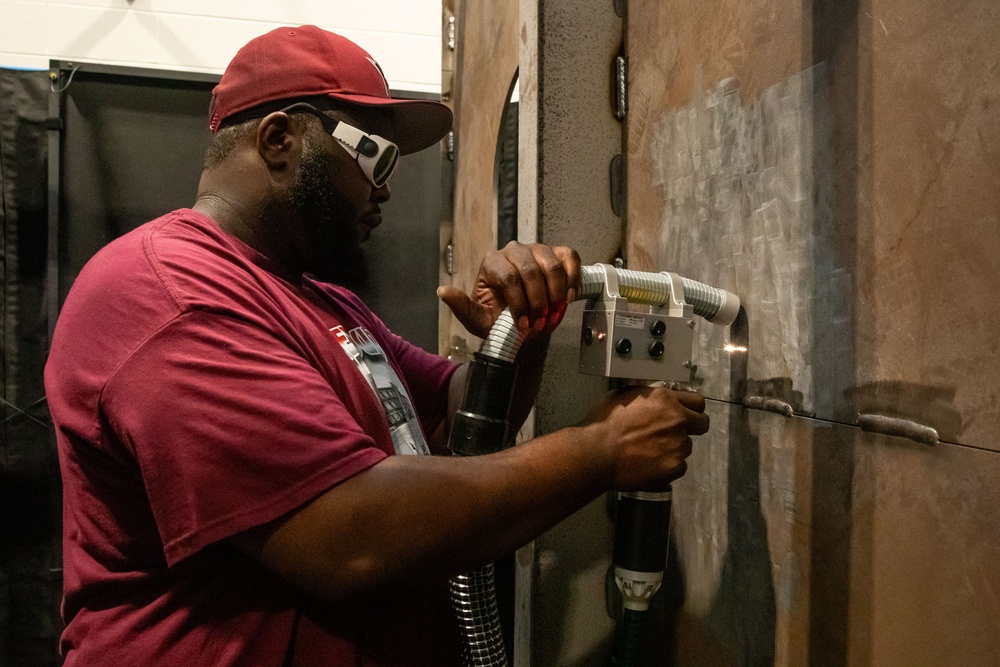
Shipboard testing shows why flat-panel scan speed is not the whole schedule. Photo: Wendy Hallmark, U.S. Navy / NAVSEA, public domain.
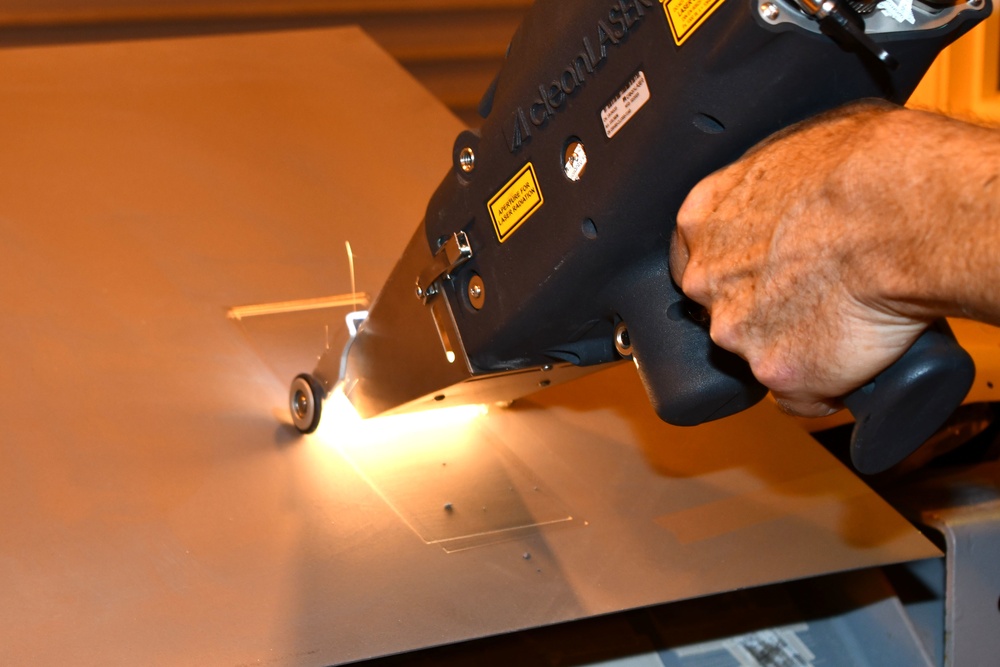
Measure the full area, including edges and rework. Photo: Kimberly Koonce, Fleet Readiness Center East / DVIDS, public-domain U.S. Navy work.
Reproducible test protocol
How do you run a repeatable supplier speed test?
Run the steps in order. Changing the acceptance rule after the laser is switched on makes the result hard to audit.
Define “clean” first.
State the allowed residual rust, pit condition, color or texture change, surface profile, coating-readiness requirement and inspection method.
Select representative parts.
Include real thickness, rust severity, paint or oil, edges, welds, pits, orientation and access limits. Use at least three similar samples.
Lock the machine record.
Record source model, CW mode, set output, wavelength, head, lens, scan width, working distance, pattern, travel, overlap, passes, air and extraction.
Define the clock.
Publish both laser-on time and total job time when possible. State whether setup, repositioning, inspection and cleanup are included.
Clean a measured area.
Keep the path consistent. Preserve raw timestamps and do not edit pauses or extra passes out of the net-throughput calculation.
Inspect the whole result.
Check center, edges, starts, stops, corners and pits. Mark areas that need rework or show heat tint, texture change or residue.
Calculate accepted rates.
Report accepted m² per laser-on hour and per total job hour separately. Keep each rust category separate.
Repeat and report the range.
For handheld work, include more than one trained operator. Report average, range and reasons for outliers—not only the fastest run.
Test report
What must a credible 3000W test report record?
| Record | Minimum detail | Why it matters |
|---|---|---|
| Machine | Model, source, CW mode, wavelength, set and verified output, scan head, lens, cooling condition | Confirms what was actually tested instead of relying on the phrase “3 kW machine.” |
| Sample | Steel type and thickness, measured area, rust category, pitting, coatings, oil, salt, fixture and orientation | Defines the removal challenge, heat sink and access conditions. |
| Program | Power, field width, working distance, pattern, forward speed, overlap, pass count, air and extraction | Makes the result repeatable and exposes quality-versus-speed trade-offs. |
| Timing | Laser-on time, repositioning, inspection, rework, total time and accepted area | Separates active removal speed from usable job throughput. |
| Acceptance | Residual rust, pit condition, surface change, roughness or adhesion checks when relevant, final images | Shows that the timed area met the real requirement. |
Equipment decision
When should you choose a 3000W CW laser cleaner?
Good reasons to test 3000W CW
- Large, robust steel surfaces with significant rust or scale
- Ship, rail, structural-steel and heavy-equipment maintenance
- Workloads large enough to justify water cooling, utilities and controlled-area setup
- Processes where sustained energy and a wide field can improve accepted coverage
- Projects that can supply representative samples and a written acceptance standard
Reasons to compare another route
- Thin sheet, precision molds, finished surfaces or heat-sensitive assemblies
- Small isolated features where broad CW exposure offers little advantage
- Deep pits or complex coating systems that still require multiple cleaning stages
- Sites without suitable electrical supply, cooling, extraction or laser controls
- Requirements that prioritize fine surface control over maximum area productivity
A 3000W unit can provide more available average energy than a 1000W unit, but accepted throughput does not automatically triple. Field width, dose, surface limits, extraction and workflow may become the bottleneck. Compare the 1000W CW vs pulsed guide and run condition-matched tests.

Safety is production time
Which safety controls must be included in production time?
Near-infrared radiation is invisible. Metal can create direct and reflected beam hazards. Rust, paint, plating, oil and residue can create particles, fumes and decomposition products. A speed calculation that ignores controls, containment, extraction pauses and filter changes is not a usable job plan.
- Use a hazard review, controlled-area plan and trained laser-safety oversight appropriate to the exact system and site.
- Control direct and reflected beams with enclosure, barriers, beam stops, access control and suitable procedures.
- Select eyewear and other PPE from the wavelength, output and hazard assessment—not from a generic “laser” label.
- Identify coatings and residues before cleaning; “rust” may hide lead paint, chromates, oil or salts.
- Capture plume at the source and include filter, protective-window and safe-repositioning time in the schedule.
Buyer and RFQ checklist
What should a 3000W CW laser-cleaner RFQ include?
Source model, CW output, wavelength, scan head, lens, field range, working-distance tolerance, cooling, head weight and cable length.
Light, moderate and heavy rust—or your actual coating, pits, welds, edges, geometry and orientation.
Residual oxide, surface alteration, profile, coating readiness and the inspection method used to approve area.
Laser-on accepted rate and net accepted job throughput, each with its exact timing boundary.
Electrical supply, water cooling, compressed air, extraction, containment, PPE, training and site responsibilities.
Define which changes to source, optics, program, part, fixture, operator or acceptance method require retesting.
Continue your evaluation
What should you validate next?
Frequently asked questions
What do buyers ask before accepting a 3000W speed claim?
How fast can a 3000W CW laser cleaner remove rust?
There is no universal rate. Measure the area that passes your agreed cleaning standard divided by a clearly defined time on representative parts. Rust severity, scan width, forward travel, overlap, passes, access, surface standard, extraction and operator handling all change the result.
Is a 3000W CW laser cleaner three times faster than a 1000W model?
Not automatically. It offers more available average power, but throughput may be limited by field geometry, required dose, thermal limits, rust condition, extraction and workflow. Compare condition-matched accepted-rate tests rather than multiplying a 1000W result by three.
Which speed figure should I request from a supplier?
Request net accepted throughput: the area that passes the agreed inspection divided by the full stated job time. Ask the supplier to report laser-on accepted rate separately. A gross scan or swept-area figure is useful for checking motion, but it does not prove rust removal or production capacity.
Can a 3000W CW laser cleaner damage steel?
Yes. Slow travel, repeated passes, tight focus, edge dwell or poor heat management can change color, texture, roughness or shape. Confirm the process with inspection and any required dimensional, roughness, adhesion or functional test.
What should a supplier test report include?
It should include the exact source and optics, steel and rust condition, field width, scan pattern, travel, overlap, working distance, passes, air, extraction, images, time boundary, accepted area, acceptance method and result range across repeat samples.

Our team creates practical guides on laser cleaning, welding, marking and industrial automation. We combine application experience with cited engineering sources to help manufacturers compare materials, evaluate processes and plan equipment trials with clearer requirements.
Technical references
Sources used for this guide
- Oceanplayer Laser: 1000W–3000W CW Laser Cleaner. First-party equipment context for the CW product class discussed on this page. Product specifications are not treated as a universal throughput claim.
- Laser Cleaning for Rust Removal on Mild Steel: An Experimental Study. Experimental evidence that removal depth changes with laser power, scan speed and number of scans.
- Optimization of Nanosecond Pulsed Laser Cleaning of Rust. Evidence that material-removal rate and an acceptable metallic surface depend on a narrow combination of process parameters. This pulsed study is not treated as CW speed data.
- Parameters and Surface Performance of Laser Removal of Rust Layer on A3 Steel. Peer-reviewed work on thresholds, scanning velocity and post-cleaning surface performance.
- Norfolk Naval Shipyard: Laser Ablation Field Report. Real-world context for a CL-1000 field rate and the difference between production work and a flat-panel demonstration.
- NAVSEA: Testing of Laser Ablation for Removal of Coatings and Corrosion. Field evidence on access, fume capture, noise, vibration and the role of laser cleaning within a broader process toolkit.
- OSHA Technical Manual, Section III, Chapter 6: Laser Hazards. Official reference for beam hazards, hazard analysis, controlled areas, ventilation, fumes, vapors and protective measures.
- NIST Laser Safety Program. Official reference for hazard identification, engineering and administrative controls, PPE, control areas, signage and training.
Make the speed claim defensible
Validate throughput on your real workpiece.
Send Oceanplayer Laser the material, dimensions, rust or coating condition, required final surface, target area per shift, site constraints and clear photos. We can use those inputs to define a documented sample trial instead of relying on an unsupported m²/h headline.