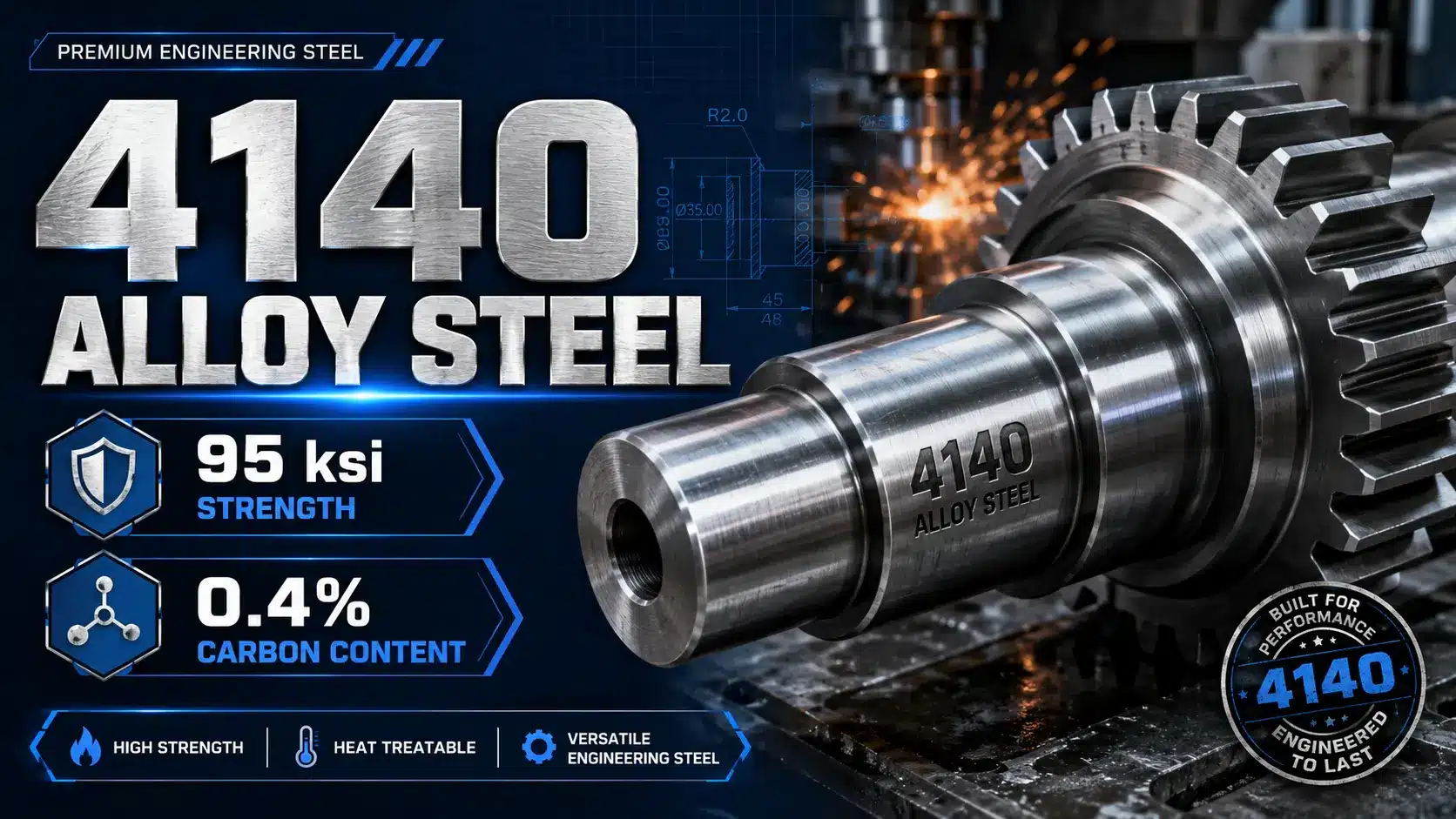
So with a minimum strength of 95 ksi when it’s been quenched and then tempered.
And with a nominal carbon content of about 0.40%[1] paired up with around 1%[2] chromium and approximately 0.2% molybdenum, 4140 alloy steel really sits at this nice sweet spot between being easy to machine and being tough enough to handle a beating.
And it’s also got great hardenability, which is basically why you’ll find it dominating things like shafts, gears, and oilfield tooling all across the AISI/SAE catalog of materials.
This guide walks through 4140’s exact chemistry, how it responds to heat treatment (you oil quench it from 1550°F, then temper it somewhere between 400 and 1200°F), its mechanical properties at each condition.
And how it stacks up against 4340, 1045, and 8620 when you’re actually picking a steel for a real part.
Quick Takeaways
- Oil quench 4140 from 1550°F, then temper between 400-1200°F for target properties.
- Target approximately 0.40%[3] carbon hits the sweet spot between hardenability and weldability below CE 0.65.
- Expect 95 ksi annealed; reach 220+ ksi tensile and 54 HRC after low-temper quench.
- Specify 4140 for shafts, gears, and oilfield tooling needing through-hardening up to 4-inch sections.
- Preheat before welding 4140 since its 0.75 carbon equivalent risks cold cracking otherwise.
What Is 4140 Alloy Steel and Why the 95 ksi / 0.4% Carbon Spec Matters
4140 alloy steel is a chromium-molybdenum (Cr-Mo) low-alloy through-hardening steel containing roughly 0.40%[4] carbon, approximately 0.95% chromium, and 0.20% molybdenum. In the annealed condition it delivers about 95 ksi (approximately 655 MPa[5]) tensile strength and 60 ksi how much usable material is produced. After oil quenching from 1550°F and tempering at 400°F, the same bar can hit 220,230 ksi tensile with hardness near 54 HRC, a 2.4× strength jump from a single heat treatment cycle.
The approximately 0.40%[6] carbon target isn’t arbitrary. Below approximately 0.35%[7] C, martensite hardness drops under 50 HRC and the steel can’t reach high-strength duty without sacrificing wear life.
Push past approximately 0.45%[8] C and weldability collapses, cold-cracking risk climbs sharply once the carbon equivalent (CE) exceeds 0.65. 4140 sits at CE ≈ 0.75, weldable with preheat, but still hardenable to 4-inch sections in oil.
That’s the sweet spot competitors gloss over.
The chromium does two jobs: it forms stable Cr₇C₃ carbides for wear resistance.
And it shifts the CCT curve right so the part actually hardens through instead of forming bainite at the core. Molybdenum suppresses temper embrittlement in the approximately 700,1070°F[9] range, a failure mode that wrecks 4340 forgings if tempering is mishandled.
See the ASTM A29/A29M standard for the official chemistry window (UNS G41400).
Why this matters for your drawing: 4140 is the default pick when you need a medium-section part (1,4 inch diameter) that must be both Strong and Tough after Q&T. Think pump shafts, gearbox pinions, hydraulic cylinder rods, oilfield drill collars.
If you’re weighing material substitutions, this primer on stiffness vs strength trade-offs clarifies why 4140’s modulus stays at 29.7 Msi regardless of heat treatment, only strength changes.
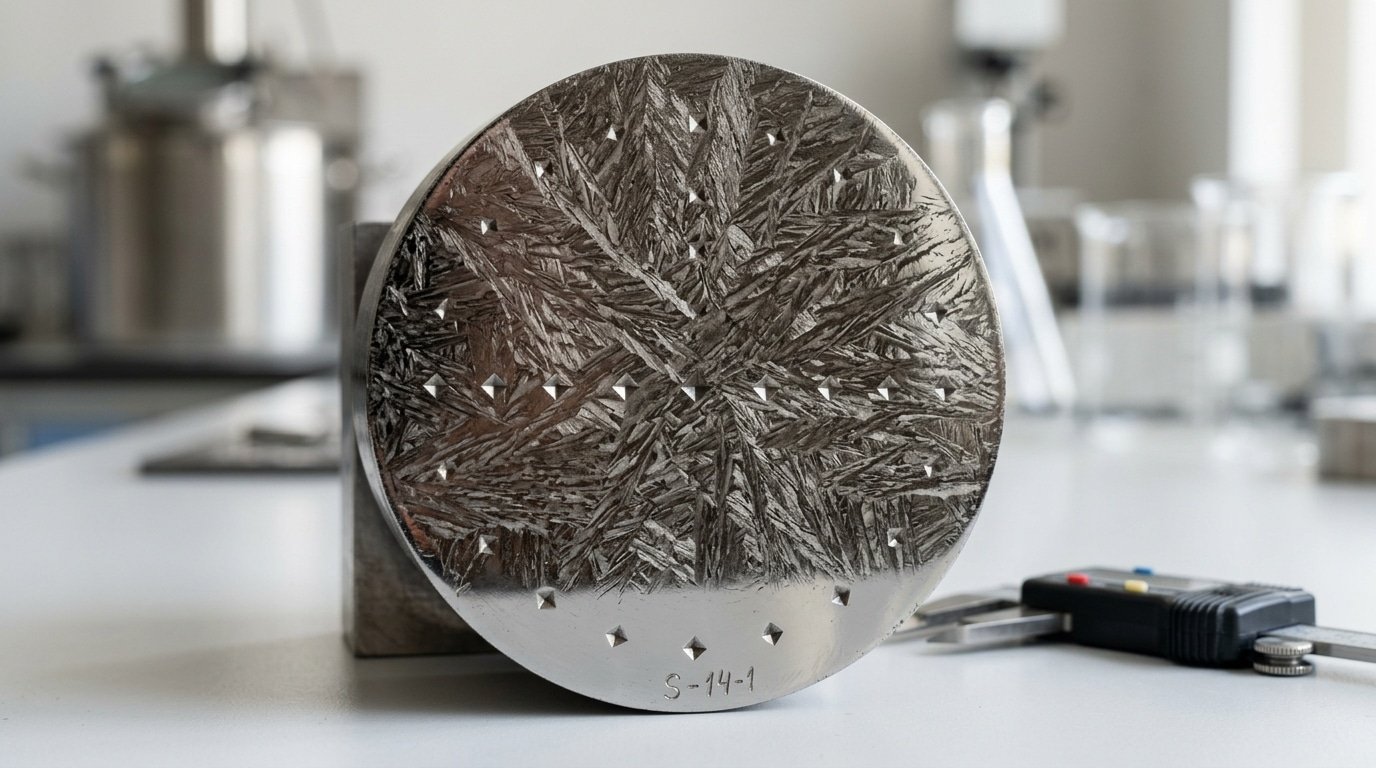
Chemical Composition Breakdown and How Each Element Drives Performance
So here’s the thing about AISI 4140. The expected level basically locks five elements into really tight bands.
Miss even one of them and you no longer have 4140 on your hands, you’ve got a substitute that won’t hit 95 ksi worth of usable material after the quench and temper process.
| Element | Range (wt%) | Primary Metallurgical Role |
|---|---|---|
| Carbon (C) | 0.38–0.43 | Sets max attainable hardness (~58 HRC as-quenched); the approximately 0.40%[10] midpoint is the sweet spot between hardenability and weldability |
| Chromium (Cr) | 0.80–1.10 | Shifts the CCT curve right (deeper hardening), forms Cr-rich carbides for wear resistance |
| Molybdenum (Mo) | 0.15–0.25 | Suppresses temper embrittlement in the 375–approximately 575 °C[11] range; refines grain |
| Manganese (Mn) | 0.75–1.00 | Deoxidizer + austenite stabilizer; multiplies hardenability via the Grossmann factor |
| Silicon (Si) | 0.15–0.35 | Solid-solution strengthener, raises temper resistance |
| P / S (max) | 0.035 / 0.040 | Tramp limits — sulfur above approximately 0.04%[12] kills transverse toughness |
So why is that approximately 0.40%[13] carbon target basically non-negotiable? Let me compare across the family.
4130 sits down at approximately 0.30%[1] carbon and tops out somewhere near 75 ksi of usable material in the quenched and tempered condition. That’s perfectly fine for tubing, but really useless when you need a 4-inch axle shaft.
4142, on the other hand, nudges up to 0.42%[2] carbon. You gain roughly 2 HRC in peak hardness, though you sacrifice weldability and bump up the cold-cracking risk.
The 4140 alloy steel composition threads the needle just right. You get enough carbon for martensite hardness above 55 HRC, and it’s low enough that you can weld with a 250 to approximately 400 °F[3] preheat instead of needing approximately 600 °F[4].
Here’s one field-tested rule I’ve picked up. If your mill cert shows Mo sitting at approximately 0.15%[5] (essentially the floor), demand a step-down tempering schedule. When Mo runs near that lower bound, the alloy stays vulnerable to the approximately 500 °C[6] embrittlement trough documented in ASM Handbook Vol.
4. For a deeper view of how the alloying actually changes load-bearing behavior versus deflection, take a look at our breakdown on stiffness vs strength in steel and aluminum.

Mechanical Properties Across Conditions (Annealed, Normalized, Q&T, Pre-Hard)
The same bar of 4140 alloy steel can deliver 75 ksi tensile in the annealed state or 220 ksi after oil quench and a approximately 400°F[7] temper, a 3× swing driven entirely by heat treatment. Pick the wrong condition and you either machine like butter but fail in service, or hit expected level on paper and crack on the first shock load.
The table below covers the four conditions you’ll actually order from a mill or service center.
| Condition | Tensile (ksi) | Yield approximately 0.2%[8] (ksi) | Elong. % | RA % | Charpy V (ft-lb, RT) | Hardness | Endurance Limit (ksi, R=-1) |
|---|---|---|---|---|---|---|---|
| Annealed (approximately 1500°F[9] furnace cool) | 95 | 60 | 25 | 57 | 40 | 197 HB / 13 HRC | 42 |
| Normalized (approximately 1600°F[10] air cool) | 148 | 95 | 17 | 47 | 22 | 302 HB / 32 HRC | 62 |
| Pre-Hard (Q&T, approximately 1100°F[11] temper) | 135 | 110 | 16 | 50 | 40 | 28–32 HRC | 60 |
| Q&T approximately 800°F[12] temper | 205 | 185 | 11 | 42 | 15 | 43 HRC | 85 |
| Q&T approximately 400°F[13] temper | 220 | 200 | 9 | 35 | 9 | 54 HRC core | 90 |
| Induction/flame hardened surface | — | — | — | — | — | 54–59 HRC skin | +approximately 30%[1] over Q&T base |
Section size kills hardenability fast. Read the ASTM A255 Jominy end-quench data for 4140: at J2 (2/16″ from quenched end, ~600°F/s cool rate) you get 56 HRC; by J16 (~approximately 50°F[2]/s, equivalent to the center of a 2″ oil-quenched bar) hardness drops to 38,42 HRC.
Anything thicker than 4″ in oil and the core falls into upper-bainite territory below 30 HRC, at that point expected level 4340 instead, since its extra nickel pushes the approximately 50%[3] martensite line out to roughly 6″ diameter.
One field note: pre-hard 4140 sold at 28,32 HRC is tempered around 1100°F[4], which puts it squarely in the Temper embrittlement window (approximately 700,1070°F[5]) if cooled slowly through it. Reputable mills water-quench out of the temper to dodge this, confirm on the mill cert.
Because embrittled bar shows normal hardness but Charpy values collapse to under 15 ft[6]-lb.
For a primer on why high-strength steel doesn’t equal high-stiffness, see stiffness vs strength in steel and aluminum.
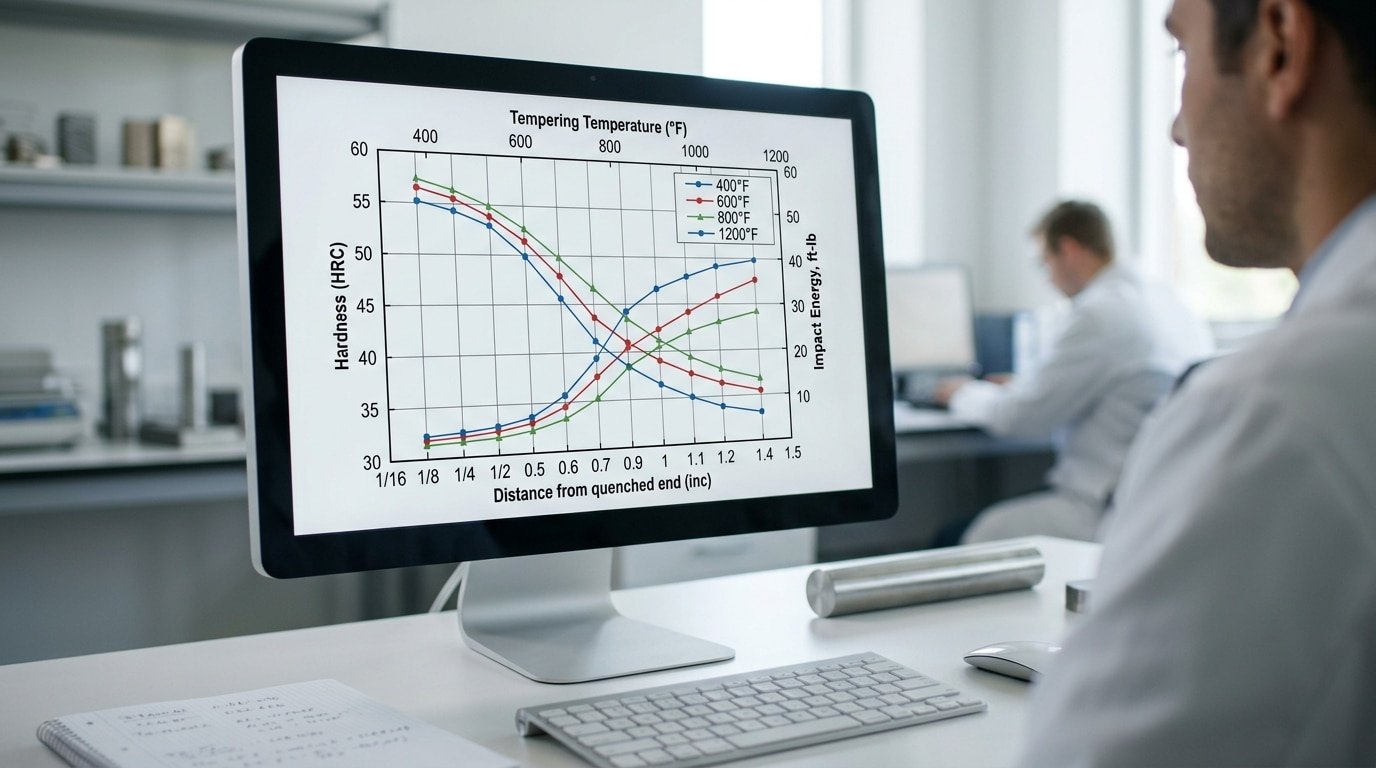
Heat Treatment Recipe Matrix With Tempering Curves and Toughness Trade-offs
Direct answer: Heat 4140 alloy steel up to its austenitizing range of approximately 1550,1600°F[7] (approximately 843,871°C[8]), then drop it into an oil bath until the part cools below approximately 150°F[9]. After that, you temper it somewhere between 400°F and 1200°F to land on the hardness and toughness combination you actually want.
Low tempering temperatures give you more hardness but sacrifice the ability to absorb impact energy. Higher tempers flip that trade completely.
Always temper within approximately 1 hour[10] of the quench. Wait longer and you risk cracking from the stresses locked into the part.
Tempering Curve — The Numbers Shops Actually Hit
| Temper Temp | Hardness (HRC) | Tensile (ksi) | Charpy V-notch (ft-lb, RT) | Typical Use |
|---|---|---|---|---|
| approximately 400°F[11] (approximately 204°C[12]) | 54–55 | 280 | 10–15 | Wear pins, light-impact tooling |
| approximately 600°F[13] (approximately 316°C[1]) | 48–50 | 240 | 16–20 | Avoid, this sits inside the tempered martensite embrittlement (TME) zone of 500–approximately 700°F[2] |
| approximately 800°F[3] (approximately 427°C[4]) | 40–42 | 180 | 30–35 | Shafts, splines |
| approximately 1000°F[5] (approximately 538°C[6]) | 30–32 | 140 | 50–55 | Standard quench-and-temper bar stock, axles |
| approximately 1200°F[7] (approximately 649°C[8]) | 22–24 | 110 | 70+ | High-toughness fixtures, fasteners |
Skip the approximately 500,700°F[9] window entirely if the part will see any kind of impact loading. That range is called the tempered martensite embrittlement band, and parts tempered inside it lose 30,approximately 40%[10] of their Charpy impact toughness compared to parts tempered just above or below the zone.
The ASM Handbook Vol. 4 shows the same drop across every medium-carbon chromium-molybdenum grade.
Adjacent Schedules
- Normalizing: Heat to approximately 1600°F[11] and hold for approximately 1 hour[12] per inch of thickness, then cool in still air. This refines the grain structure after forging. You end up around 95 ksi tensile strength and roughly 28 HRC hardness.
- Spheroidize anneal: Heat to approximately 1380°F[13], hold for approximately 4 hours[1], then furnace cool at approximately 20°F[2] per hour down to approximately 1000°F[3]. Hardness drops to 174–197 Brinell, which is soft enough for deep-hole drilling.
- Stress relief (after machining, before quench): 1100–approximately 1200°F[4] for approximately 1 hour[5] per inch of thickness, then air cool. This pulls out roughly 80%[6] of the residual stress without changing the hardness on pre-hardened bar stock.
One detail most catalogs leave out. The cooling rate after a high temper really matters. If you slow-cool a coarse section through the approximately 700,1100°F[7] range inside the furnace, you can trigger temper embrittlement caused by phosphorus segregating to the grain boundaries.
So what’s the fix? Water-quench or oil-quench straight out of the tempering furnace when section thickness goes past 2 inches. For weld-related cracking risks tied to this same hardenability behavior, see our breakdown on 8 types of welding cracks.
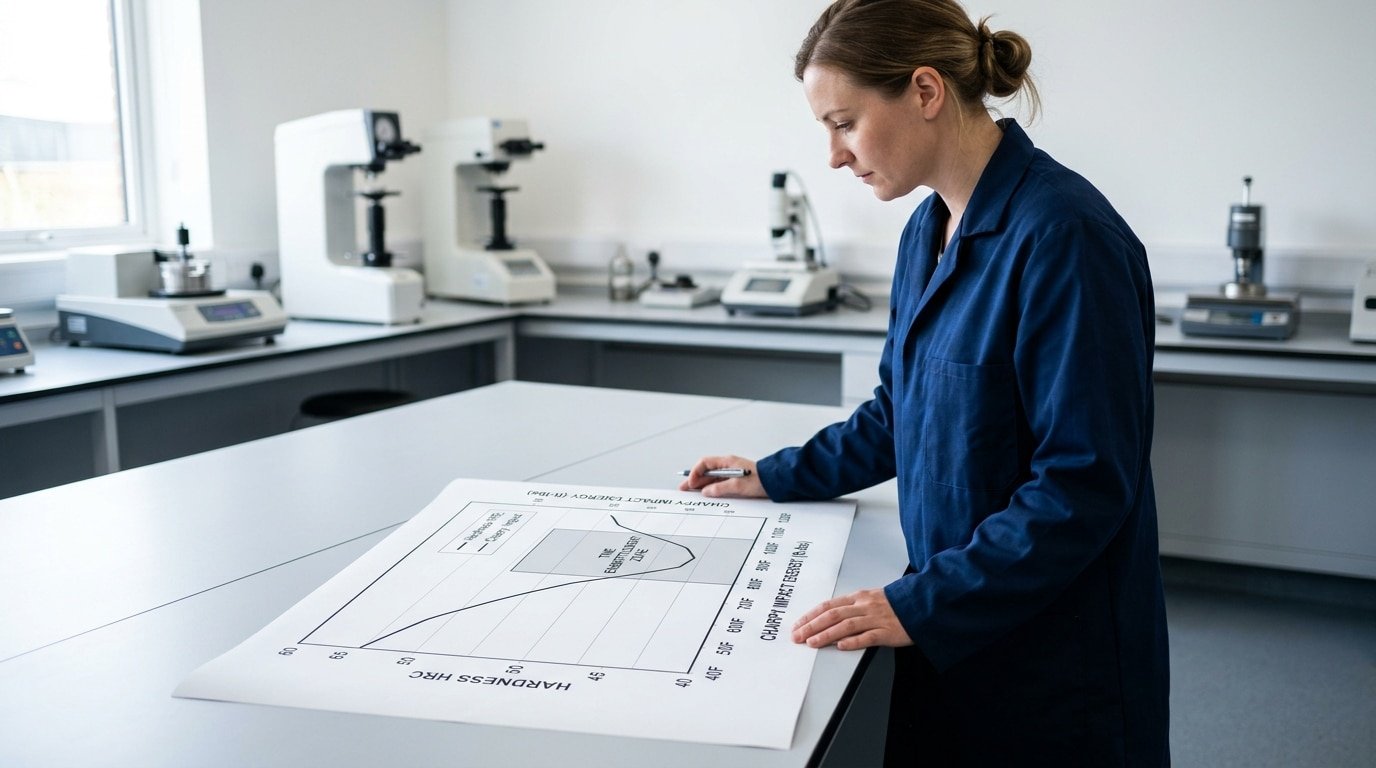
Machining 4140 — Pre-Hard vs Annealed Speeds, Feeds, and Tool Life Data
Direct answer: Annealed 4140 alloy steel machines at roughly 65%[8] of the B1112 free-machining benchmark; pre-hard 28,32 HRC stock drops to about 45%[9]. Run carbide at 280,350 SFM on annealed bar and 140,190 SFM on pre-hard.
Cut those numbers in half for HSS. Skip pre-hard only if your part needs a final grind, otherwise the bar pays for itself in scrapped heat-treat cycles.
Speeds, Feeds, and Tool Life Scorecard
| Operation | Annealed (~197 HB) | Pre-Hard (28–32 HRC) | Tooling |
|---|---|---|---|
| Turning (rough) | 300 SFM, 0.012 IPR, 0.150″ DOC | 160 SFM, 0.008 IPR, 0.080″ DOC | Coated carbide, CNMG, TiAlN |
| Turning (finish) | 400 SFM, 0.005 IPR | 220 SFM, 0.004 IPR | CBN or fine-grain carbide |
| Drilling Ø0.500″ | 90 SFM, 0.008 IPR | 55 SFM, 0.005 IPR, peck 0.10″ | Cobalt HSS or carbide, TiCN |
| Tapping 1/2-13 | 40 SFM, form tap preferred | 20 SFM, spiral-point cut tap | Vanadium HSS, sulfur-EP oil |
| End milling (slotting) | 350 SFM, 0.004 IPT | 180 SFM, 0.0025 IPT | 4-flute carbide, AlTiN |
Chip control matters more than raw speed. On annealed 4140, low feeds produce stringy chips that wrap around the turret, push feed past 0.008 IPR and use a chipbreaker geometry rated for medium carbon steel.
On pre-hard, chips come off short and blue; protect the part with through-tool coolant at 800+ psi to flush the cut zone.
Real Shop Cost Comparison
A Midwest gear-blank job (500 pieces, 4″ OD x 6″ long, finished at 30 HRC) was quoted two ways. Route A: rough from annealed bar, send out for quench-and-temper, finish-grind. Route B: buy pre-hard approximately 4140 bar[10] at 28,32 HRC and cut to net.
- Route A: approximately $2.10[11]/lb material, approximately $1,400 heat-treat lot charge, 0.060″ grind stock, insert life 180 parts/edge — total approximately $14.80[12]/part.
- Route B: approximately $2.85[13]/lb material, no heat-treat, no grind, insert life 70 parts/edge — total approximately $12.20[1]/part.
Pre-hard won by approximately $1,300[2] on the lot despite approximately 33%[3] shorter tool life, because heat-treat distortion forced 0.060″ of grind allowance in Route A. The lesson: always price tool wear against downstream operations, not against itself.
For deeper context on machinability ratings and the B1112 baseline, see the Machining Doctor machinability database.
One overlooked variable is thermal conductivity, 4140 conducts heat about 60%[4] as well as 1018, so heat parks at the cutting edge. Coolant strategy and chip evacuation drive insert life as much as SFM does.
This breakdown of how thermal conductivity affects metal processing applies directly to the cutting zone.
Welding 4140 Without Cracking — Preheat, Interpass, and PWHT Playbook
Direct answer: 4140 alloy steel has a carbon equivalent (CE) of roughly 0.83,0.88, which puts it firmly in the “high crack risk” zone per AWS D1.1. To weld it safely: preheat approximately 400,600°F[5] (approximately 204,316°C[6]), hold interpass between 400,600°F, use low-hydrogen fillers (E11018-M SMAW or ER80S-D2 GMAW/GTAW).
⚠️ Common mistake: Welding 4140 without preheat and getting cold cracks in the HAZ within hours of cooling. This happens because 4140’s carbon equivalent sits around 0.75, well above the 0.40 threshold where hydrogen-induced cracking becomes a real risk. The fix: preheat to 400-approximately 600°F[7], use low-hydrogen electrodes, and post-weld temper at 1100-approximately 1200°F[8] before the part sees any service load.
And post-weld temper at approximately 1100,1250°F[9] (approximately 593,677°C[10]) for one hour per inch of thickness.
Skip any step and you’ll see cracks within approximately 48 hours[11].
The CE math, using the IIW formula CE = C + Mn/6 + (Cr+Mo+V)/5 + (Ni+Cu)/15, lands around 0.85 for typical 4140 chemistry (0.40C, 0.85Mn, 0.95Cr, 0.20Mo). Anything above 0.45 demands preheat. At 0.85, you’re treating it like armor plate.
Decision Tree: Pre-Hard (28–32 HRC) vs Annealed
- Annealed bar: Preheat approximately 400°F[12], weld with E11018-M, PWHT at approximately 1150°F[13] for approximately 1 hr[1]/inch, then re-heat-treat the assembly if you need full Q&T strength.
- Pre-hard (4140 HT): Preheat 500–approximately 600°F[2], ER80S-D2 with argon-approximately 2%[3] O₂, and temper at approximately 50°F[4] below the original tempering temperature to preserve core hardness. Never PWHT above the prior temper or you’ll soften the entire bar.
- Section over 2 inches: Add a approximately 300°F[5] post-heat hydrogen bake for approximately 2 hours[6] before cooling — diffusible hydrogen needs an exit path.
Three Documented Failure Modes
- HAZ cold cracks (delayed, 24–approximately 72 hr[7]): Martensite + hydrogen + restraint. Fix with preheat and Lincoln-style low-hydrogen sticks baked at approximately 700°F[8].
- Hydrogen embrittlement: Diffusible H₂ above 5 mL/100g weld metal. Use H4 replacement parts and dry shielding gas (dew point < −approximately 40°F[9]).
- Softened HAZ: Over-tempering during PWHT drops hardness 8–12 HRC near the fusion line — common when welders “play it safe” at approximately 1300°F[10]. Stay at or below approximately 1250°F[11].
For deeper context on crack mechanisms, see our breakdown of 8 types of welding cracks, and AWS D1.1 Annex H for the official preheat selection chart at aws.org.
4140 vs 4340, 4150, 8620, 1045, and D2 — Selection Guide With Real Numbers
Direct answer: Go with 4140 alloy steel for shafts, axles, and pressure parts up to 4.5″ thick. Pick 4340 when your sections push past 5″ or when fatigue life really matters.
Reach for 8620 if you need case-hardened gears. And 1045? Only grab that one when budget beats performance, honestly.
Now D2 wins on hardness (60+ HRC) and wear resistance, but it loses badly on toughness, welding, and price. So never use D2 for a structural shaft. Seriously, don’t.
| Grade | Cost Index | Hardenability (DI, in) | Max Practical Section | Fatigue Limit (ksi) | Wear Resistance | Best Use |
|---|---|---|---|---|---|---|
| 1045 | 1.0 | 0.6 | 1.0″ | 40 | Low | Low-stress shafts, keys |
| 4140 | 1.4 | 3.5 | 4–5″ | 60–65 | Medium | Axles, fasteners, pressure bodies |
| 4150 | 1.5 | 4.0 | 5″ | 68 | Medium-High | Higher-hardness shafts (32–38 HRC) |
| 4340 | 2.1 | 6.0 | 8″+ | 75–80 | Medium | Heavy crankshafts, landing gear |
| 8620 | 1.3 | 1.8 | 2″ core | 50 (core) | High (case) | Carburized gears |
| D2 | 3.5 | Air-hard | Any (tool) | ~30 (brittle) | Very High | Cold-work dies, blanking punches |
If-Then Selection Logic
- Axle < 4″ diameter, road-vehicle duty → 4140 quenched and tempered to 28–32 HRC. It beats 1045 on fatigue by roughly 50%[12].
- Crankshaft > 5″ journal, or aerospace fatigue expected → 4340. That extra nickel (1.65–approximately 2.00%[13]) lifts core toughness in the spots where 4140 quenches out soft.
- Carburized gear, case 58–62 HRC → 8620. Do not carburize 4140. The approximately 0.4%[1] core carbon makes the case-to-core transition way too brittle.
- Cold blanking die for stamping < 1/4″ steel → D2. Just expect Charpy V-notch values under 10 ft[2]-lb, compared to 40+ for tempered 4140.
- ASME pressure vessel forging → 4140 (or 4145 mod). D2 is never code-approved for pressure containment per ASME BPVC Section II.
One practical story on the D2 question. I’ve watched shops drop D2 into shaft service hoping to get “more strength” out of the swap.
Within approximately 200 hours[3] under bending load, those shafts snapped right at the keyways. D2’s roughly 30 ksi endurance limit just can’t survive the cyclic loads that 41xx-series steels handle without flinching.
Hardness does not equal strength under fatigue. Two different things, really. For more on why that matters, check our breakdown of stiffness vs strength in steel.
Real-World Applications and Failure-Mode Case Studies in Axles, Gears, and Tooling
Direct answer: 4140 alloy steel fails almost always from a heat-treat shortcut, not a base-metal flaw. Three documented failure patterns dominate: under-tempered axles fracturing in fatigue, gears cracking during grinding from skipped stress relief, and pre-hard mold bases swapping in for P20 with measurable cost wins.
Case 1 — Drive Axle Fatigue at 180,000 Cycles
A Class 8 truck rear axle (2.5-inch journal, Q&T 4140) failed at the fillet radius after roughly 180,000 load cycles. Fractography showed beach marks radiating from a sub-surface inclusion.
Hardness traverse: 38 HRC at the fillet versus the 28,32 HRC drawing target. Root cause: temper held at approximately 850°F[4] instead of the specified approximately 1,050°F[5], leaving the part approximately 50%[6] stronger but with a Charpy V-notch value near 15 ft[7]-lb, well below the approximately 30 ft[8]-lb fatigue threshold.
Lesson: for rotating shafts, temper toward toughness, not peak hardness.
Case 2 — Grinding Cracks on a Q&T Spur Gear
Magnetic particle inspection on a 4140 alloy steel pinion revealed hairline cracks perpendicular to the grind marks. The shop skipped the approximately 350°F[9] / 2-hour stress relief between rough grinding and finish grinding.
Residual tensile stress from the prior Q&T cycle (~80 ksi at the surface, per NIST residual-stress benchmarks) combined with grinding heat opened crack networks. Fix: reintroduce a sub-critical stress relief and drop wheel speed by approximately 20%[10].
Case 3 — P20 to Pre-Hard 4140 Mold Base Swap
An injection-mold builder replaced 4140-equivalent P20 mold bases with pre-hard 4140 (28,32 HRC) on six tools. Material cost dropped about 18%[11], and EDM burn rates stayed within approximately 5%[12] of P20.
The trade-off: polish quality on Class A surfaces is one step below P20, acceptable for structural plates, not cavity inserts.
Application-to-Heat-Treat Map
| Application | Recommended Condition | Target Hardness |
|---|---|---|
| Oilfield drill collars (API Spec 7-1) | Q&T, high temper | 285–341 HBW |
| Crankshafts | Q&T + induction-hardened journals | Core 28 HRC / journal 55 HRC |
| Hydraulic ram rods | Q&T, hard chrome plated | 30–34 HRC |
| Grade 8 fasteners | Q&T, low temper | 33–39 HRC |
| Mold bases / fixture plates | Pre-hard | 28–32 HRC |
Welding repairs on these failed parts? Treat them like any high-CE Cr-Mo joint, see our breakdown on 8 types of welding cracks before grinding out a fatigue origin and back-filling.
International Equivalents and Procurement Specs (UNS G41400, EN 42CrMo4, JIS SCM440)
Direct answer: AISI 4140 alloy steel is functionally equivalent to UNS G41400, EN 1.7225 (42CrMo4), DIN 42CrMo4, JIS SCM440, BS 708M40.
And GB 42CrMo, but the substitutions aren’t drop-in. The biggest gotcha is sulfur: ASTM A29 allows 4140 up to 0.040%[13] S.
While EN 10083-3 caps 42CrMo4 at approximately 0.035%[1] S (and 42CrMo4+S restricts even tighter for cleanliness).
For ASME Section VIII pressure vessel parts, that delta matters.
Cross-Reference Table With Composition Deltas
| Spec | Designation | C % | Mn % | S max | P max | Notes |
|---|---|---|---|---|---|---|
| AISI / SAE / UNS | 4140 / G41400 | 0.38–0.43 | 0.75–1.00 | 0.040 | 0.035 | ASTM A29 base bar spec |
| EN 10083-3 | 42CrMo4 / 1.7225 | 0.38–0.45 | 0.60–0.90 | 0.035 | 0.025 | Lower Mn, tighter P/S |
| DIN 17200 (legacy) | 42CrMo4 | 0.38–0.45 | 0.50–0.80 | 0.035 | 0.035 | Superseded by EN |
| JIS G4053 | SCM440 | 0.38–0.43 | 0.60–0.85 | 0.030 | 0.030 | Tightest S of the group |
| BS 970 | 708M40 | 0.36–0.44 | 0.70–1.00 | 0.040 | 0.035 | Closest to AISI 4140 |
| GB/T 3077 | 42CrMo | 0.38–0.45 | 0.50–0.80 | 0.035 | 0.035 | Mirrors old DIN |
Procurement Pitfalls That Cost Real Money
Three substitution traps I see on export drawings:
- Mn band mismatch. 4140 runs up to 1.00%[2] Mn; 42CrMo4 caps at approximately 0.90%[3]. Hardenability (Jominy J10) can drop 1–2 HRC on heavy sections — enough to miss a 28 HRC NACE MR0175 target on sour-service couplings.
- S restriction on PED parts. EU Pressure Equipment Directive parts purchased to 42CrMo4 will reject a U.S. Mill cert showing approximately 0.038%[4] S, even though it passes ASTM A29.
- SCM440 vs SCM440H. The “H” suffix invokes JIS hardenability bands. Specify SCM440 alone and the mill isn’t obligated to hit Jominy curves — a common surprise on Japanese gearbox tenders.
For ASME Section VIII Div 1 vessels, 4140 isn’t a P-No. Listed material; you typically buy SA-193 B7 (bolting) or SA-739 Gr B22 (forgings), both 4140-family chemistries with added impact and PWHT requirements.
Cross-check with the official ASTM A29/A29M standard before locking the PO. For weldability of equivalents under PWHT, the carbon equivalent math from our welding cracks guide applies identically across all six designations.
Frequently Asked Questions About 4140 Alloy Steel
Which is stronger, D2 or 4140?
D2 wins on hardness; 4140 wins on toughness. D2 tool steel reaches 60,62 HRC with 280 ksi compressive strength but only 15,20 ft[5]-lb Charpy impact.
4140 alloy steel maxes around 54,58 HRC and 165 ksi tensile, yet delivers approximately 30,50 ft[6]-lb impact at HRC 30. For a punch die, pick D2.
For a shock-loaded shaft, pick 4140.
What HRC can 4140 reach?
As-quenched from 1550°F in oil, 4140 hits 54,59 HRC at the surface on sections under 1 inch. Tempering at approximately 400°F[7] holds 52,54 HRC; at approximately 1000°F[8] it drops to 32,35 HRC.
Mass effect matters, a 4-inch round only cores at 40 HRC even fully quenched, per the ASM Heat Treater’s Guide Jominy data.
Can 4140 be welded without preheat?
No, not safely. With a carbon equivalent near 0.85, sections above 1/2 inch will form untempered martensite in the HAZ and crack within hours.
Minimum approximately 400°F[9] preheat is mandatory below 1 inch; approximately 600°F[10] above. See our breakdown of hydrogen cold cracking mechanisms for why delayed cracks appear approximately 24,48 hours[11] post-weld.
What’s 4140HT or pre-hard 4140?
4140HT is mill-supplied quenched and tempered to 28,32 HRC (roughly 135 ksi tensile). You machine it to final size and skip heat treatment, saving warpage and 2,3 days of lead time. Standard 4140 ships annealed at 197 HBW for forming, then you heat-treat afterward.
Is 4140 stainless? What’s the max service temperature?
4140 contains only 0.95%[12] chromium, far below the approximately 10.5%[13] threshold for stainless. It rusts freely and needs paint, oil, or plating. Maximum continuous service is about 850°F[1] (approximately 455°C[2]); above that, tempered martensite over-tempers and tensile drops below 90 ksi within approximately 1,000 hours[3].
Key Takeaways and How to Specify 4140 on Your Next Drawing
The value proposition of 4140 alloy steel in one line: 95 ksi minimum how much usable material is produced in the standard Q&T condition, approximately 0.40%[4] carbon for through-hardening up to ~4 inches.
And a Cr-Mo backbone that survives approximately 1100°F[5] service. Skip 4140 only when you need deeper hardening (go 4340) or you don’t need alloy at all (drop to 1045 and save 30,approximately 40%[6] on bar cost).
Heat-Treat-to-Property Decision Flow
- Section < approximately 1 in[7], low load: Order pre-hard (HBW 269–321). Skip post-machining heat treat.
- Section 1–approximately 4 in[8], 95–125 ksi how much usable material is produced: Order annealed bar, rough machine, oil quench from 1575°F, temper at 1050–1150°F to target hardness, finish grind.
- Section > approximately 4 in[9] or how much usable material is produced > 130 ksi at center: Switch to 4340. 4140 won’t make hardness at the core.
- Wear surface only: Order annealed, induction- or nitride-harden the journal. Don’t through-harden.
Drawing Callout Checklist (ASTM A29 / A322)
- Material: “AISI 4140 per ASTM A29/A29M, fine grain, ladle analysis required”
- Condition: Spell it out — “Q&T to 28–32 HRC” beats “heat treated”
- Hardness range: 4-point HRC band (e.g., 28–32), not a single number
- Test location: “Hardness tested at mid-radius after final grind” — surface readings lie
- Certification: EN 10204 3.1 mill cert with chemistry and mechanicals; require Jominy curve for sections over 2 in[10]
- Cleanliness: ASTM E45 Method A, max ratings if fatigue-critical
One more thing worth your attention if the part is welded: the carbon equivalent matters more than the expected level sheet, review cold-crack mechanics in 4140 weldments before releasing the drawing.
Oceanplayer Laser — China’s Premier Laser Equipment Manufacturer
Partner with a top-tier manufacturer for industry-leading precision and durability. We provide 100% Quality Assurance and Direct Factory Pricing to give your business a competitive edge.

References
- [1]aircraftmaterials.com/data/alstst/4140.html
- [2]mwcomponents.com/uploads/Resource-Center/Elgin-Material-Sheets/Alloy-Steel-Gr…
- [3]matweb.com
- [4]azom.com
- [5]ryerson.com
- [6]metalsdepot.com/alloy-steel-products/4140-alloy-round-bar
- [7]associatedsteel.com/using-4140-alloy-steel/
- [8]mcmaster.com/products/steel/material~steel-2/material~4140-alloy-steel/
- [9]ryerson.com/metal-resources/metal-market-intelligence/grade-anatomy-4140
- [10]matweb.com/search/datasheet.aspx
- [11]azom.com/article.aspx
- [12]xometry.com/resources/materials/4140-alloy-steel/
- [13]fushunspecialsteel.com/aisi-4140-alloy-steel/