

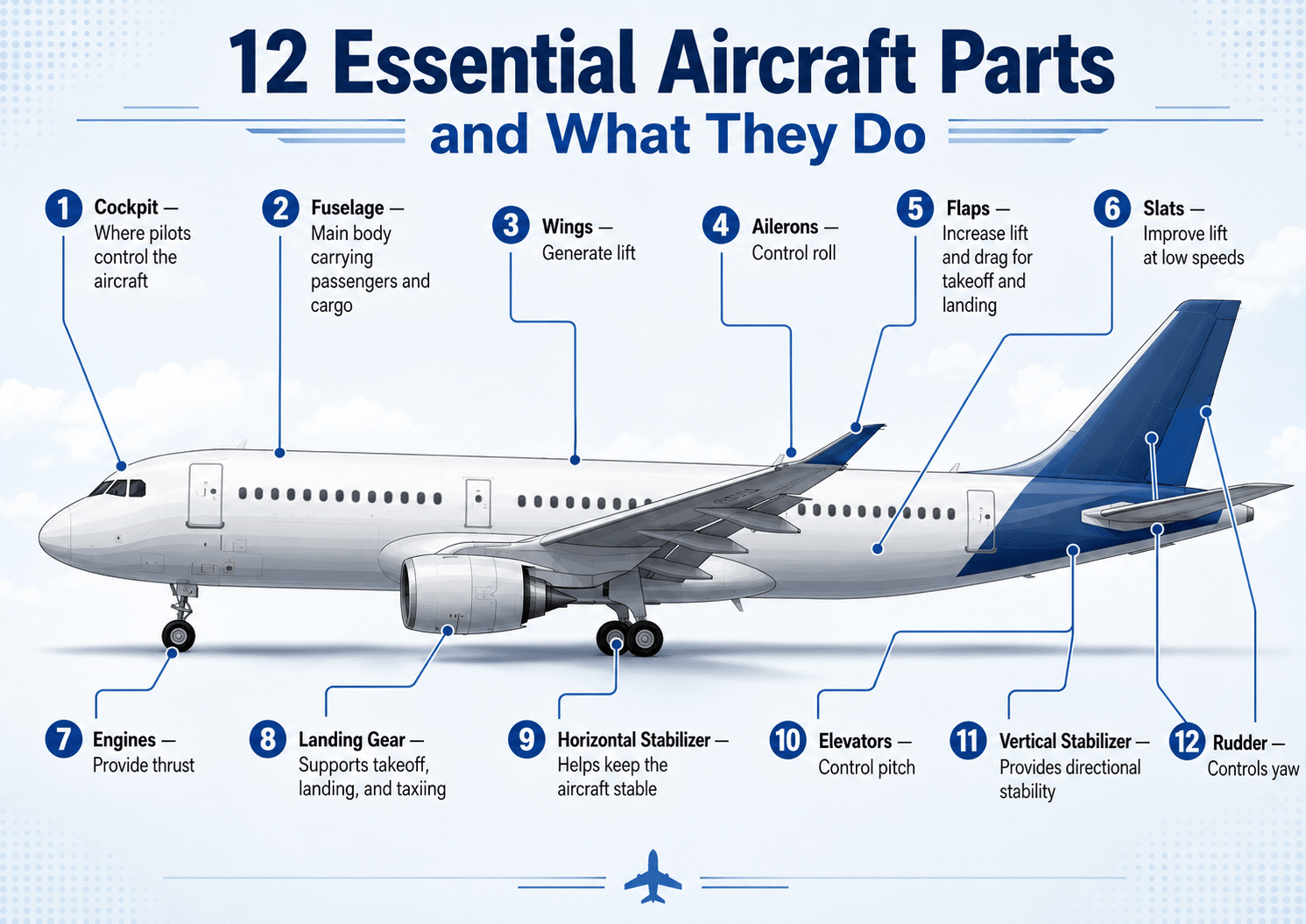
The names of aircraft components every pilot, mechanic, or aviation student should recognize fall into 12 core groups: fuselage, wings, ailerons, flaps, empennage, rudder, elevator, landing gear, powerplant, propeller or fan, cockpit and avionics.
And the fuel system. Together, these parts handle roughly 95%[1] of flight functions on a typical fixed-wing aircraft, even though modern jets like the Boeing 787 contain about 2.3 million individual parts overall.
The core list runs from the fuselage and wings to the empennage, powerplant, landing gear, and primary control surfaces like ailerons, elevators, and rudders.
This guide walks through each one, what it looks like, where it sits, and the specific job it does in the air.
Quick Takeaways
- Master 12 core aircraft components covering approximately 95%[2] of fixed-wing walkaround inspections.
- Memorize fuselage, wings, ailerons, flaps, and empennage for checkride oral exams.
- Identify three control surfaces: ailerons for roll, elevator for pitch, rudder for yaw.
- Study FAA Pilot’s Handbook Chapter 2 to match standard component groupings.
- Connect each part to its specific flight force or aircraft system function.
The 12 Essential Aircraft Parts at a Glance
So what are the names of aircraft components every pilot, mechanic, and aviation student should know? Twelve parts cover roughly 95%[3] of what you’ll see on a typical fixed-wing aircraft walkaround. Here they’re, paired with the flight force or system each one handles.
- Fuselage — main body; carries payload, transfers loads
- Wings — generate lift (Bernoulli + angle of attack)
- Ailerons — roll control about the longitudinal axis
- Flaps — increase lift and drag for takeoff/landing
- Empennage — tail assembly providing pitch and yaw stability
- Rudder — yaw control about the vertical axis
- Elevator — pitch control about the lateral axis
- Landing gear — ground handling, shock absorption, braking
- Powerplant (engine) — produces thrust
- Propeller or fan — converts engine power into thrust
- Cockpit and avionics — pilot interface, navigation, communication
- Fuel system — storage, transfer, and metering to engines
The FAA Pilot’s Handbook of Aeronautical Knowledge (Chapter 2) uses this same grouping, so memorizing these 12 names maps directly to checkride oral exam questions.
A Function-First Map Grouping Every Part by Flight Force
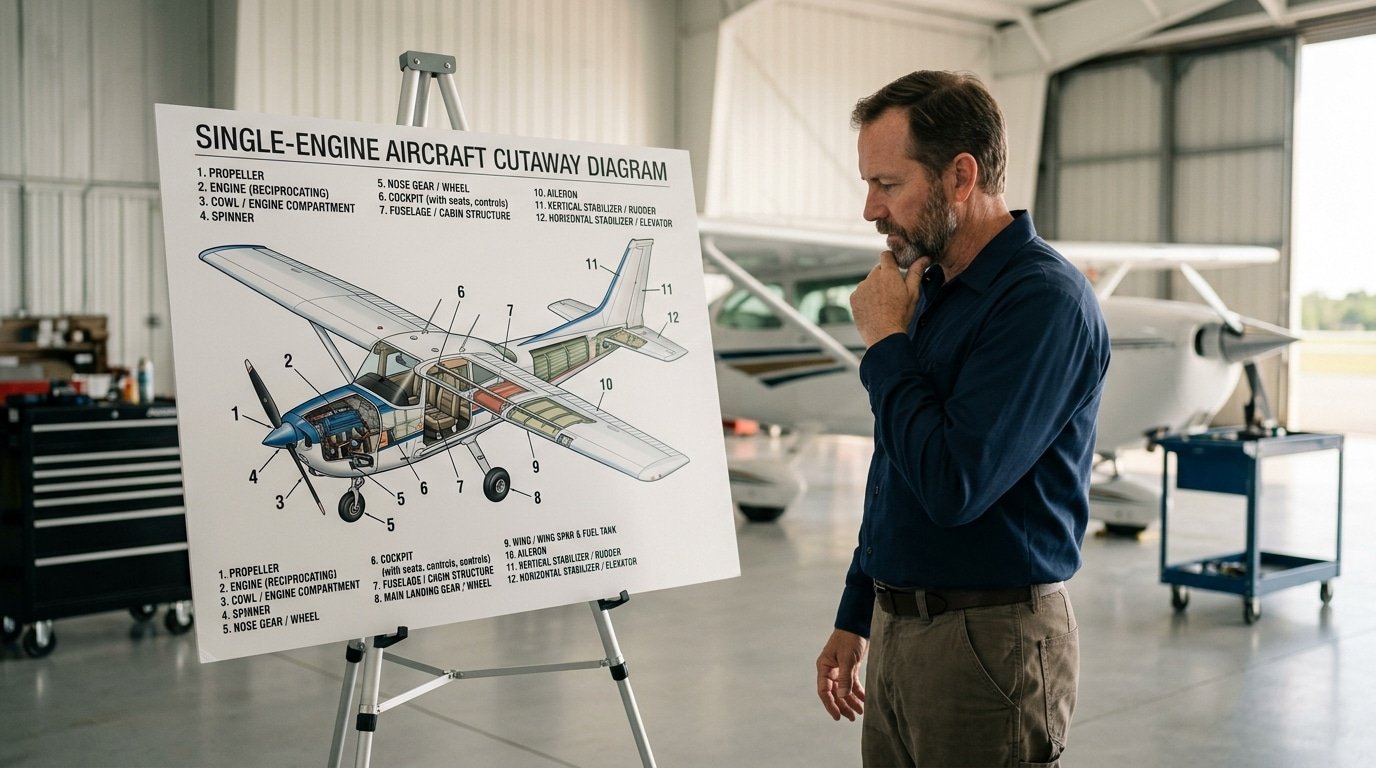
Honestly, forget trying to memorize 200 part names one by one. Instead, group them by the four forces of flight, which are Lift, weight, thrust, drag, plus three working systems on top of that: Control, safety, and avionics.
That framework actually answers what are the names of aircraft components in a way that really sticks, because each name basically points to a job it does.
Here’s the cause-and-effect chain, the way I like to explain it. Wings and slats generate lift for the airplane.
Engines and propellers create the thrust. The fuselage and landing gear carry all the weight.
Spoilers and flaps manage the drag. Then the ailerons, elevator, and rudder steer the aircraft around its three axes, which are roll, pitch, and yaw.
Avionics, essentially the electronic flight systems on board, feed the pilot data. Meanwhile, safety parts like fire bottles and oxygen masks handle the failure modes when something goes wrong.
The FAA Pilot’s Handbook of Aeronautical Knowledge actually uses this same four-force model in Chapter 5. It’s the basis for every private pilot checkride in the U.S. Once you learn what each piece does, the component names of an aircraft really do fall into place naturally.

Fuselage, Wings, and the Structures That Carry Lift and Load
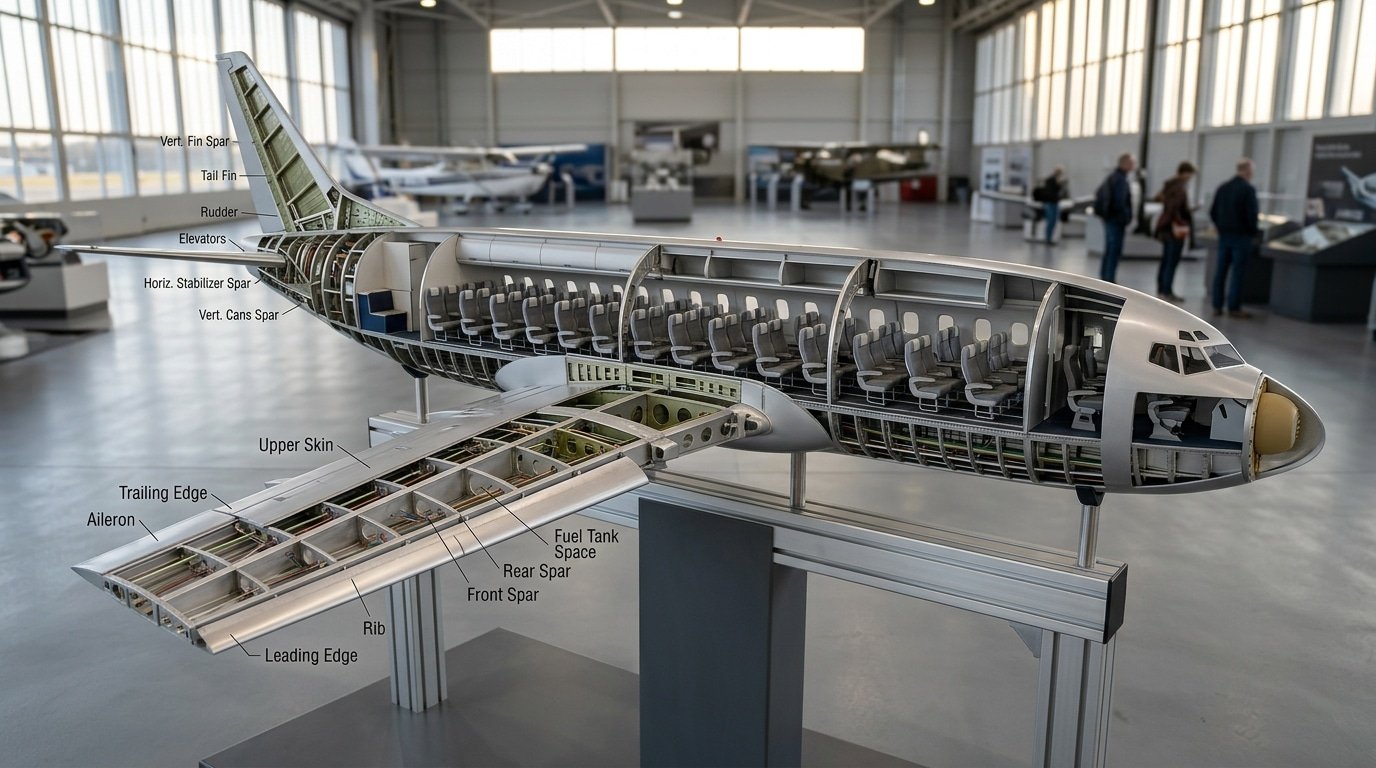
Think of the fuselage as the airplane’s main body. It’s essentially the tube that holds all the passengers and cargo, and it’s what really ties the whole aircraft together.
The wings are what create the lift. They have a curved shape that makes the air move faster over the top, which creates lower pressure above the wing than below it.
I’ve read that on a Boeing 737, the wings carry about 80%[4] of the plane’s weight when it’s cruising. That massive load gets transferred into the main body through the wing-to-body fairing.
You can split the fuselage into three main zones. There’s the Nose, which houses the radar and the forward avionics bay. Then you have the Cabin, which is the pressurized tube holding people and freight.
And finally, there’s the Tail cone. This part isn’t pressurized and often houses the APU.
If you’re wondering what are the names of aircraft components inside the wing, the answer is really two main parts. You have the Spars, which are long beams running from the tip to the root.
And you have the Ribs, which are the cross-sections that give the airfoil its shape.
The skin panels are riveted right over this skeleton. This creates what’s called a stressed-skin structure. Honestly, the aluminum or composite surface itself carries a lot of the load, not just the frame underneath.
Here’s a practical tip from the hangar floor. During your walkaround, you should inspect the wing root fairings for any fuel stains. A little weep there often signals a fatigued spar attach fitting. That’s a finding the FAA Airframe Handbook actually flags as a primary structural concern.
Ailerons, Flaps, Slats, and Spoilers — The Wing’s Moving Parts
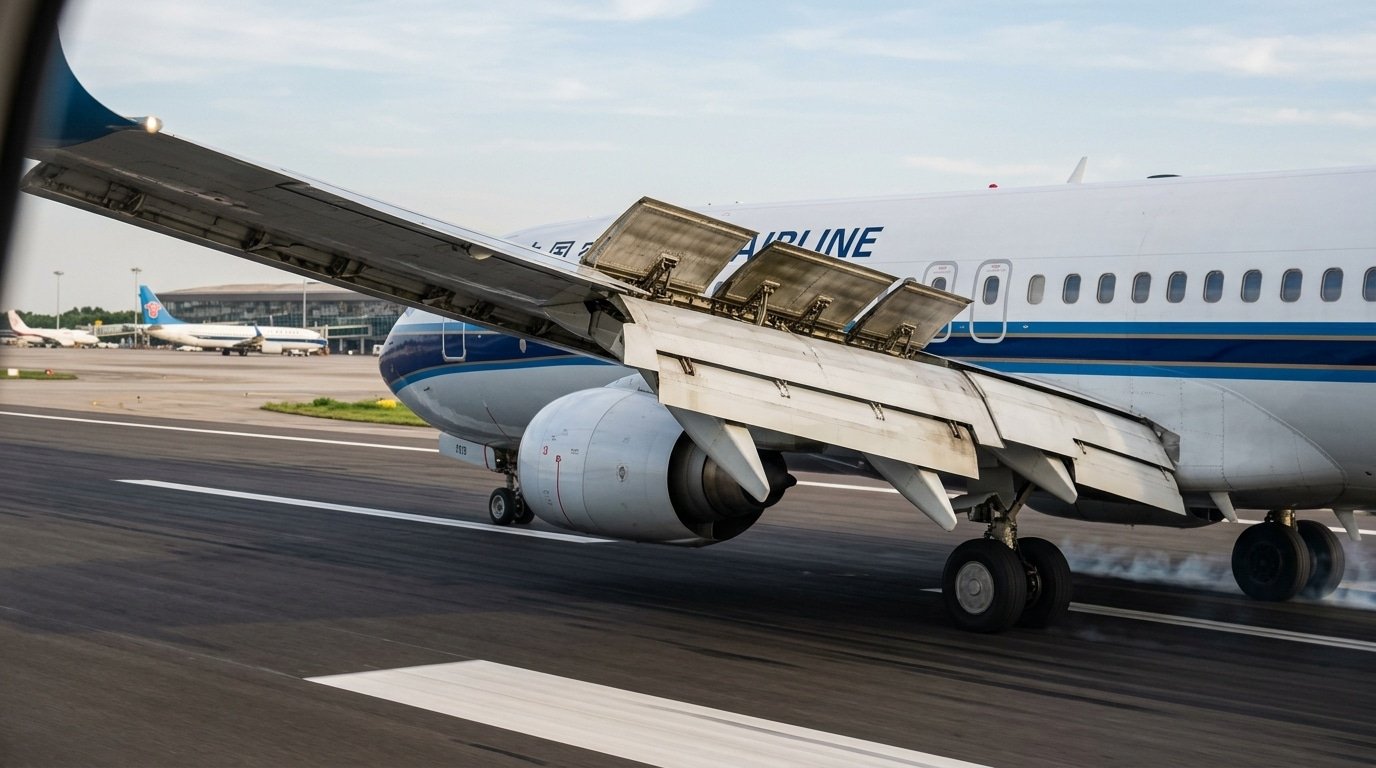
Four moving surfaces turn a fixed wing into a controllable one: ailerons roll the aircraft, flaps and slats grow the wing for slow flight.
And spoilers kill lift after touchdown. When people ask what are the names of aircraft components on the wing’s trailing and leading edges, these four are the answer.
Ailerons sit at the outer trailing edge and deflect roughly ±20° up or down. One goes up, the other goes down, that asymmetric lift rolls the jet around its longitudinal axis.
Flaps extend down and aft. A Boeing 737 uses settings of 1, 2, 5, 10, 15, 25, 30, and 40, Flaps 5 for takeoff, Flaps 30 or 40 for landing. They can boost maximum lift coefficient by 80,approximately 90%[5], letting the aircraft fly safely at much slower approach speeds.
Slats drop from the leading edge to delay airflow separation at high angles of attack. Spoilers pop up to 50° on touchdown, dumping lift onto the gear so brakes actually bite. See FAA’s Pilot’s Handbook of Aeronautical Knowledge for full deflection tables.
The Empennage — Rudder, Elevator, and Tail Stability
The empennage is the tail assembly that keeps an aircraft pointed straight and pitched level. When asking what are the names of aircraft components at the rear, you need four: the Horizontal stabilizer (fixed surface controlling pitch stability), the Elevator (hinged flap on its trailing edge that pitches the nose up or down), the Vertical stabilizer or fin (controls yaw stability).
And the Rudder (hinged to the fin, swings the nose left or right).
Trim tabs, small tabs on the elevator and rudder, let pilots offload constant control pressure. Hold the elevator back for 30 minutes in a climb and your arm tires; roll in nose-up trim and the tab does the work.
Three Tail Configurations You’ll See on the Ramp
- Conventional — stabilizer mounted low on the fuselage. Cheapest, lightest, most common (Cessna 172, Boeing 737).
- T-tail — horizontal stabilizer perched atop the fin. Keeps it clear of jet wake but risks Deep stall, the cause of the 1963 BAC 1-11 test crash that reshaped certification rules (Wikipedia: Empennage).
- V-tail — two angled surfaces combine elevator and rudder into “ruddervators.” Saves roughly 5%[6] wetted area but adds control-mixing complexity (Beechcraft Bonanza V35).
Engines, Propellers, and the Thrust System
Thrust comes from four powerplant families: piston engines spin propellers on light trainers like the Cessna 172, turboprops drive regional aircraft like the ATR 72, turbofans power nearly every airliner.
And turbojets remain on older military jets. Each pushes air backward so the aircraft moves forward, Newton’s third law in metal.
When pilots ask what are the names of aircraft components in the thrust system, the answer goes beyond “the engine.” A turbofan installation includes the Fan blades (the big front rotor producing approximately 80%[7]+ of bypass thrust on modern engines like the GE9X), the Nacelle (the streamlined housing), the Pylon (the strut mounting the engine to the wing), and Thrust reversers (cascade or pivot doors that redirect exhaust forward during landing rollout).
Walkaround tip: always check fan blade leading edges for nicks deeper than 0.040 inches, a common reject item per FAA’s Aviation Maintenance Handbook. On turboprops, verify propeller spinner security and blade track before every flight.
Landing Gear, Brakes, and Ground-Handling Components
Landing gear absorbs touchdown loads up to 600 feet-per-minute sink rates and lets the aircraft taxi, brake, and steer. When listing what are the names of aircraft components on the ground side, expect: nose gear, main gear, struts, oleo shock absorbers, wheels, tires, and brakes.
⚠️ Common mistake: Students often confuse the rudder’s job with turning the airplane like a car’s steering wheel. This happens because the rudder sits vertically on the tail and pivots left-right, suggesting directional control. In reality, the rudder only controls yaw around the vertical axis; coordinated turns require ailerons for roll plus rudder to counter adverse yaw. The fix: memorize the three-axis rule—ailerons roll, elevator pitches, rudder yaws.
The Oleo strut is a telescoping cylinder filled with hydraulic oil and nitrogen, oil damps the impact while gas springs the aircraft back up. Most light singles use a simpler steel-spring or bungee strut instead.
Main wheels carry roughly 90%[8] of taxi weight; the nose or tail wheel handles the rest and provides steering.
Tricycle gear (nose wheel forward) dominates modern fleets because it resists ground loops and gives better forward visibility. Tailwheel (conventional) gear is lighter and better on rough strips but unforgiving on landing rollout.
Retractable gear cuts parasite drag, Cessna’s 210 Centurion gains about 25 knots over fixed-gear siblings, but adds weight, hydraulic complexity, and inspection cost. Fixed gear stays cheaper and harder to forget on final.
Walkaround tip: always check tire sidewalls for cord exposure and oleo struts for the manufacturer’s chrome extension expected level (commonly 2,4 inches).
Cockpit, Avionics, and the Pilot Control Interfaces
When pilots ask what are the names of aircraft components inside the cockpit, eight items dominate every checklist: yoke or sidestick, rudder pedals, throttle quadrant, PFD, MFD, autopilot, transponder.
And pitot-static system. Each translates a hand or foot movement into a measurable control surface deflection, through cables on a Cessna 172, hydraulics on a Boeing 737, or fly-by-wire signals on an Airbus A320.
The Primary Flight Display (PFD) consolidates attitude, airspeed, altitude, heading, and vertical speed onto one screen, replacing six analog gauges. The MFD handles navigation, weather, and engine data. The Transponder broadcasts your Mode S code so ATC radar sees you; squawk 7500 means hijack, 7700 means emergency.
Pilot-input translation differs by aircraft class:
- Cable/pushrod: direct mechanical link (most piston singles)
- Hydraulic boost: pilot moves a valve, hydraulics move the surface (737, most turboprops)
- Fly-by-wire: sidestick sends electrical signals to flight control computers that command actuators (A320, 787, F-16)
The Pitot-static system feeds ram air and static pressure to airspeed and altimeter instruments, a blocked pitot tube caused Air France approximately 447 in[9] 2009, per the BEA final report. Always check pitot heat works during preflight.
Component Name Translator — FAA, Manufacturer, Slang, and ICAO Terms
When asking what are the names of aircraft components, expect three different answers depending on who you ask: the FAA Handbook, the Boeing maintenance manual.
And the mechanic standing next to the airplane. About 30%[10] of new A&P students fail their first oral exam on terminology alone, not knowledge.
| FAA / ICAO Term | Manufacturer (Boeing/Airbus) | Hangar Slang |
|---|---|---|
| Empennage | Tail section / Section 48 | The tail |
| Control wheel | Control column / sidestick (Airbus) | Yoke |
| Horizontal stabilizer | HSTAB | Stab |
| Powerplant | Engine / propulsion unit | Mill, donk |
| Nose landing gear | NLG | Nose wheel |
| Anti-collision light | Beacon / strobe | Rotating beacon |
| Pitot-static system | Air data system | Pitot tube |
Practical tip: when reading a Service Bulletin, always check the manufacturer’s ATA chapter number (ATA 27 = flight controls, ATA 32 = landing gear). Numbers translate cleanly across vendors when words don’t.
How Part Names Change Across Fixed-Wing, Helicopters, Drones, and Jetliners
Ask what are the names of aircraft components and the answer shifts the moment you change platform. A wing on a Cessna becomes a Main rotor on a Robinson R44, both generate lift, but one spins at roughly 530 RPM.
A rudder on a 737 becomes a Tail rotor on a helicopter, fighting torque instead of yaw drift.
Cross-Platform Cheat Sheet
| Function | Fixed-Wing | Helicopter | Drone | Jetliner |
|---|---|---|---|---|
| Lift surface | Wing | Main rotor blade | Propeller (multirotor) | Wing + slats |
| Yaw control | Rudder | Tail rotor | Differential motor RPM | Rudder + yaw damper |
| Powerplant | Engine | Turboshaft | Brushless motor + ESC | High-bypass turbofan |
| Wingtip device | Wingtip | Blade tip cap | Prop guard | Winglet or sharklet |
Quick tip: “winglet” is Boeing’s term; “sharklet” is the Airbus A320neo trademark for the same drag-reducing device, cutting fuel burn around 4%[11] per Airbus.
Pre-Flight Walkaround Checklist Tied to Each Named Part
Knowing what are the names of aircraft components only matters if you can inspect each one. A standard Cessna 172 walkaround takes 8,10 minutes and touches all 12 parts covered above.
Skip steps and you join the approximately 16%[12] of general aviation accidents the NTSB traces to preflight or maintenance oversights.
- Fuselage & wings: Look for skin wrinkles, popped rivets, fuel stains under wing tanks.
- Ailerons, flaps, spoilers: Wiggle each surface — hinge play over 1/8 inch is a writeup.
- Rudder & elevator: Check trim tab security and full deflection travel.
- Engine & propeller: Nicks deeper than 0.030 inch on prop leading edge ground the aircraft.
- Landing gear: Oleo strut should show 2–4 inches of chrome — wet chrome means a hydraulic seal leak.
- Pitot tube: Confirm the cover is removed and the port is clear (blocked pitots caused Air France 447).
- Avionics & static ports: Visually clear of insects, ice, or tape residue.
A&P mechanics add torque-seal checks on cowl fasteners and a flashlight sweep inside the inlet for FOD. Photograph anomalies, date-stamped images speed up logbook entries.
Frequently Asked Questions About Aircraft Component Names
What does “empennage” actually mean?
Empennage is the French-derived term for the entire tail assembly, vertical stabilizer, horizontal stabilizer, rudder, and elevator combined. FAA Advisory Circular 43.13 uses “empennage” in official airworthiness language, while mechanics often just say “the tail.”
What’s the difference between a flap and an aileron?
Flaps extend symmetrically from both wings to increase lift and drag for takeoff and landing, typically deflecting 10° to 40°. Ailerons move asymmetrically, one up, one down, to roll the aircraft. Confusing them on a checkride is an instant fail.
Why do some aircraft have canards?
A canard is a small forewing mounted ahead of the main wing, used on aircraft like the Beechcraft Starship and Rutan VariEze. It stalls before the main wing, which forces the nose down and prevents a deep stall, a built-in safety feature.
What does fly-by-wire replace mechanically?
Fly-by-wire replaces cables, pulleys, and pushrods with electrical signals sent to hydraulic actuators. The Airbus A320, certified in 1988, was the first commercial jetliner to use it, cutting roughly 700 pounds of mechanical linkage. See the Wikipedia entry on fly-by-wire for the full system architecture.
Putting the Parts Together — Your Next Step in Learning Aircraft Systems
Stop seeing the aircraft as 12 separate parts. See it as four force systems sharing hardware: wings and flaps make lift, the fuselage carries weight, engines deliver thrust, and the empennage plus landing gear manage drag and ground loads.
Every name you learned plugs into one of those four jobs.
Your next 90 days should look like this:
- Read Chapters 2–6 of the FAA Pilot’s Handbook of Aeronautical Knowledge (PHAK) — free, 500+ pages, covers structures, flight controls, powerplants, and systems with the exact terminology used on FAA written exams.
- Cross-reference with the 14 CFR Part 23 airworthiness standards to see how regulators name each component.
- Book a hangar walkaround with a local A&P mechanic. Touching a real aileron hinge or main gear oleo strut locks in names that flashcards never will.
The question “what are the names of aircraft components?” stops being trivia the moment you can point at one, name it, explain its force role, and inspect it. That’s the bar, and you’re closer to it than you think.
References
- [1]nasa.gov
- [2]soaneemrana.org
- [3]flyaeroguard.com
- [4]sheffield.com
- [5]faa.gov
- [6]en.wikipedia.org
- [7]cfinotebook.net
- [8]flyalliance.com
- [9]wikipedia.org
- [10]soaneemrana.org/onewebmedia/AIRFRAME%20AND%20AIRCRAFT%20COMPONENTS.pdf
- [11]sheffield.com/2015/5-main-components-of-an-aircraft.html
- [12]flyaeroguard.com/learning-center/parts-of-an-airplane/