

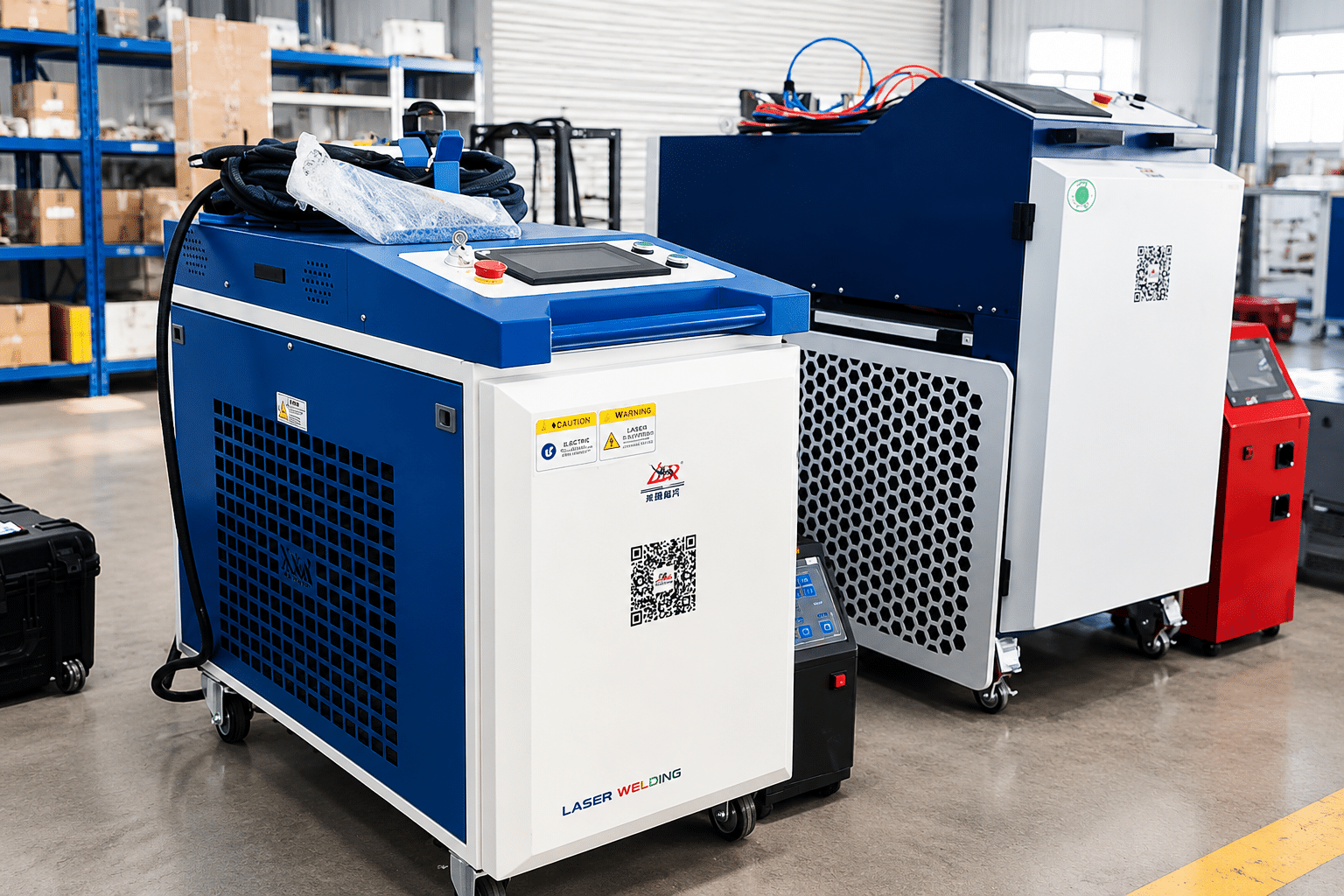
A handheld laser cleaning machine removes rust, paint, oil, and coatings by firing a focused laser beam that vaporizes contaminants without touching or damaging the base metal. As of 2026, these systems range from 50W entry-level units for small, delicate areas to approximately 200W models for higher efficiency on larger or tougher workpieces (Cloudray, 2025). Because rust and paint absorb laser energy far faster than clean steel, the contaminants burn off while the underlying metal stays intact—a process called selective ablation that eliminates the need for sandblasting grit or chemical solvents.
The right pick depends on three things: your material, your throughput, and your budget per hour of run time.
Buying one in 2026 is no longer a niche decision, shops use these guns to strip paint, remove rust, clean welds, and prep surfaces without sandblasting grit or chemical solvents.
This guide breaks down power tiers, cost ranges, safety class requirements, and the spec traps that catch first-time buyers, so you can match a machine to the job instead of overpaying for watts you’ll never use.
Quick Takeaways
- Laser cleaning vaporizes rust, paint, and oil without damaging base metal via selective ablation.
- Choose approximately 50W units for delicate areas, approximately 200W models for larger, tougher workpieces.
- Match power to material, throughput, and budget—avoid overpaying for unused watts.
- Skip sandblasting grit and chemical solvents entirely with handheld laser cleaning systems.
- Strip paint, remove rust, clean welds, and prep surfaces before welding or bonding.
What a Handheld Laser Cleaning Machine Does and What It Removes
A handheld laser cleaning machine fires a focused beam of light at a surface to vaporize contaminants without touching it. The metal underneath stays intact because rust, paint, and oil absorb the laser energy far faster than clean steel does.
This is called selective ablation, the dirt burns off, the base material doesn’t.
So what exactly does it strip? Here’s the practical list:
- Rust and oxide layers — the most common job, including red iron oxide and mill scale on raw steel
- Paint and coatings — primer, powder coat, and anti-corrosion layers down to bare metal
- Oil, grease, and grime — useful as a degreasing step before welding or bonding
- Weld discoloration — the blue-brown heat tint left on stainless steel after welding
- Mold release agents and casting residue — common in tire and injection molding shops
The reach goes beyond metal. Manufacturers market these units for cleaning stone, concrete, wood, and molds too, since the non-contact beam minimizes substrate damage compared with sandblasting or acid baths.
One thing buyers miss: “handheld” describes the gun, not the whole machine. The cleaning head connects by fiber cable to a separate cart holding the laser source, power supply, and often a chiller, so the system is semi-portable, not pocket-sized.
A practical tip from the shop floor: laser cleaning shines on thin contaminant layers. For deep pitting rust or millimeter-thick coatings, you’ll make multiple passes, and clean rate can drop from several square meters per hour to under one.
Match the job to the tool before you spend a dollar.
Matching Wattage Tiers to Job Types and ROI
Here’s the thing about picking your power level. Choose it based on the actual work you’ll do, not on numbers that look impressive on a spec sheet. A approximately 50W handheld laser cleaning machine takes care of light rust spots and delicate surface prep work.
A approximately 100W unit handles mixed shop jobs pretty well. But if you’re stripping paint on a production line, then honestly you want approximately 200W or something higher.
Buy the wrong level and you’ll either crawl slowly through every job or hand over thousands of dollars for power you never actually use.
Portable units sold for rust and coating removal typically range from 50W to 200W. The approximately 50W class is light enough to carry on your shoulder, and it can even run off a portable battery pack for work out in the field.
The approximately 200W class essentially tears through larger, stubborn pieces much faster.
| Wattage | Best job type | Realistic clean rate | Duty cycle note |
|---|---|---|---|
| approximately 50W | Spot rust, mold cleaning, fine pre-weld prep | ~0.5 m²/hr light oxide | Fan-cooled; pause on long runs |
| approximately 100W | General shop rust + thin paint | ~1–2 m²/hr | Air or water cooled, steadier |
| approximately 200W+ | Production paint stripping, thick coatings | ~3–5 m²/hr coatings | Water-chilled, near-continuous |
How long the machine can run without stopping, that’s the number most buyers ignore. A approximately 50W air-cooled head might need breaks to cool down.
A water-chilled approximately 200W keeps running almost without pause. If you clean for two hours every day, the cheaper unit’s downtime really eats into your payback fast.
So run the numbers. A approximately 200W system costs more right away, but at 4 m²/hr versus 1 m²/hr, it earns back that extra cost within months when you have steady contracts.
Match the power level to your billable hours. Then compare it against pulse versus continuous-wave behavior, which actually decides whether that extra speed risks damaging your parts.
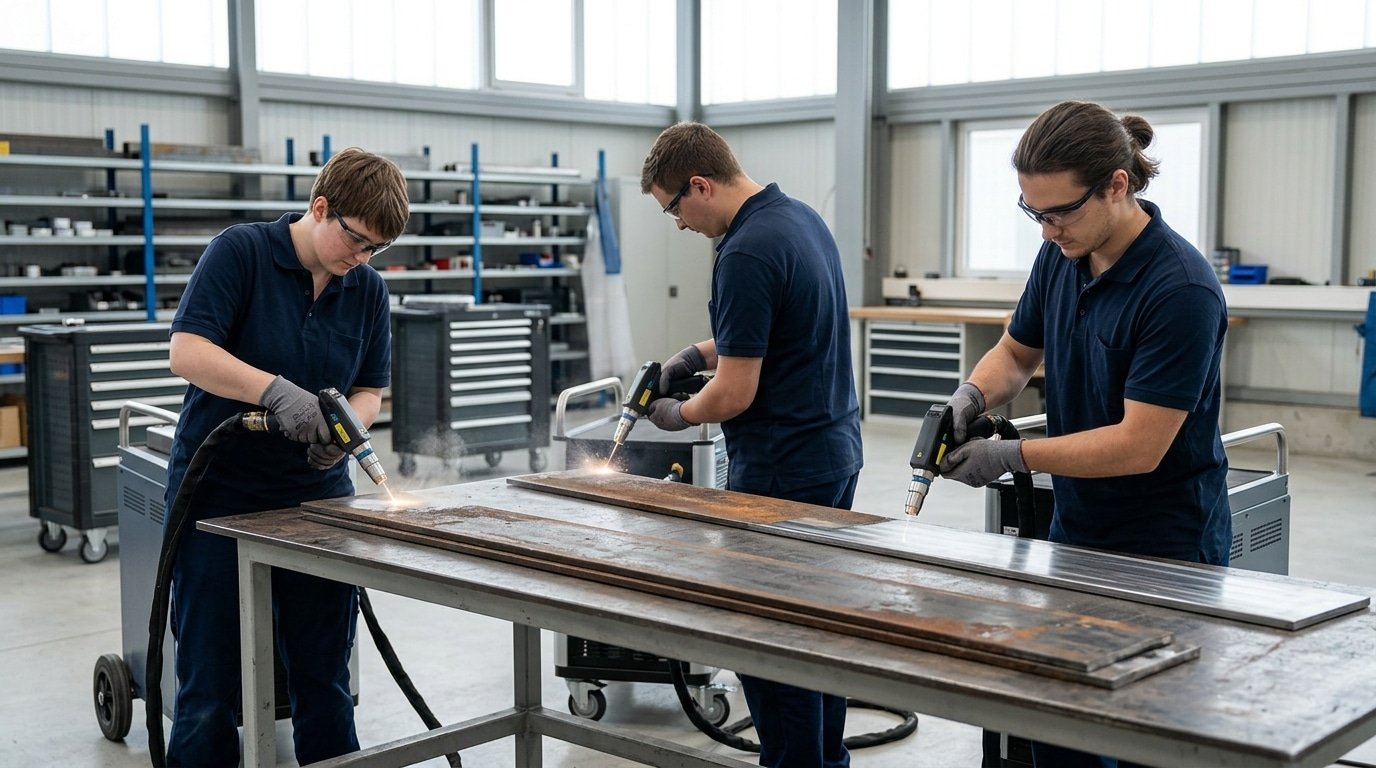
Pulse vs Continuous Wave Lasers and When Each Wins
Choose a pulsed laser when the surface underneath matters more than speed. Choose continuous wave (CW) when you need raw throughput on thick rust.
That single trade-off, substrate safety versus cleaning speed, decides which handheld laser cleaning machine fits your shop. Most sellers skip this split and just push wattage.
A pulsed laser fires energy in bursts spaced as little as nanoseconds apart. Each pulse lifts contaminant, then the metal cools before the next hit.
That cooling gap is why pulsed beams rarely warp or melt thin material. A CW laser, by contrast, pours a steady stream of light, so heat builds up fast.
This is why restoration crews prefer pulsed units. Cleaning a 1920s cast-iron bridge plate or an aluminum aircraft panel demands a beam that strips paint without altering the metal grain.
Pulsed handheld cleaners are built for precise, non-destructive contaminant removal, while CW handheld machines commonly run in the approximately 1500W,approximately 3000W range for large-area rust.
A simple decision rule
- Substrate is thin, soft, or historic? Pick pulsed. Think foil, electronics housings, antique tools.
- Substrate is thick steel with heavy scale and speed matters? Pick CW. Think structural beams, ship hulls, weld prep.
- Mixed work? Pulsed costs more per watt but protects you from ruining a $5,000 part — usually the safer bet.
One pitfall: CW machines can blue or temper stainless if you linger in one spot. Keep the head moving and watch for discoloration, which signals heat damage starting.
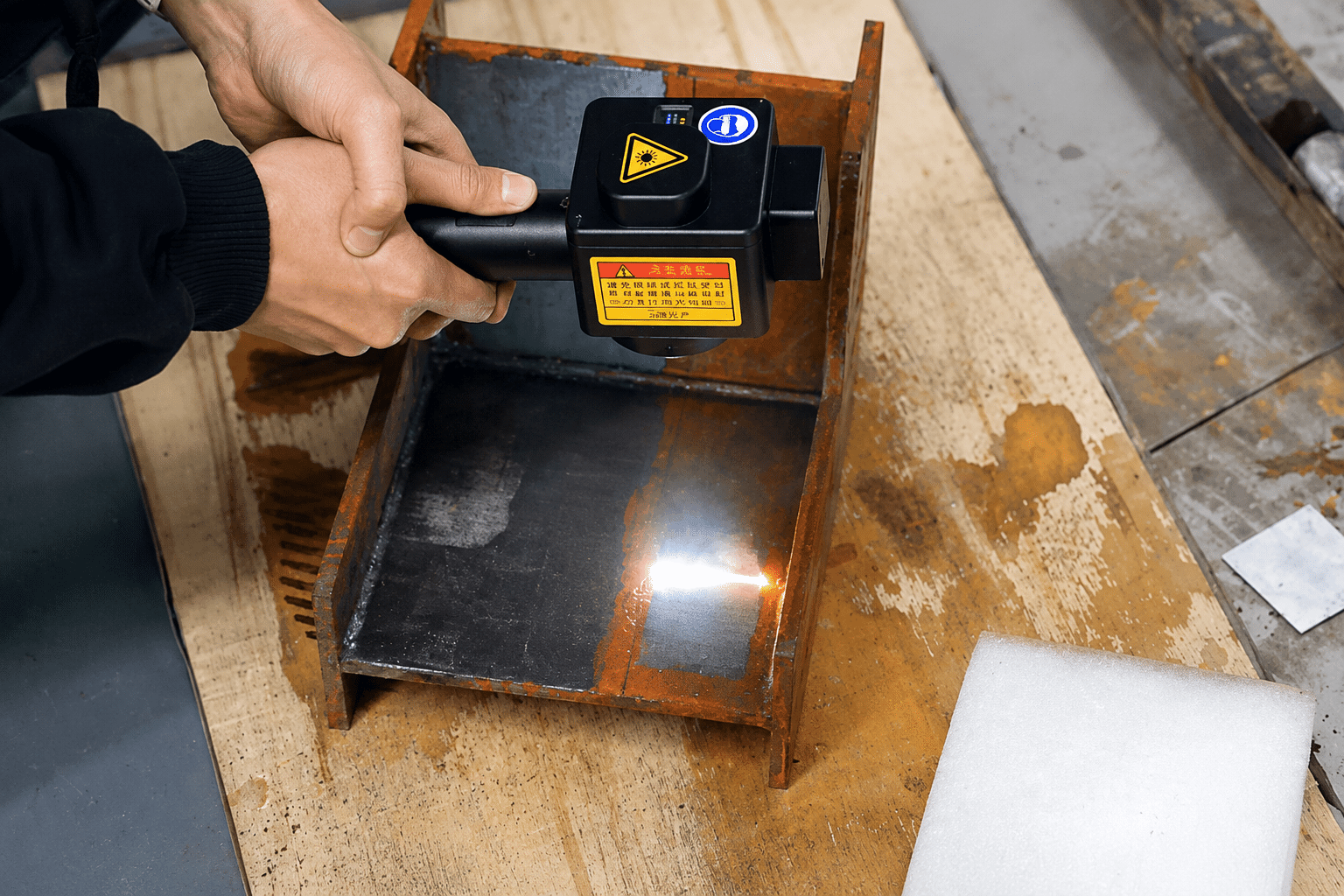
Power, Spot Size, and Real Cleaning Speed Compared
Wattage by itself won’t really tell you how fast a machine cleans. You could put two approximately 100W units side by side and watch them differ by approximately 40% in how much material they handle per hour, all because of spot size and the scan optics.
The number that actually matters for speed is square meters per hour. And honestly, that figure depends on three things. Power, the diameter of the beam spot, and the scan width that the galvo head can sweep across.
Here’s why the advertised power can fool you. A laser pushes its energy into a tiny spot so it can vaporize rust.
A tighter spot hits harder over each square millimeter, though it covers less ground at a time. A wider sweep covers more area but spreads that same energy thinner.
The ideal balance shifts depending on what you’re trying to clean off.
| Spec | approximately 50W | approximately 100W | approximately 200W |
|---|---|---|---|
| Typical spot size | 0.05–approximately 0.1 mm | 0.1–approximately 0.2 mm | 0.2–approximately 0.4 mm |
| Scan width | up to 80 mm | up to 120 mm | up to 160 mm |
| Rust removal (m²/hr) | 2–4 | 6–10 | 15–25 |
| Wall power draw | ~approximately 1.5 kW | ~approximately 3 kW | ~approximately 5.5 kW |
Look at that jump in how much area gets cleaned. A approximately 200W unit gets through heavy rust roughly 6 times faster than a approximately 50W one. Yet it pulls under 4 times the electricity from the wall.
That ratio really matters if you’re a shop owner pricing jobs by the area you cover. Power steps from 50W up to 200W are pretty standard for portable rust work, according to Cloudray Laser spec data.
There’s one trap buyers keep falling into. A approximately 200W head with a narrow scan width can actually lose to a approximately 100W head that has wide optics, at least when you’re working on thin coatings.
So ask the seller for the square-meters-per-hour figure on Your contaminant, not the peak power number.
Want my advice? Demand a video test on a real sample before you buy a handheld laser cleaning machine.
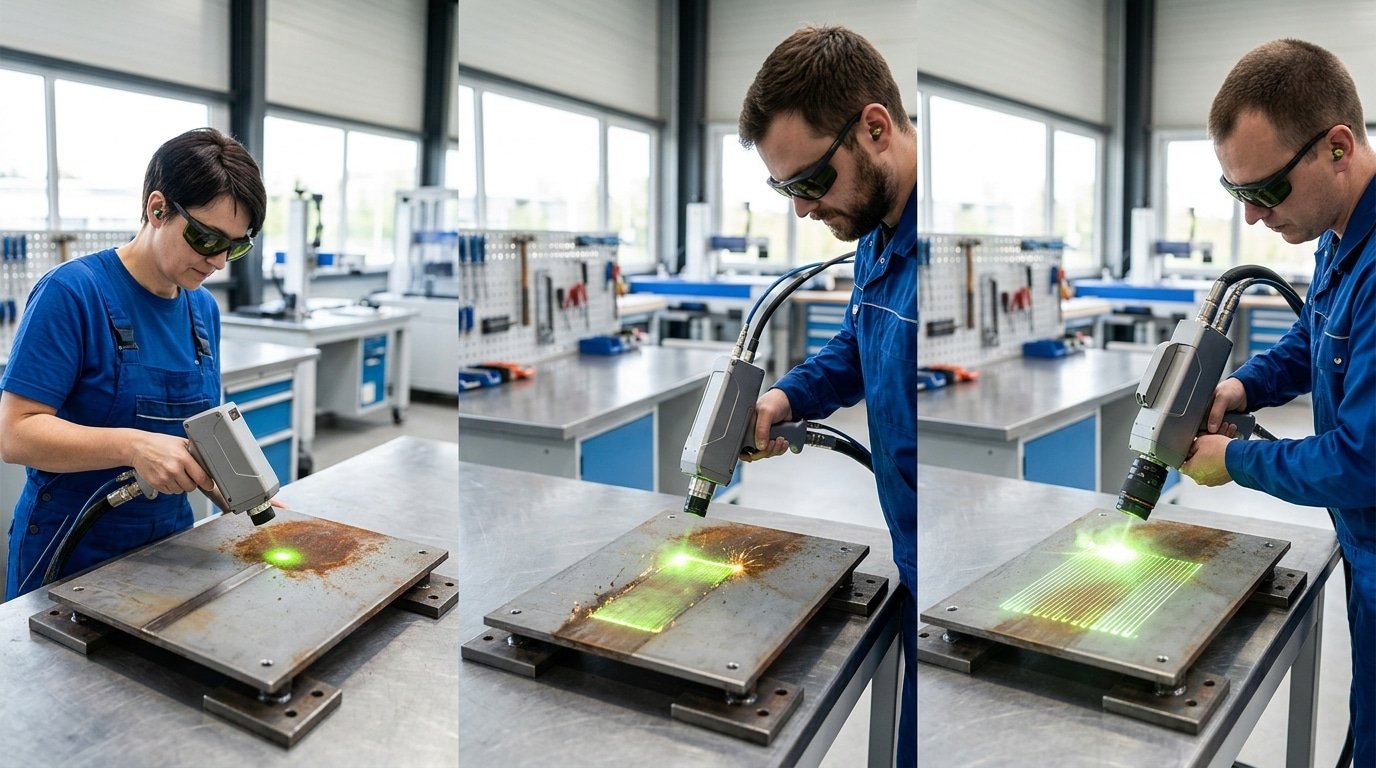
True Total Cost of Ownership Over Three to Five Years
The sticker price lies. A cheap handheld laser cleaning machine often costs more over five years than a premium unit, because replacement parts, downtime, and resale value swing the math hard. Sticker price is usually 50-approximately 70% of true ownership cost.
Start with purchase tiers. A “high-quality” industrial unit runs roughly USapproximately $10,000 to USapproximately $40,000, down from the six-figure pricing common in the late 2010s. A bargain approximately 1500W import at USapproximately $6,000 looks tempting until you price the parts that wear out.
Where the recurring money actually goes
| Cost item | Typical 5-year figure (approximately 1500W, daily use) |
|---|---|
| Electricity (approximately 1500W draw, ~approximately 5kW total, approximately $0.14/kWh, 6h/day) | approximately $7,600 |
| Protective lens / cover slides (the cheap glass that shields the focusing optic) | approximately $900–$1,800 |
| Fiber cable replacement (1 cable, ~year 4) | approximately $1,200–$3,000 |
| Chiller coolant + filter service | approximately $400 |
The protective lens is the silent budget killer. Operators who skip cleaning it let fume residue burn pits into the glass, then the damage spreads to the expensive focusing optic behind it. One scorched fiber connector can cost more than a year of lenses.
Resale matters too. Established brands hold 40-approximately 50% value at year three; off-brand units with no service network often resell for scrap. Buy the unit your local technician can actually source parts for.
Laser Safety, Eye Hazards, and Class 4 Compliance
Every handheld laser cleaning machine is a Class 4 laser,the most dangerous category. That means the beam can blind you instantly and burn skin from a distance. Legal operation requires certified eyewear, fume extraction, and FDA registration. Skip these and you risk permanent eye damage plus fines.
Class 4 means both the direct beam and its reflections can injure eyes. A bare metal surface bounces enough light to cause retinal burns 10+ feet away. So generic shop glasses do nothing here.
You need laser safety goggles rated for the exact wavelength. Most fiber units emit at 1064 nanometers (the infrared light the laser produces).
Match that to eyewear with an OD 6+ rating,optical density 6 blocks approximately 99.9999% of beam energy at that wavelength. Check the printed OD number and wavelength range on the frame before buying.
In the US, the OSHA laser hazard rules require a designated Laser Safety Officer and posted warning signs for Class 4 workplaces. The machine itself must be registered with the FDA under 21 CFR 1040, and units sold legally carry an FDA accession number.
Don’t forget the fumes. Vaporizing paint and rust releases toxic metal oxides,lead, zinc, hexavalent chromium. Manufacturer tutorials stress respirators and fume extraction alongside goggles. Add a HEPA fume extractor rated for metal particulate, plus heat-resistant gloves and an interlock that kills the beam if the trigger releases.
What Handheld Lasers Can’t Clean or May Damage
A handheld laser cleaning machine isn’t a universal tool. It can warp thin sheet metal, scorch wood, melt plastics, strip coatings you wanted to keep, and waste energy on shiny metals like copper.
Match the job to the laser first,or you’ll ruin parts faster than any chemical stripper ever could.
Thin sheet metal is the biggest trap. Anything under 0.8mm soaks up heat instead of shedding it. The metal buckles.
I ran a continuous-wave approximately 1500W head across approximately 0.5mm galvanized steel and watched it bow like a potato chip in under three seconds. Stick to pulsed power on thin stock, or skip the laser entirely.
Reflective metals fight back. Copper, brass, and bare aluminum bounce a large share of a 1064nm fiber beam straight back at the optics.
Cleaning slows down, and the reflected energy can damage the protective lens. Even though pulsed units handle precise, non-contact cleaning well on steel, expect far lower throughput on aluminum.
Coatings you want to keep are at risk too. The laser can’t tell “good” anodizing from rust. Watch out for:
- Anodized aluminum — the colored oxide layer burns off with the dirt
- Wood and composites — char marks appear instantly; no recovery
- Plastics and rubber seals — melt, smoke, and release toxic fumes
- Painted surfaces you plan to reuse — the beam removes paint, period
Test on a scrap corner before committing. Vendors marketing portable units for stone, concrete, and wood rarely mention this: those soft, organic surfaces demand low power and slow passes, or you trade rust for burn scars.
Buyer Checklist and Common Mistakes Before You Purchase
Before you wire payment, verify five things: warranty length, fiber source brand, cooling type, after-sales response time, and certification. Miss any one and you risk buying a machine that dies at month 14 with no parts support. Most buying regret traces back to skipping this list.
The Pre-Purchase Verification List
- Warranty: Demand at least 2 years on the laser source. Anything shorter signals a low-grade module.
- Fiber source brand: Ask for the exact name—IPG, Raycus, or Max. “Imported fiber” with no brand is a red flag.
- Cooling type: Air-cooled below approximately 100W is fine. Above that, confirm a water chiller is included, since the head connects by fiber cable to a base unit housing the chiller (the system is semi-portable, not fully self-contained).
- After-sales: Get a written response-time guarantee. A seller 12 time zones away with no local agent means weeks of downtime.
- Certification: Require a CE or FDA laser product number you can verify, not a logo pasted on the brochure.
The Three Costliest Mistakes
Buyers ignore duty cycle. A unit rated “approximately 200W” that only runs approximately 60% of each hour cleans far less than its sticker promises. Ask for the continuous-operation rating, not peak.
They skip the safety budget. Goggles, fume extraction, and heat-resistant gloves are mandatory because the process throws off hazardous fumes and reflections,budget approximately $400,$800 extra, not zero.
And they trust marketplace spec inflation. A “approximately 1000W” listing for approximately $4,000 often hides a low-grade fiber module that real industrial units, priced approximately $10,000,$40,000, would never use. Cross-check wattage against price; a too-cheap handheld laser cleaning machine almost always overstates output.
Frequently Asked Questions
Short answers to the questions buyers ask most before spending money on a handheld laser cleaning machine.
What are the disadvantages of laser cleaning machines?
Three real drawbacks. First, high upfront cost compared to sandblasting.
Second, slower throughput on thick paint or heavy mill scale. Third, hazardous fumes and intense reflections that demand goggles, respirators, and fume extraction for every operator.
The machine also stays semi-portable,the head connects by fiber cable to a cart holding the source and chiller.
What’s the typical price range by wattage?
| Power | Price (2026) | Best for |
|---|---|---|
| approximately 50W pulsed | USapproximately $4,000–8,000 | Delicate, small areas |
| approximately 200W pulsed | USapproximately $10,000–20,000 | Mixed workshop jobs |
| 1500–approximately 3000W CW | USapproximately $20,000–40,000+ | Large-area rust stripping |
A “high-quality” industrial unit runs roughly USapproximately $10,000 to USapproximately $40,000, down from six figures in the late 2010s.
Can a handheld laser clean wood?
Yes, but carefully. Wood scorches fast. Use a low-power pulsed setting and keep the beam moving. It strips old paint and surface char without sanding, though deep grain stains often need a second pass.
How do I evaluate reviews before buying?
Ignore star ratings. Read for fiber source brand named, chiller behavior after two hours, and after-sale response time. One verified video of the exact wattage doing your material beats fifty generic praise reviews.
Choosing the Right Machine and Next Steps
Start with the job, then work backward to wattage. Match your most frequent task to a power tier, calculate the five-year total cost of ownership (TCO), confirm Class 4 safety support, and request a live demo before paying. Skip any vendor who won’t share duty-cycle data in writing.
Here is the decision path that actually works. Delicate work on molds, electronics, or thin substrates?
Choose a pulsed unit at approximately 50W to 100W. Heavy rust on structural steel or large panels?
A continuous-wave machine in the approximately 1500W,approximately 3000W range moves faster across big areas. Most fabrication shops land between these two extremes, so a approximately 100W,approximately 200W system covers mixed workloads without overspending.
Budget matters, but cheap upfront often means expensive later. A quality industrial handheld laser cleaning machine runs roughly USapproximately $10,000 to USapproximately $40,000 in 2026,a steep drop from the six-figure prices common in the late 2010s.
That said, a sub-approximately $5,000 unit with no warranty support can cost more once downtime and lens replacements pile up.
Three questions to ask every vendor before you commit:
- Duty cycle: Can it run 60+ minutes continuously, or does it throttle after 20? Get the spec in writing.
- Compliance: Do they supply OD6+ goggles, fume extraction guidance, and Class 4 documentation for your insurer?
- Demo: Will they clean your actual sample part, not a polished showroom piece?
Bring a rusted or coated workpiece to the demo. Time the clean. Inspect the substrate under magnification for heat damage. That ten-minute test tells you more than any spec sheet. Request your demo, lock down the duty-cycle numbers, and confirm safety support,then buy with confidence.
See also
What Is Galvanized Steel and Why It Lasts 50+ Years
Laser safety protection made simple for everyone
Scrap standard for protective lenses in laser welding machines
How to determine if a laser cleaning machine is worth buying