


Rust vs Corrosion vs Oxidation
They overlap, but they are not synonyms. Learn which term describes a reaction, which describes damage, which applies only to iron, and what to inspect before cleaning, repairing, coating, or replacing a metal part.
Hero image: ImagePerson, Wikimedia Commons, CC BY-SA 4.0.
What is the difference between rust, corrosion, and oxidation?
Oxidation describes a chemical change: electron loss or an increase in oxidation state. Corrosion describes the deterioration of a material because it reacts with its environment. Rust is the iron-specific product left by a subset of corrosion processes. This is why aluminum oxidizes and can corrode but does not technically rust, while stainless steel can pit with very little red-brown staining.
Visible coverage, product color, and surface texture are useful clues. They do not establish remaining wall thickness, pit depth, crack size, load capacity, leak risk, or remaining life.
Related concepts at three different levels
A useful way to avoid confusion is to assign each word a different job. Oxidation names the reaction. Corrosion names the unacceptable change or deterioration. Rust names a group of iron-rich products that can appear during ferrous corrosion.
This is an operational map, not a claim that every oxidation reaction causes corrosion or that every corrosion mechanism creates rust.
| Term | What it describes | Typical scope | Is O2 always required? | Example |
|---|---|---|---|---|
| Oxidation | Loss of electrons or increase in oxidation state. In metalworking, it can also refer informally to oxide-film or scale formation. | Metals, ions, molecules, organic materials, combustion, and other reactions. | No Oxygen is common, not part of every oxidation definition or reaction. | Aluminum forming a thin oxide film; iron dissolving as Fe2+ at a corrosion anode. |
| Corrosion | Deterioration caused by chemical or electrochemical interaction between a material and its environment. | Usually metallic assets in engineering, although broader definitions include other materials. | No Other cathodic reactions or reactive environments can sustain attack. | Chloride pitting in stainless steel; general thinning in a carbon-steel pipe. |
| Rust | A variable family of iron oxides, hydroxides, oxyhydroxides, retained water, salts, dirt, and other products. | Iron and iron-containing alloys. Rust staining can also come from free-iron contamination. | Usually in air service Atmospheric rusting normally involves moisture and oxygen, but the product chemistry varies. | Red-brown products on uncoated carbon steel; darker iron-oxide products can also occur. |
The practical distinction is not semantic trivia. It changes the inspection method, cleaning decision, material selection, coating plan, acceptance criteria, and supplier responsibility.
What might this surface change mean?
Choose the closest description. The result suggests a terminology route and next checks; it does not approve repair or return to service.
Likely iron rust; inspect before repair
Carbon steel with a red-brown product in a wet atmosphere is consistent with ferrous corrosion. The visible product does not show how much metal remains.
Planning aid only. A reliable diagnosis requires substrate confirmation, history, environmental data, representative cleaning, measurement, and the applicable code or OEM acceptance limits.
Oxidation is broader than "reaction with oxygen"
In strict chemical language, oxidation means net electron loss or an increase in oxidation state. The school shortcut "gain of oxygen" describes many familiar reactions, but it is not the complete definition. Whenever one species is oxidized, another is reduced. In corrosion, a metal commonly supplies electrons at an anodic site while a cathodic reaction consumes them somewhere else.
This distinction explains why the statement "corrosion cannot occur without oxygen" is incorrect. Dissolved oxygen is a common cathodic reactant in neutral aerated water, but acidic systems can reduce hydrogen ions, and other industrial oxidants, reactive gases, molten salts, or sulfur-bearing species can support different redox routes.
How factories use the word oxidation
In metalworking, people also use "oxidation" informally for visible oxide formation: heat tint beside a weld, dark mill scale on hot-rolled steel, a dull gray film on aluminum, or scale on a furnace component. That shorthand does not tell you whether the film is stable, whether meaningful metal loss has occurred, or whether the surface still meets electrical, coating, sealing, brazing, welding, dimensional, or appearance requirements.
An oxide on an electrical contact can increase resistance. Weld heat tint can signal a locally altered stainless surface. Scale can interfere with coating adhesion, welding, sealing, or tolerance even when the part is not structurally weakened.
When oxidation protects a metal
Passivating materials form a very thin surface film that reduces further reaction in a compatible environment. Aluminum spontaneously forms adherent aluminum oxide in air. Stainless steel relies on a chromium-rich passive surface. Anodizing deliberately builds a controlled oxide on aluminum. Heat-resistant alloys are selected to form compact, slow-growing alumina, chromia, or silica scales.
Protection is conditional. Chloride deposits, crevices, unsuitable pH, fabrication contamination, mechanical damage, or thermal cycling can break down or remove the film. The better question is not merely "is there an oxide?" It is "is the film continuous, adherent, stable in this service, compatible with function, and able to reform after damage?"

How an electrochemical corrosion cell consumes metal
Most ambient wet corrosion requires four working elements: an anodic site, a cathodic site, an electronic path through the metal, and an ionic path through an electrolyte. A potential difference drives the cell. The anode loses metal; the cathodic surface can remain visually intact while supporting the reaction.
Fe -> Fe2+ + 2e-O2 + 2H2O + 4e- -> 4OH-Fe2+ + 2OH- -> Fe(OH)2Why a single steel surface can contain both anode and cathode
Local differences in alloy phase, oxygen concentration, deposits, stress, temperature, surface condition, or chemistry can create electrochemical sites on one component. A shielded crevice may become anodic while the better-aerated surrounding surface supports cathodic reduction. The exposed area can look clean while the hidden zone deteriorates.
Why salt often accelerates corrosion
Dissolved salts raise electrolyte conductivity. Chlorides can destabilize passive films and salt deposits can retain moisture. Salt is not a one-step ingredient that creates rust by itself: wetness, temperature, concentration, material, coating, crevices, oxygen gradients, and wet-dry cycles work together.
Can corrosion occur without molecular oxygen?
Yes. Hydrogen-ion reduction can support corrosion in acids, while high-temperature and process environments can involve other oxidizing species. Atmospheric iron rust normally involves water and oxygen, but corrosion is a much wider set of mechanisms.
These equations are a teaching model. Actual products and rates depend on pH, oxygen, chloride, contaminants, temperature, alloy, geometry, flow, and exposure history. They are not a service-life formula.
Eight corrosion forms buyers and maintenance teams should recognize
Visible rust is only one clue. Corrosion form controls what must be measured and why a small area can create a large consequence.
General corrosion
Relatively distributed roughening and thinning. A large area may be shallow, yet thickness loss still accumulates.
Trend thickness and restore protection.Pitting
Pinholes or cavities, often on passive alloys. A tiny opening can hide deep penetration.
Measure pit depth, density, and leak risk.Crevice corrosion
Attack under gaskets, washers, deposits, laps, threads, or sheltered joints while exposed metal remains bright.
Inspect beneath hardware and deposits.Galvanic corrosion
The anodic material corrodes faster when electrically coupled to a more noble surface in a shared electrolyte.
Review isolation and area ratio.Intergranular attack
Preferential damage along or near grain boundaries can reduce cohesion with modest surface evidence.
Control alloy condition and heat history.Stress-corrosion cracking
Susceptible material, tensile stress, and a specific environment combine to create cracks with little uniform rust.
Escalate to qualified NDT and engineering.Erosion-corrosion
Fluid, particles, or turbulence remove protective films. A clean swept surface can be actively thinning.
Check velocity, solids, geometry, and alloy.High-temperature attack
Scale, hot corrosion, carburization, sulfidation, or mixed-gas damage can be protective or rapidly destructive.
Specify temperature and gas chemistry.
Rust is a variable family of iron corrosion products
One formula such as Fe2O3 or Fe2O3.xH2O is an oversimplification. Real atmospheric rust can include goethite, lepidocrocite, magnetite, other oxides and oxyhydroxides, retained water, chlorides, sulfates, carbonates, dirt, and amorphous material.
Its composition changes across the layer and evolves through wet-dry cycles. Rust can therefore appear yellow, orange, red, brown, black, or occasionally greenish. Color does not identify phase composition or remaining strength by itself.
Which metals rust, which oxidize, and which can passivate?
The substrate determines what the product is called, whether the film may protect, and which failure modes deserve attention.
Carbon steel
Red-brown rust, dark scale, blistering, pits, and general thinning are common signs. Coating holidays, welds, edges, and water traps often lead.
Main concern: hidden section loss and recurring moisture.Stainless steel
A chromium-rich film provides resistance, not immunity. Orange contamination, heat tint, tea staining, pits, and crevices need different investigations.
Main concern: chlorides, grade, crevices, finish, and contamination.Aluminum
The natural oxide is usually adherent and self-reforming, but white products, pits, blistering, intergranular attack, or exfoliation can occur.
Main concern: chloride, pH, galvanic contact, and alloy/temper.Copper and brass
Brown, black, blue, or green films are not rust. Stable patina may protect, while pitting, erosion, or dezincification can still damage service.
Main concern: water chemistry, flow, alloy, and patina stability.Zinc and galvanized steel
White storage stain is a zinc product. Red-brown products at damage, welds, or cuts can indicate exposed underlying steel.
Main concern: remaining zinc, wet storage, and repair continuity.Weathering steel
A dense iron-rich patina may slow atmospheric attack when drainage and exposure support it. It is not universally maintenance-free.
Main concern: chloride, persistent wetness, sheltered details, and runoff.| Observation | Possible explanation | Do not assume | Useful next check |
|---|---|---|---|
| Red-brown flaky product on carbon steel | Iron rust after coating breakdown or direct wet exposure. | That the damage is cosmetic or uniform. | Clean representative areas; measure thickness, pits, edges, welds, and water traps. |
| Orange specks on stainless steel | Free-iron contamination, runoff, heat-tint-related attack, or localized corrosion. | That the base alloy is deeply corroded - or that it is only staining. | Check fabrication history, free iron, pits, chlorides, crevices, grade, and finish. |
| White powder on galvanized steel | Wet-storage stain or another zinc corrosion product. | That the underlying steel has failed, or that zinc loss is negligible. | Improve drying, inspect coating thickness and continuity, and look for red rust at damage. |
| Green or blue-green copper surface | Developing or mature patina, possibly stable in atmospheric service. | That every green product is protective or must be removed. | Assess adherence, runoff, water chemistry, pit depth, wall loss, and intended appearance. |
| Bright stainless around a washer | A passive exposed surface with a potentially active low-oxygen crevice below. | That the joint is sound because most of it looks bright. | Inspect below hardware; evaluate pitting, crevice design, and chloride exposure. |
| Dark scale on hot equipment | High-temperature oxide that may be protective, growing, cracked, or spalling. | That it is ordinary ambient rust or harmless discoloration. | Review alloy, temperature cycles, adherence, deposits, and dimensional loss. |

Galvanic-corrosion principle. Diagram: Joanna Kosmider, Wikimedia Commons, CC0/public domain.
Galvanic corrosion needs a complete circuit
Dissimilar metals alone are not enough. Accelerated galvanic attack requires electrical contact, a shared electrolyte, and a sufficient potential difference. The less noble surface becomes anodic and corrodes faster; the more noble surface becomes cathodic and can remain visually perfect.
Examples include aluminum joined to stainless steel in a wet chloride environment, galvanized steel connected to copper plumbing, and carbon-steel fasteners used with more noble panels without isolation. The specification should define materials, contact design, coating placement, fastener geometry, and maintenance access.
Why the same alloy performs differently at two sites
Corrosion depends on material, environment, design, fabrication, and time. Macro-environment labels such as "coastal" or "indoor" are useful starts, but local microclimates often decide where damage begins.
Time of wetness
Condensation, splash, rain retention, and poor drainage can matter more than an average regional humidity value.
Chloride and salts
Marine aerosol, deicing salt, and residues increase conductivity, hold moisture, and destabilize passive films.
pH and process chemicals
Acids, alkalis, cleaners, sulfur species, and unknown deposits can change the dominant electrochemical route.
Temperature
Temperature affects reaction rates, evaporation, condensation, chemical concentration, and passive-film stability.
Geometry and crevices
Laps, seals, ledges, seams, blind cavities, and horizontal surfaces trap liquid and create concentration differences.
Flow and erosion
High velocity, solids, impingement, and turbulence can remove protective films and concentrate attack.
Stress and metallurgy
Residual or applied stress, weld condition, heat treatment, grain structure, and inclusions can enable specific failure modes.
Contamination and deposits
Free iron, abrasive residue, salts, dirt, insulation, and biological deposits can retain moisture or create local cells.
There is no single relative-humidity threshold that predicts all atmospheric attack. Salt deposits can retain moisture and support corrosion below a simple textbook threshold. Laboratory exposure hours do not convert automatically into outdoor years.
Move from color to evidence in eight steps
The objective is to preserve useful evidence, expose representative metal safely, measure what matters, and correct the actual driver before hiding the surface again.
Verify substrate and history
Record exact alloy or grade, product form, heat treatment, coating, fabrication, weld cleanup, repairs, and exposure time.
Do not identify alloy from color.Record the environment
Include humidity, condensation, immersion, pH, chlorides, process chemicals, temperature, flow, deposits, soil, stray current, and metal contacts.
Capture the microclimate.Map the morphology
Distinguish general loss, pits, crevices, blisters, galvanic patterns, cracks, exfoliation, erosion, deposits, and hot scale.
Location is evidence.Preserve evidence
Photograph scale and orientation, record dimensions, retain representative products when failure analysis may be needed, and avoid destroying crack evidence.
Document before cleaning.Expose representative metal
Remove loose products or coating in controlled zones using a procedure suitable for the substrate, hazard, and investigation objective.
Reveal, do not erase blindly.Quantify rather than guess
Use thickness, pit depth, coating DFT, holiday, adhesion, free-iron, microscopy, chemistry, profile, or NDT methods as consequence requires.
Measure the right variable.Evaluate consequence
Compare condition with drawings, OEM or code limits, pressure or load calculations, leakage risk, hygiene, electrical needs, and criticality.
Appearance is not acceptance.Correct and trend
Repair or upgrade protection, drainage, alloy, isolation, chemistry, crevice detail, inhibitor, or cathodic protection, then remeasure defined points.
Control recurrence.Safety boundary: no universal rust-depth, pit-depth, or visible-area threshold declares every product safe or unsafe. Pressure equipment, lifting devices, structural load paths, rotating parts, electrical systems, hygienic surfaces, and safety-critical assemblies require applicable codes, OEM limits, and qualified engineering or NDT review.
Let measured damage and consequence choose the response
A broad stain on a thick noncritical bracket can be less urgent than one small pit in a pressure boundary. Coating restores environmental isolation; it does not restore section, close a crack, or correct the wrong alloy.
Clean and restore
Use a substrate-compatible method, prepare the surface, and restore protection if no measurable loss exists.
Confirm source, contamination, coating condition, acceptance, and recurrence risk.Open and inspect
Remove failed coating and products in representative areas before selecting a repair system.
Measure pits and thickness; correct salts, drainage, edges, and preparation.Engineering assessment
Deep pits or crevice attack require a qualified repair or replacement decision.
Confirm remaining ligament, growth, crack screening, load or pressure, and code limits.Follow isolation procedure
Cracks, perforation, leakage, distortion, seized function, or loss of fit are not coating problems.
Use approved repair, inspection, acceptance, and return-to-service authorization.Stop treating the symptom
Repeated corrosion signals a root-cause problem rather than a need for another cosmetic cycle.
Review environment, moisture traps, galvanic couples, cure, alloy, and maintenance access.Build a protection system, not a product nickname
There is no universally "rust-proof" metal. A durable solution begins with the actual environment and combines material, geometry, preparation, protection, inspection, packaging, and maintenance.
Paint or powder coating
Flexible colors, repair routes, and broad application fit. Defects, poor preparation, sharp edges, wrong DFT, or incomplete cure expose the substrate.
Best fit: machinery, enclosures, and fabricated structures.Hot-dip galvanizing
Zinc protects steel and can support small damaged regions. Venting, drainage, dimensions, storage, thickness, appearance, and repair require planning.
Best fit: outdoor steelwork, racks, poles, and hardware.Stainless steel selection
Resistance is built into the alloy and passive surface. Grade, finish, chloride, temperature, crevices, and contamination still control.
Best fit: hygienic, process, and architectural equipment.Aluminum and anodizing
Low mass with natural or controlled oxide protection. Galvanic coupling, strong acid or alkali, chloride pitting, wear, and alloy condition remain concerns.
Best fit: enclosures, transport, electronics, and architecture.Cathodic protection
Controls buried or immersed structures when current distribution, continuity, electrolyte contact, monitoring, and coating coordination are engineered.
Best fit: pipelines, tanks, marine and buried assets.Corrosion inhibitors
Can reduce attack in controlled fluids, but concentration, compatibility, flow, temperature, monitoring, and replenishment must be maintained.
Best fit: closed loops, storage, and selected process systems.Define substrate and condition, environment, surface-preparation standard, soluble-contaminant controls, profile, edge and weld treatment, primer/intermediate/topcoat, nominal DFT, cure, inspection, repairs, packaging, and maintenance assumptions.
Translate surface language into purchasing action
Each example starts with a familiar appearance and ends with a specification or inspection decision that a supplier can act on.
"Corrosion-resistant powder coat" is not enough
Chloride deposition, condensation, drainage, cut edges, hinges, fasteners, door seals, preparation, coating thickness, holidays, repair, and maintenance all affect life. Define the environment and complete system, not only color or resin family.
Buyer lesson: require preparation, DFT, edge treatment, inspection, repair, and maintenance assumptions.Orange specks can be free-iron contamination
Carbon-steel grinding dust, shared tooling, racks, runoff, and weld heat tint should be investigated. Cleaning and passivation can restore a suitable surface, but passivation does not fill pits or compensate for the wrong alloy.
Buyer lesson: specify dedicated tooling, post-fabrication cleaning, verification, and chloride controls.White powder is not automatically exposed-steel failure
Trapped moisture and limited airflow can create zinc wet-storage staining. Separate, dry, clean appropriately, assess remaining zinc, and inspect damage for red iron rust.
Buyer lesson: define packaging, ventilation, coating thickness, damage repair, and separate red-rust limits.Passivity does not remove galvanic risk
If water bridges the metals, aluminum can become anodic around the more noble fastener. Isolation, sealants, drainage, anodizing or coating continuity, edge damage, and area ratio matter.
Buyer lesson: specify the joint and electrolyte path, not just the two material names.Dark scale may be intended protection or active failure
Removing scale without analysis can strip a protective film or miss spallation driven by sulfur, salts, thermal shock, abrasion, or overheating. Review alloy, temperature cycles, gas chemistry, deposits, and dimensional trends.
Buyer lesson: use hot-service criteria, not ambient rust language.Another coat may hide the same root cause
Soluble salts, poor edge coverage, trapped water, inaccessible crevices, incomplete cure, transport damage, or galvanic contacts can defeat a new finish. Open representative areas and correct the system before repeating the cycle.
Buyer lesson: ask for a corrective-action plan and measurable evidence.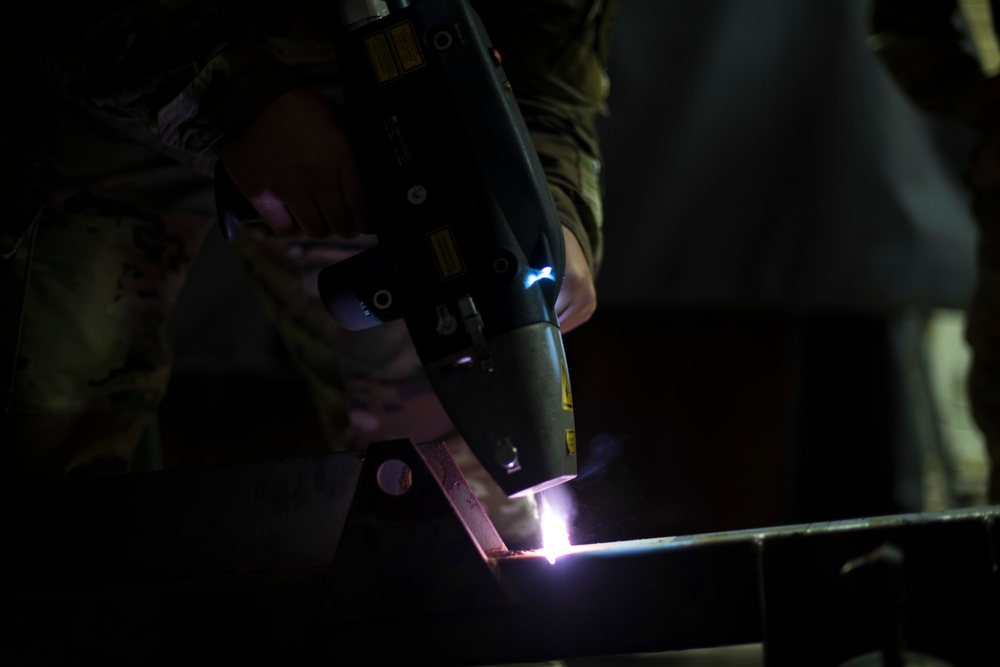
Where laser cleaning fits - and where it stops
Laser cleaning can selectively remove rust, oxides, paint, or other surface layers without abrasive contact when a suitable process window exists. It can be attractive for localized treatment, precision surfaces, repeated parts, weld preparation, and applications where secondary abrasive waste has operational cost.
Replace "rust-proof" with requirements a supplier can verify
A supplier can quote a controlled solution only when the purchase definition says what the product is, where it will operate, how it will be protected, and how conformance will be measured.
Material and construction
- Exact grade, governing product standard, form, and condition.
- Dimensions, tolerances, corrosion allowance, edge radius, weld and joint details.
- Holes, fasteners, drainage, ventilation, and permitted substitutes.
- Required mechanical, electrical, hygienic, or appearance performance.
Actual service environment
- Indoor, outdoor, immersion, burial, or high-temperature service.
- Humidity, condensation, time of wetness, chlorides, pollutants, pH, chemicals, temperature, flow, and deposits.
- Cleaning agents, washdown, metal contacts, and local microclimates.
- Required service period and maintenance assumptions.
Surface preparation
- Preparation standard and grade, abrasive controls, soluble-salt limit, and profile.
- Treatment of edges, welds, cut surfaces, heat tint, and damaged zones.
- Dedicated-tool and free-iron requirements for stainless parts.
- Hold points before coating or assembly.
Protection system
- Coating, plating, galvanizing, anodizing, passivation, inhibitor, or cathodic-protection route.
- Measurable process, thickness, cure, and finish requirements.
- Approved repair procedure for fabrication, shipping, and site damage.
- Compatibility between base metal, treatment, sealant, and fasteners.
Inspection and acceptance
- Visible rust distribution, pits, cracks, coating DFT, holidays, adhesion, and zinc repair.
- Contamination, free iron, appearance, dimensional loss, and functional checks.
- Sampling plan, witness points, acceptance limits, and rework route.
- Material certificates, batch records, reports, photos, and traceability.
Packaging and change control
- Separation of dissimilar metals, temporary protection, ventilation, desiccant, and storage orientation.
- Maximum storage duration and site handling requirements.
- Written approval for alloy, finish, preparation, process, thickness, supplier, or inspection changes.
- Defined responsibility for transit and installation damage.
No change to base material, finish, preparation, coating system, process route, thickness, or repair method is permitted without written purchaser approval supported by a clause-by-clause comparison of corrosion performance, fabrication, inspection, maintenance, and service-environment assumptions.
Use each method for the question it actually answers
A visual rating, accelerated test, or laboratory ranking can support a decision without predicting every aspect of field service.
| Standard or method | Useful question | What it does not prove | Buyer use |
|---|---|---|---|
| ASTM D610 / ISO 4628-3 | How much visible rusting and what distribution are present on a coated steel surface? | Remaining wall thickness, pit depth, crack risk, or exact service life. | Define visual coating condition and maintenance triggers together with dimensional inspection. |
| ASTM G46 | How should pitting be examined, measured, and evaluated in field or laboratory studies? | A universal safe pit depth or automatic remaining-life decision. | Structure pit-depth and density assessment, then connect it to engineering limits. |
| ASTM B117 | How should salt-spray apparatus and exposure be operated for an agreed specimen evaluation? | Direct conversion of chamber hours into outdoor years or performance in every natural environment. | Use with a product specification, agreed criteria, and corroborating cyclic or field evidence. |
| ASTM G48 | How do stainless and related alloys compare for pitting or crevice initiation in defined ferric-chloride tests? | Universal service resistance, propagation rate, or nonchloride performance. | Agree specimen condition, method, temperature, acceptance, and service relevance. |
| ISO 8501-1 | What rust and preparation grades describe uncoated steel before painting? | Soluble salts, hidden pits, structural capacity, or the complete coating-system life. | Pair visual preparation with contaminant, profile, coating, DFT, and inspection controls. |
| ISO 9223 / ISO 12944-2 | How can atmospheric and coating-service environments be classified for planning? | Every microclimate, sheltered crevice, chemical atmosphere, or exact asset life. | Use as environment-selection input, then add local salt, wetness, temperature, and process data. |
| ASTM A380 / ASTM A967 | How can stainless parts be cleaned, descaled, pickled, or passivated and checked under specified practices? | That pits are filled, lost metal is restored, or an unsuitable alloy becomes immune to service. | Define post-fabrication cleaning and passive-surface requirements with the applicable product acceptance. |
Standards are revised. Verify the active edition, contract, jurisdiction, specimen condition, and application-specific acceptance criteria before issuing an order or returning equipment to service.
Eleven shortcuts that create poor corrosion decisions
Rust and corrosion are the same
Rust is an iron-specific product. Corrosion is the broader deterioration process across many materials and mechanisms.
Oxidation always requires oxygen
Strict chemistry defines oxidation through electron loss or oxidation-state increase, not the presence of molecular oxygen.
Every oxide means failure
Aluminum oxide, stainless passivity, and stable copper patina can reduce further reaction in suitable service.
Only red corrosion is serious
Pitting, crevice attack, SCC, erosion-corrosion, and galvanic attack can produce little broad red product.
Stainless steel cannot rust
Free-iron contamination can rust on stainless, while passive-film breakdown can create localized iron-rich corrosion products.
Aluminum cannot corrode
Aluminum does not form iron rust, but it can pit, exfoliate, and suffer severe galvanic or chemical attack.
Green copper must be polished away
A stable patina may be intended and protective. Remove it only when service, appearance, or investigation requires it.
White zinc product means all protection is gone
White storage stain and red iron rust need different diagnosis. Measure remaining zinc and inspect coating continuity.
Painting over rust solves the cause
Preparation, salts, drainage, crevices, edge coverage, cure, damage, and maintenance decide coating performance.
Passivation repairs stainless steel
Passivation supports a clean passive surface. It cannot replace missing metal, close pits, or correct the wrong grade.
Salt-spray hours equal field years
Correlation is product- and environment-specific. Chamber results cannot be converted by a universal time factor.
A large rusty area is always worse than a small spot
One deep pit or crack can be more critical than broad shallow staining. Measure consequence, not drama.
Tools for cleaning feasibility, machine route, time, and cost
Once the substrate and damage are understood, use the next tool that matches the remaining commercial question.
Rust, corrosion, and oxidation FAQ
What is the main difference between rust, corrosion, and oxidation?
Oxidation is a chemical process involving electron loss or an increase in oxidation state. Corrosion is deterioration caused by chemical or electrochemical interaction with the environment. Rust is the family of iron corrosion products formed on iron or iron-based materials. Rust is one result of corrosion, while oxidation is much broader than both.
Is rust a form of corrosion or oxidation?
Rust is a corrosion product created during corrosion of iron or ferrous alloys, and iron is oxidized during that process. The precise wording is that rusting is an iron-corrosion process involving oxidation, while rust itself is the resulting mixture of iron-rich products.
Can metals other than iron rust?
In strict technical usage, no. Aluminum, copper, zinc, silver, and other metals can corrode and form oxides, sulfides, carbonates, hydroxides, or patinas, but these are not ordinary iron rust. Trade terms such as "white rust" are common for zinc products, so always identify the substrate.
Can corrosion occur without oxygen?
Yes. Molecular oxygen is a common cathodic reactant in atmospheric and neutral-water corrosion, but it is not required for every system. Hydrogen ions, dissolved oxidants, reactive gases, molten salts, sulfur species, or other chemicals can support redox reactions.
Why does aluminum oxidize but usually not rust?
Aluminum is not iron, so its products are not called rust. It rapidly forms a thin adherent aluminum-oxide film in air, and that film often limits further attack. Aluminum can still corrode when chlorides, unsuitable pH, crevices, contamination, or galvanic contact defeat protection.
Can stainless steel rust?
Stainless steel can show red rust from free-iron contamination and can form iron-rich products when its passive surface breaks down. It can also pit, corrode in crevices, or crack with little visible red rust. Grade, chloride, temperature, finish, weld treatment, contamination, and design all matter.
How can you tell surface rust from structural corrosion?
You cannot determine structural significance from color or visible area alone. Clean representative areas using an approved method, then measure remaining thickness, pit depth, cracks, distortion, coating condition, and function. Compare results with drawings, OEM limits, codes, service loads, and qualified engineering judgment.
Should rust always be removed before painting?
Loose rust, scale, salts, failed coating, and contamination normally require controlled removal to the preparation level defined by the selected coating system. Some coatings permit tightly adherent residual rust under specific rules, but "paint over rust" is not a universal shortcut.
Does salt cause rust?
Salt alone is not the complete corrosion cell, but dissolved ions increase conductivity, deposits retain moisture, and chlorides can disrupt passive films. Salt exposure often accelerates rusting when water, oxygen, and an electrochemical path are present.
Can laser cleaning repair corrosion pits?
No. Laser cleaning can remove corrosion products and expose the pit for inspection, but it cannot replace consumed metal. Pit depth, remaining ligament, cracks, and service consequence still require assessment.
Definitions, mechanisms, and safety sources
Primary and authoritative sources were used for core definitions and safety boundaries. Standards should be checked for the edition required by the project.
Technical review date: July 30, 2026. Confirm current standards, local regulations, equipment instructions, and application-specific acceptance criteria before use.
Know what the product is, reveal the substrate, and verify what remains
Send Oceanplayer the material grade, affected area, corrosion photos, geometry, and required post-cleaning finish. We can help determine whether pulsed or continuous-wave laser cleaning deserves a controlled sample test.