

How to Remove Anodizing from Aluminum: Methods and Surface Damage Risks
Remove anodizing with a controlled chemical stripping process, mechanical removal, or a validated laser process.
The right choice depends on whether you need full-part stripping or a local bare area, and how much dimensional or surface change the part can tolerate.
Removing the color is not proof that the oxide film is gone—or that the aluminum is undamaged.
Which anodizing removal method fits your part?
Start with the next operation and the drawing—not the strongest chemical or the highest laser power. A decorative cover, a precision bore and an electrical contact pad need different outcomes.
Scroll sideways to compare methods, limitations and inspection requirements.
| Your requirement | Route to evaluate | Main limitation | Evidence before approval |
|---|---|---|---|
| Strip a whole part for refinishing | Qualified chemical stripping | Exposed aluminum may etch while remaining film is removed. | Film removal, measured metal loss and a compatible cleanup sequence. |
| Remove film on an accessible cosmetic surface | Sanding, polishing or controlled blasting | Texture changes, rounded edges and uneven removal. | Acceptable finish, geometry and absence of trapped abrasive. |
| Create a defined bare pad or feature | Local machining where the drawing permits it | Tool access, stock allowance, burrs and changed dimensions. | Final pad size, flatness, depth and functional test. |
| Remove film selectively without a stripping bath | Representative pulsed-laser trial | Color change, residual film or substrate damage can be mistaken for success. | Required removal plus roughness, depth and surface-integrity checks. |
| Preserve a tight-tolerance or safety-critical feature | Approved rework review before any process | There may be too little remaining allowance for a successful repair. | Written acceptance limits and repair or replacement disposition. |
First ask whether stripping is necessary. An intact anodic layer may be acceptable—or useful—under an approved paint, adhesive or other finish system. Removing it without a downstream requirement can add cost and risk without improving the part.
Why is anodizing harder to remove than paint?
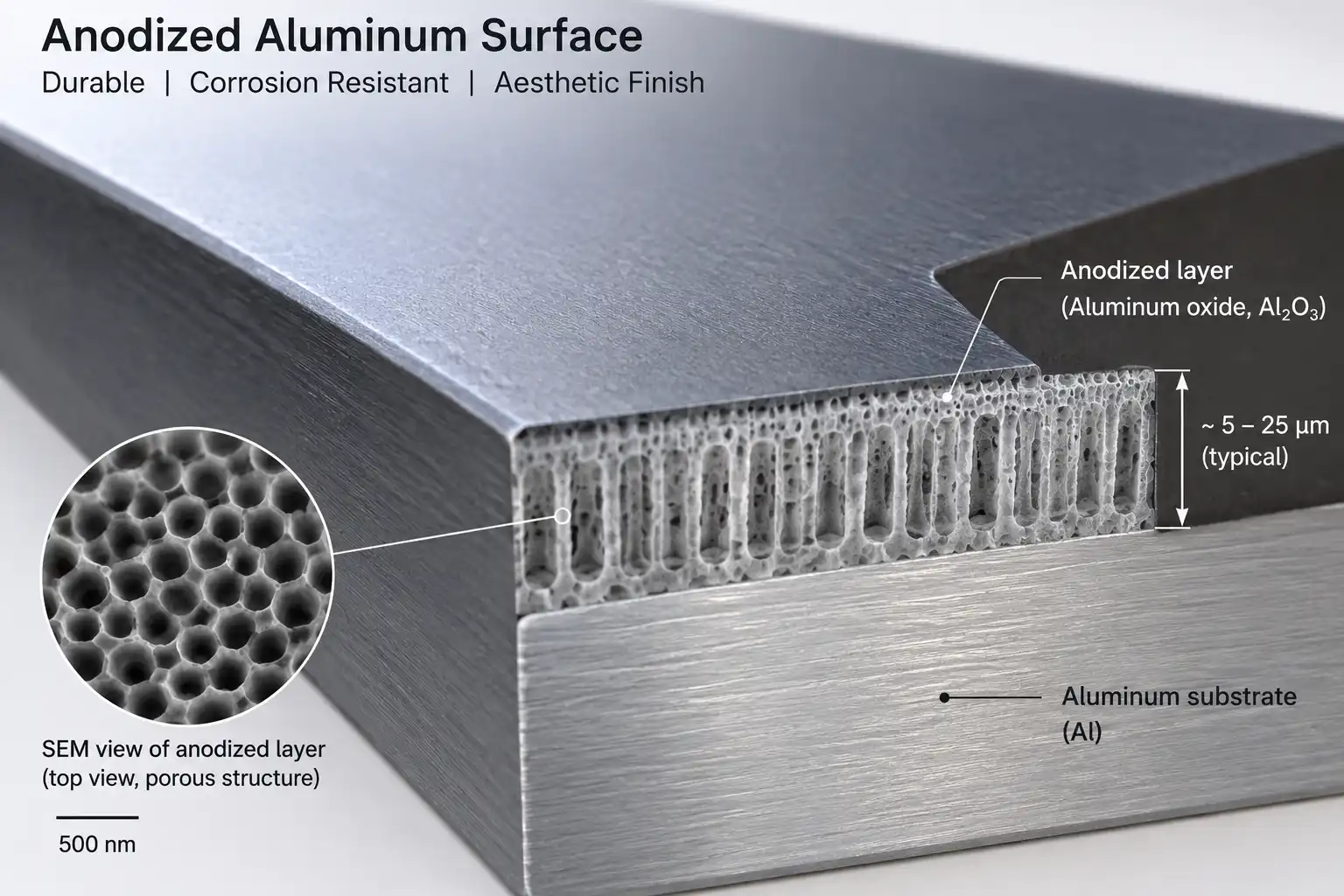
Paint is normally an added coating. Anodizing forms an oxide by converting the aluminum surface itself. Part of that film occupies space once occupied by metal; part grows outward. The Aluminum Anodizers Council explains the resulting dimensional change and rework risks. Stripping cannot turn the consumed aluminum back into solid metal.
This also explains why a solvent that lifts paint may leave anodizing untouched. A part can carry several layers: oil, adhesive, an organic topcoat, dye and anodic oxide. Identify which layer you actually need to remove.
Scroll sideways to compare all three stages.
Removing anodized color is not the same as removing the oxide
A colored surface can become pale while clear oxide remains. Conversely, a dark residue after chemical treatment may be smut rather than intact anodizing. Smut is residue left as the surface reacts; its removal requires a compatible finishing sequence, not simply a longer stripping exposure.
Define the endpoint in functional terms: full anodic-film removal for reprocessing, a specified contact resistance at a pad, or an approved preparation for a new coating. “Looks silver” is not a complete inspection requirement.
Identify the alloy and coating before choosing a process
Ask for the alloy, temper, anodizing type, film thickness, sealing condition and any previous rework. Note inserts, bonded joints, blind holes, masked faces and features that must stay coated. If the records are missing, use a finisher or laboratory to narrow the unknowns before treating valuable inventory.
Can chemical stripping remove anodizing without damaging aluminum?
A qualified chemical process can be a practical whole-part route, but “no damage” must be defined by measured limits. A bath that removes oxide may also attack the newly exposed aluminum. Thin or easily reached film may disappear first; that area then remains exposed while thicker or less accessible areas finish stripping.
Caustic stripping needs a metal-loss limit
Sodium-hydroxide-based chemistry can attack both anodic oxide and aluminum. Bath condition, alloy and exposure affect the result. The AAC bulletin on caustic etching shows why appearance is a poor timer: gloss can level off while metal loss continues. Its discussion of etching is not a universal anodize-stripping recipe.
For a production job, ask the finisher how they control the bath, identify the removal endpoint, handle uneven film and verify local loss. An attractive uniform matte finish can still fail a drawing if a bore has opened up or a fitted diameter has become too small.
Specialist strippers still need alloy-specific qualification
Do not treat “deoxidizer,” “desmutter” and “anodize stripper” as interchangeable product names. For example, Cee-Bee A-601L is described by its manufacturer as capable of stripping anodic films and etching aluminum. That is evidence that the functions can overlap—not a recommendation for your part. The product is chromated and requires its own chemical controls.
Use the exact product's current technical and safety data, approved application conditions and cleanup process. A supplier's “low-etch” claim is not a promise of zero loss on every alloy, film or geometry.
Oven cleaner and drain cleaner are not precision rework procedures. A caustic ingredient may explain why they affect anodizing, but household instructions do not control aluminum loss. NIOSH identifies sodium hydroxide as corrosive and incompatible with aluminum. Reaction hazards include heat and possible hydrogen generation. Do not mix household chemicals or use sealed reaction containers; use a professional finisher if the required controls are unavailable.
When do sanding, blasting or machining make sense?
Mechanical removal cuts through the film rather than dissolving it. It is useful when the target area is accessible and the design allows changes in texture or stock. The trade-off is that the tool does not automatically stop at the oxide–metal boundary.
Sanding and polishing suit accessible surfaces with allowance
Flat, noncritical surfaces are easier to control than sharp corners, grooves and thin edges. High spots can lose metal while recesses still retain film. A polished reflection can also hide waviness, so inspect dimensions and texture separately from brightness.
Polishing can reduce scratches only by removing surrounding material. It cannot fill a pit or restore an undersized feature. If the part has little allowance, trying to polish away a stripping defect can turn a cosmetic problem into a dimensional reject.
Blasting trades film removal for a new surface texture
Media, impact angle, pressure, distance and exposure all affect the surface. Trial the same geometry, including recesses that can retain abrasive. Plan cleaning and inspection for embedded or trapped particles before painting, bonding or assembly.
Dust collection must match the actual material and process. NIOSH warns that finely divided aluminum can ignite and cause explosions. An ordinary shop vacuum is not a substitute for an assessed combustible-metal-dust collection system.
Local machining can define a contact pad precisely
A controlled machining operation may suit a small pad if the drawing permits the removal depth. Check tool access, fixture datum, burr control and final flatness. For repeat production, ask whether masking that area during anodizing would avoid a separate removal step altogether.
Can a laser remove anodizing without damaging the surface?
A laser can modify or remove anodic films, but successful stripping is not established by a white mark or a clean-looking photograph. The useful question is whether a repeatable setting range removes the required film while keeping the substrate within your damage and dimensional limits.
Average power alone cannot answer that question. Wavelength, pulse duration, pulse energy, spot size, focus, scan spacing, overlap and repeated passes change how energy reaches the oxide and aluminum. A setting that works on one decorative sample may fail on a sealed hardcoat, a curved surface or a different alloy.
What a published laser study actually demonstrates
In a 2009 study of anodized aluminum printing plates, Ansari and colleagues found areas of anodic film remaining after picosecond-laser exposure. Separate bare-aluminum controls showed pitting and evidence of melting and resolidification. The work studied printing-surface modification—not a general industrial stripping service.
The lesson is narrow but useful: a changed surface appearance does not prove complete removal, and short pulses do not guarantee undamaged metal. Its settings should not be copied to a handheld cleaner. Read the accepted research paper.
What should an anodizing-removal laser trial include?
- A representative part: match alloy, temper, film thickness, seal and geometry—not only color.
- A mapped test area: include pass overlaps, starts and stops, corners and focus changes.
- Separate removal and damage checks: inspect residual film, texture, depth, pitting and any application-specific thermal concern.
- A repeatability check: repeat the acceptable condition and record the setup before processing a batch.
Proceed only if a usable processing window exists. If complete film removal requires unacceptable erosion or heat effects, choose another route rather than adding passes until the part looks right.
Testing also needs a controlled laser work area, reflection assessment, appropriate guarding and interlocks, extraction and trained operators. The FDA identifies direct and reflected-beam hazards for Class 4 lasers. A finished system's accessible-emission classification and its service conditions must be assessed; process success does not establish laser safety.
How much can dimensions change after stripping?
Allow for four effects: aluminum consumed during the original anodizing, additional metal removed during stripping, cleanup or polishing, and the next finishing cycle. External diameters tend to shrink when material is removed; bores tend to grow. Thin walls and fitted edges can be affected even when the change is hard to see.
A worked diameter example—not a process prediction
Assume an original shaft diameter of 20.000 mm. For this illustration only, a 20 µm anodic film on each surface consists of 10 µm inward conversion and 10 µm outward growth. Actual growth ratios vary; obtain the real process allowance from the anodizer.
- Original metal diameter20.000 mmBefore anodizing.
- After anodizing20.020 mm10 µm outward growth on each side.
- Ideal oxide-only strip19.980 mmThe converted aluminum is not restored.
- With extra substrate etch19.970 mmIf stripping removes another 5 µm per side.
Arithmetic: 20.000 − 2 × 0.010 − 2 × 0.005 = 19.970 mm. These are assumed values, not measured results or a guaranteed etch rate.
A final tolerance of ±0.010 mm around the original diameter would already be exceeded by the ideal-strip result in this example. The decision to rework must therefore come before stripping. Re-anodizing may add outward growth again, but it also converts more metal and is not an automatic repair for a rejected dimension.
How do you verify complete removal and acceptable surface damage?
Use independent checks. A part may pass the coating check and fail its dimensions; it may pass dimensions and fail roughness or cleanliness. Agree the method, locations and limits before treatment so that “good enough” is not decided after damage appears.
Scroll sideways to see each inspection method and its limitations.
| What to check | Useful evidence | What that evidence does not prove |
|---|---|---|
| Residual anodic film | Suitable coating-thickness measurements; microscopy or a qualified destructive check when needed. | A color change or a single continuity reading does not prove complete removal. |
| Dimensions and geometry | Before/after measurements of critical bores, diameters, wall thickness, flatness and edges. | An average mass loss does not locate the worst local attack. |
| Roughness and pitting | Specified roughness measurements, magnified examination and local depth checks where required. | A bright or uniformly matte surface is not a roughness specification. |
| Residue and cleanliness | Checks matched to the next coating, bond, weld or contact process. | Rinsing alone does not demonstrate freedom from smut, trapped media or process residue. |
| Thermal or structural condition | Application-specific inspection when the treatment or part function warrants it. | A visually smooth laser track does not exclude subsurface or thermal effects. |
Choose a coating measurement that can resolve the remaining film
Eddy-current instruments can measure anodic coating thickness on aluminum when used within their capability. ASTM B244 describes this method and the need for suitable calibration. Match the reference to the substrate and account for probe range, geometry and surface condition. A zero display below the instrument's resolution is not proof of an atomically oxide-free surface.
Aluminum forms a thin native oxide again in air. The practical endpoint is removal of the specified anodic layer—not permanent absence of all oxygen at the surface. Likewise, a probe can contact metal through a scratch or at an edge while film remains elsewhere.
Record defects before treatment as well as afterward
Baseline photos and measurements help distinguish new pits from existing corrosion or machining marks. When inspection finds patchy film, deep attack, melted tracks, rounded edges or a failed fit, hold the part for review. More stripping, polishing or laser passes are not automatically acceptable corrective actions.
What is a controlled removal and refinishing workflow?
- Define the finished requirement. State the next finish or operation, protected areas and permitted rework. Obtain design approval for critical parts.
- Identify and measure the incoming part. Record alloy, temper, coating information, photos and the critical dimensions that must survive.
- Agree a removal route and stop limits. Specify maximum loss, surface limits, endpoint checks, cleanup and how a failed trial will be handled.
- Trial representative material. Include difficult features and verify the result before committing valuable parts or a full batch.
- Process under the validated instructions. Use controlled equipment, trained operators and the exact approved chemical or machine setup.
- Inspect, refinish and release. Complete the approved cleaning sequence, check the agreed criteria, apply the next finish and retain the rework record.
The exposure time is only one part of the job. Masking, fixturing, inspection, cleanup and refinishing can determine the real lead time and cost. Compare quotes for the same finished requirement, not just minutes in a bath or seconds under a laser.
Choose the next finish before stripping
For re-anodizing, let the anodizer review remaining dimensions, surface texture and preparation. A new film will not restore lost stock or hide every scratch. For painting or bonding, follow the approved preparation system; for welding, follow the relevant welding procedure; for electrical contacts, specify resistance and environmental protection.
Plan waste collection before the trial
Used liquid, rinse water, filters and collected residue can contain process chemicals and metals. Neutral pH alone does not establish that waste may be discharged. In the US, the EPA metal-finishing framework includes anodizing and chemical etching, with applicability and permit requirements depending on the facility. Use the site's environmental specialist and local rules to establish a collection and disposal route.
Questions about anodizing removal and rework
Does acetone remove anodizing?
Ordinary acetone is not a practical anodic-oxide stripper. It may remove organic contamination or a topcoat, which can change appearance while leaving the anodic layer in place. Identify the coating stack rather than interpreting a cleaner-looking surface as complete removal.
Can hard anodizing be stripped and applied again?
Sometimes, if an approved rework route leaves enough material and preserves the required finish and function. Hardcoat wear surfaces, fits and thin features need particular attention. Ask the anodizer and design authority to review the complete strip-and-recoat allowance before processing, not after the first coating is gone.
When is replacement better than stripping?
Replacement may be the better option when the remaining allowance is insufficient, material or coating identity cannot be established, the trial causes unacceptable attack, or the required fit and surface properties cannot be recovered. Safety-critical parts must follow their approved repair and release requirements; cosmetic success is not a substitute.
Need to evaluate laser removal on an anodized part?
Send Oceanplayer Laser the alloy and temper, coating thickness and seal if known, clear photos, the area to remove, critical dimensions, permitted material loss and the next operation. Include the required inspection result—not only the desired appearance.
A representative trial should establish whether laser processing is suitable before machine selection or batch approval. Chemical or mechanical rework may be the better choice when it meets the same requirements with lower risk or cost.
Discuss your part and trial requirementsTechnical references
These sources support the process mechanisms, measurement principles and safety context. They do not certify a repair or establish settings for an untested part.
- Aluminum Anodizers Council — Anodized Aluminum FAQ: conversion-film growth and dimensional considerations.
- AAC — Technical Bulletin 2-99, Caustic Etch (2013): process variables, appearance and ongoing metal loss.
- McGean Cee-Bee — A-601L: manufacturer example of a chemistry that both strips anodic films and etches aluminum.
- Ansari et al. — Modification of Aluminium Surface Using Picosecond Laser for Printing Applications (2009): findings from a specific printing-plate experiment.
- ASTM B244 — Eddy-current coating-thickness measurement: method scope and calibration principles; use the edition required by the applicable specification.
- NIOSH — Sodium Hydroxide and Aluminum: chemical incompatibility and fine-metal-dust hazards.
- FDA — Laser Products and Instruments: laser hazard classes.
- US EPA — Metal Finishing Effluent Guidelines: US wastewater regulatory context.
About Oceanplayer Laser
Oceanplayer Laser provides industrial laser equipment. This guide helps buyers and manufacturing teams frame process-selection and trial questions; it does not replace an approved repair specification or site-specific safety assessment.