

Tape adhesive, label residue, light glue dots and a small smear are often easier to control than a thick bead.
Adhesive residue removal · metal surface preparation guide
Can Laser Cleaning Remove Adhesive and Sealant From Metal?
A practical guide to removing glue, tape residue, cured sealant and sticky films without approving a process from appearance alone.
Direct answer
Yes, often—when the residue is thin, exposed and known. Laser cleaning is usually strongest as a controlled finishing process. Thick cured sealant, filled epoxy and residue trapped inside a joint normally need bulk removal first, followed by laser cleaning and a representative coupon test.
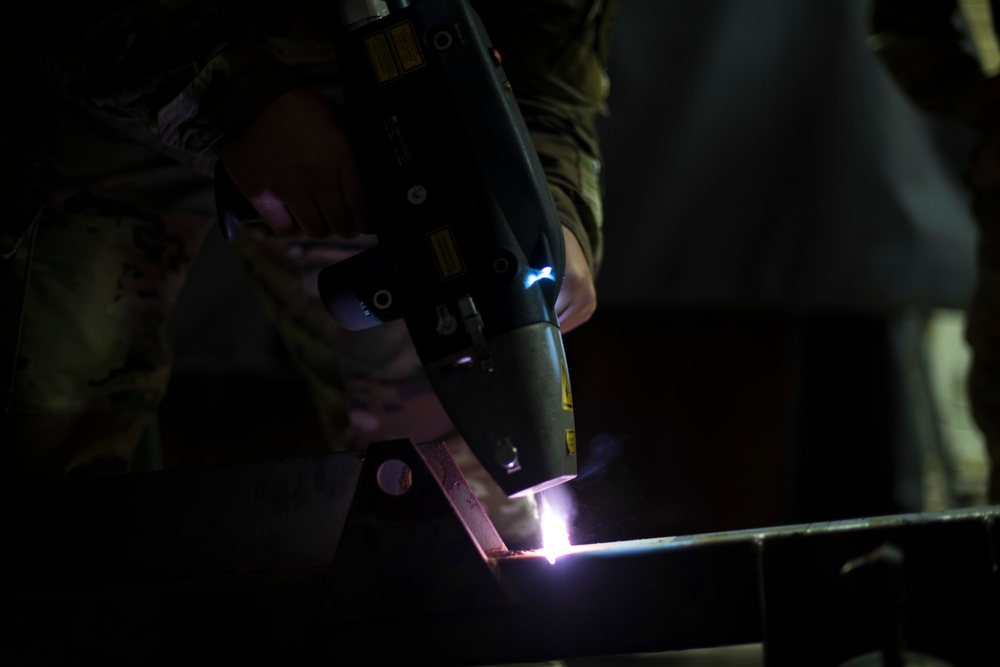
Image: U.S. Air Force / SrA Zachary Heal, DVIDS, public domain.
When Is Laser Cleaning a Good Fit for Adhesive Residue?
These four checks decide whether laser cleaning should lead the process, finish it, or stay out of it.
Peel, scrape or cut away the main sealant mass. Use the laser for the thin film that remains on accessible metal.
Some polymers carbonize, smear or create a dark film before the interface is clean. More power can make that worse.
A bright surface is not proof. Verify the weld, bond, coating, electrical contact or sealing result that matters.
Define success first
What Does “Fully Removed” Mean for the Next Process?
Laser cleaning does not dissolve glue. The beam deposits energy into the contamination and sometimes the metal below it. Depending on the material, the residue may soften, decompose, vaporize, fracture, expand or eject from the surface. The correct endpoint depends on what happens next.
A surface that looks clean to the eye can still carry a thin organic film. That film may be harmless for a cosmetic repair but unacceptable for structural bonding or an electrical contact. The cleaning specification should therefore name the next process and its pass/fail test.
Do not approve the process from color alone.
Use a representative part or coupon, record the laser conditions and check the property that affects production: weld porosity, bond strength, coating adhesion, contact resistance, leak rate or dimensional condition.
01
Welding or brazing
Control hydrocarbons and polymer remnants that may create gas, inclusions or unstable wetting.
02
Adhesive bonding
Measure surface energy and confirm bond strength and failure mode on the real adhesive system.
03
Painting or coating
Check water-break behavior or a specified cleanliness method, then test coating adhesion.
04
Electrical contact
Verify contact resistance; invisible residue or oxide changes may still affect performance.
05
Sealing surface
Protect flatness, roughness and edges, then verify leak performance with the new seal.
Interactive planning aid
Should You Laser This Adhesive Residue?
Choose the closest conditions. The result is a screening route for discussion, not a qualified process recipe.
The selector intentionally does not provide universal power, speed or frequency settings. Those values must be established on representative coupons with the actual residue and metal finish.
What the beam actually does
How Does Laser Cleaning Release Adhesive From Metal?
The useful process window appears when the contamination absorbs enough energy to release while the metal and its functional finish remain acceptable.
01
AbsorbThe residue and metal absorb different fractions of the beam. Color, fillers, thickness and wavelength change the balance.
02
HeatLocal temperature rises. A polymer may soften, expand or begin to break into smaller molecules.
03
ReleaseThermal stress, gas pressure or rapid expansion weakens the bond between the residue and metal.
04
EjectVapor, particles and fragments leave the surface. Some materials instead smear or form char.
05
CaptureSource-capture extraction must collect the plume before it spreads or settles back onto the part.
Reviews of laser cleaning mechanisms describe ablation, gasification, vibration and explosive stripping as interacting processes. The dominant mechanism changes with the contamination, substrate and pulse conditions—which is why a copied parameter sheet is not a qualification plan.
Residue family matters
Which Adhesive and Sealant Residues Are Good Laser Candidates?
The labels below are starting directions. Formulation, age, fillers, curing history and surface preparation can change the behavior.
| Residue | Typical laser fit | What may happen | Practical starting route |
|---|---|---|---|
| Tape or label adhesive | Often promising | A thin pressure-sensitive film may soften and eject. Old residue may carbonize. | Remove the tape carrier first; screen a pulsed finishing pass. |
| Hot-melt adhesive | Case dependent | Heat can make the polymer flow or smear before it releases. | Cool, scrape bulk material, then test short controlled passes. |
| Light uncured silicone or PU | Case dependent | Wet material can redistribute. Thin contamination may respond differently from a bead. | Remove wet bulk without spreading it; laser only the remaining trace after a coupon test. |
| Cured silicone sealant | Usually hybrid | Elastic bulk absorbs time and can produce heavy fume or residual silicon-containing contamination. | Cut or peel the bead; laser-finish the accessible metal. |
| Cured polyurethane | Usually hybrid | May char, smoke and leave a film. Filled grades can respond unevenly. | Mechanical bulk removal plus controlled laser finishing. |
| Epoxy or filled structural adhesive | Demanding | Hard, thick material may require high energy and risk substrate heating or roughness change. | Use machining or other bulk removal first; assess laser only for a thin final layer. |
| Cyanoacrylate or threadlocker | Test required | Thin films can be responsive, but blind threads and joints are a line-of-sight problem. | Open-surface coupon test; use another method inside closed features. |
| Unknown adhesive chemistry | Stop and identify | Decomposition products, fluorinated ingredients or metal coatings may create unplanned hazards. | Obtain the SDS and process history before any laser trial. |
Select control before speed
Should You Use a Pulsed or CW Laser?
There is no automatic winner, but their normal strengths are different. Thin residue on a valuable surface often favors control; large, robust parts with heavy contamination may justify a CW comparison.
Pulsed laser cleaning
Short pulses can concentrate energy in the surface layer while limiting average heat input. This often makes pulsed systems a better first screening route for thin residue, precision surfaces, aluminum, copper alloys, plated parts and bond preparation.
- Better control for thin films and sensitive surfaces
- Useful for multi-pass process development
- Can still change oxide, color or roughness if the window is too aggressive
- Common commercial ranges include 200W–500W pulsed cleaners
CW laser cleaning
Continuous-wave systems offer high average power and production speed on robust surfaces. For sticky organics, that same heat can increase smearing, charring and part-temperature rise, so CW should be proven rather than assumed.
- Potentially faster on broad, heat-tolerant work
- More thermal accumulation during slow travel or repeated passes
- Needs close control near thin sheet, coatings and precision faces
- Compare with 1000W–3000W CW platforms only after feasibility is established
Power is not the recipe.
Wavelength, pulse energy, pulse width, frequency, spot size, focus, scan speed, hatch spacing, overlap, number of passes, extraction and part temperature work together. Use the pulse energy and frequency calculator to understand relationships, then qualify the real process on coupons.
Protect the surface beneath
How Does the Metal and Surface Finish Change the Risk?
The substrate controls heat flow, reflection, oxidation and the cost of surface damage. Include the actual finish in every trial.
Often a forgiving development surface, but excessive energy can create discoloration, oxide change or roughness. Check the surface if painting or precision sealing follows.
Watch heat tint and surface chemistry. A bright appearance does not prove that an adhesive-bond or corrosion requirement has been met.
High thermal conductivity and a functional oxide layer make process control important. Thin sheet can distort, and anodizing may be damaged.
High reflectivity and conductivity can narrow the process window. Confirm the laser source is suitable and protect electrical-contact requirements.
The adhesive may sit over a thin functional layer. Cleaning that removes zinc, nickel, paint or conversion coating can create a new defect.
Flatness and roughness may matter more than appearance. Use metrology before and after the trial and inspect edges and grooves separately.
The practical route for thick sealant
When Should You Remove the Bulk Residue First?
A hybrid sequence usually reduces cycle time, fume and heat while preserving the laser’s strongest advantage: controlled removal of the thin film left on accessible metal.
Confirm the adhesive or sealant, read the SDS, isolate the work and decide how removed bulk material will be collected.
Peel, cut, scrape or machine the raised bead without gouging the metal or spreading uncured material.
Use controlled passes, effective overlap and source capture. Stop if char grows, the part overheats or the finish changes.
Inspect residue and surface condition, then run the downstream weld, bond, coating, contact or leak test.
From demonstration to process
How Do You Validate Laser Adhesive Removal for Production?
Published work on silicone contamination and bonded aluminum shows why surface analysis and mechanical testing belong together. The exact limits still depend on your adhesive, metal and acceptance standard.
Define the endpoint
State the next operation, acceptance limit and measurement method. “Looks clean” is not a complete specification.
Build representative coupons
Match alloy, finish, residue chemistry, thickness, aging, geometry and temperature as closely as practical.
Screen a safe window
Begin conservatively. Vary one group of parameters at a time and record passes, overlap, focus, extraction and part temperature.
Inspect both residue and metal
Use magnification and a suitable cleanliness method. Add roughness, color, gloss or dimensional checks where the surface is functional.
Run the downstream test
Weld, bond, coat, assemble or seal the coupon. Measure performance and inspect the failure mode, not only the average result.
Challenge repeatability
Test normal variation: more residue, aged adhesive, corners, operator changes, long shifts and a loaded extraction filter.
Freeze the measurement method and failure boundary before testing
There is no universal cleanliness number for every metal and downstream process. The buyer, drawing, customer specification or qualified baseline must supply the limit. Record the method, unit, sample location and fail condition so the same decision can be repeated during factory acceptance and production.
Swipe sideways to view the full acceptance table.
| What to verify | Possible method | Unit | Failure boundary to define |
|---|---|---|---|
| Visible residue and char | Controlled lighting and magnified inspection at named locations | Pass/fail or affected area | Any film, char, redeposition or missed geometry beyond the agreed visual standard |
| Surface wetting | Contact angle or qualified surface-energy test | Degrees or mN/m | Outside the approved range established for the next bond, coat or seal |
| Surface finish | Profilometer and finish inspection before and after cleaning | Ra or Rz in µm | Outside the drawing or qualified process window; coating or plating damaged |
| Bond performance | Peel, lap-shear or another joint-specific coupon test | N/mm or MPa | Below the engineering requirement or with an unacceptable failure mode |
| Electrical contact | Four-wire or specified contact-resistance measurement | mΩ | Above the product specification or unstable across repeated samples |
| Thermal effect | Validated sensor or thermal imaging at the defined location | °C | Above the limit for the metal, finish, adhesive, fixture or nearby component |
| Production rate | Complete cycle from load through approved inspection | Seconds/part | Longer than takt time, or dependent on unplanned rework and extra passes |
Evidence boundary
Published adhesive-bond studies measure more than appearance.
A 2026 open-access study of laser treatment on silicone-contaminated aluminum linked the cleaning step to surface condition and later bond testing. That supports the method used here: inspect the metal and test the next operation. It does not provide one transferable setting for every silicone, alloy or laser. Review the study record.
Troubleshooting by symptom
What Do Common Adhesive-Removal Failures Mean?
Black char remains
The polymer is decomposing faster than it releases. Reduce thermal buildup, improve removal between passes or use bulk removal first.
Residue smears
The adhesive is softening and moving. Shorter interaction, cooling, scraping or a different sequence may be needed.
Striping appears
Hatch spacing or overlap is inconsistent. Check scanner calibration, stand-off, focus and actual working width.
Metal color changes
The substrate or its oxide is being affected. Lower the energy delivered per area and verify surface chemistry and function.
Bond test still fails
Invisible organics, oxide change, low surface energy or poor adhesive compatibility may remain. Add surface analysis and failure-mode review.
Corners stay dirty
The beam or extractor lacks line of sight. Change orientation, add a smaller head or use another method in blind geometry.
Part temperature climbs
Average heat input exceeds cooling. Increase travel, add dwell between passes, fixture heat-sensitive parts or reconsider CW use.
Results drift during a shift
Optics, focus, filter loading, residue variation or operator stand-off may have changed. Define checks and maintenance intervals.
Non-negotiable controls
What Safety and Fume Controls Are Required?
Class 4 laser work can create eye, skin, fire and plume hazards. Adhesive removal adds another uncertainty: the laser can generate decomposition products that are not present during normal room-temperature use.
- Identify the chemistry. Review the SDS, including exposure controls and hazardous decomposition information. Unknown fluorinated or halogenated materials need specialist review.
- Prefer an enclosure. Use validated guarding, interlocks, beam stops and a formal laser safety program. Treat reflections from metal as part of the hazard analysis.
- Capture at the source. Position extraction near the plume and select filtration for the real contaminant. Use the airflow planning calculator only as a starting estimate.
- Control fire and residue. Remove combustible bulk material, protect nearby equipment and plan for filter and waste handling.
- Monitor the process. Stop for unexpected odor, dense smoke, repeated flame, optic contamination, overheating or surface damage.
NIOSH recommends engineering controls, ventilation, training and appropriate protective equipment for laser-generated airborne contaminants. Your laser safety officer and industrial hygienist should approve the actual setup.
Choose the whole process
When Is Another Removal Method Better?
Compare methods against the required surface, access, waste stream, cycle time and risk—not only the removal speed.
Peeling, scraping or machining
Efficient for thick beads and hard bulk adhesive. It can gouge precision metal, struggle with a final film and require tool-access planning.
Heat or dry-ice-assisted removal
May soften or fracture some residues. Evaluate part temperature, condensation, noise, secondary waste and material compatibility.
Solvent or adhesive remover
Can reach some complex surfaces but may create VOC, compatibility, drying and disposal issues. It can also leave a film.
Bulk removal plus laser finishing
Often the best balance for raised sealant on accessible metal: fast bulk removal followed by a controlled, dry finishing step.
Prepare a useful sample test
What Should You Send for an Application Test?
A good request lets the supplier reproduce the difficult part of your job and propose a test that can actually be approved.
Metal and finish
Alloy, thickness, coating, plating, anodizing, roughness and any dimensional limit.
Residue identity
Product name, SDS, cured or uncured state, fillers, age and previous cleaning chemicals.
Amount and geometry
Film or bead thickness, coverage, corners, holes, overlap joints and line-of-sight constraints.
Required endpoint
Welding, bonding, coating, electrical contact, sealing or cosmetic restoration.
Pass/fail method
Cleanliness check, surface energy, roughness, weld quality, bond strength, contact resistance or leak result.
Production target
Parts per shift, available takt time, manual or automated handling, extraction and site power.
Let Oceanplayer Laser test the real residue–metal pair
Request application reviewShare photos, the adhesive SDS, sample parts and your downstream acceptance test. We can help compare a pulsed cleaning route with other practical options.
Continue planning
Continue Planning Your Laser Cleaning Process
Frequently asked questions
Frequently Asked Questions About Laser Adhesive Removal
Can laser cleaning remove tape residue from metal?
Often, yes. Thin, exposed pressure-sensitive adhesive on bare metal is a reasonable screening case. Remove the tape carrier first, identify the adhesive where possible, use source-capture extraction and confirm that no thin organic film remains.
Can a laser remove cured silicone sealant?
It may remove a thin remaining trace, but using a laser to consume an entire cured silicone bead is often slow and fume-intensive. A better route is usually cutting or peeling the bead, then laser-finishing the accessible metal and verifying the new bond or seal.
Will laser cleaning damage aluminum under the adhesive?
It can if the process window is too aggressive. Aluminum conducts heat well, while its oxide or anodized finish may be functionally important. Start with conservative pulsed trials, monitor temperature and inspect roughness, color, oxide condition and downstream performance.
Is pulsed laser cleaning better than CW for glue?
Pulsed cleaning is often the safer first route for thin residue and sensitive surfaces because it can limit average heat input. CW may be useful on broad, robust parts, but heat can cause adhesive smearing, charring or part distortion. Test both only when the application justifies it.
How do I know when all adhesive residue is gone?
Use a method tied to the next process. Options include magnified visual inspection, a controlled wipe test, contact-angle or surface-energy testing, chemical surface analysis, roughness measurement and a representative weld, bond, coating, resistance or leak test.
What should I send for an Oceanplayer Laser sample test?
Send representative parts, the alloy and finish, residue product name and SDS, photos, layer thickness or bead size, annual volume, geometry constraints and the downstream pass/fail test. Difficult and aged samples are more useful than a perfectly prepared demonstration coupon.
Technical references
Sources and Technical Review
- Investigations on 2Cr13 Stainless Valves after Dry-Type Laser Degumming. Experimental study of laser glue removal from stainless valve components.
- Research Progress on Laser Cleaning Technology for Surface Treatment of Aluminum Alloy. Review of laser-cleaning mechanisms and aluminum-surface effects.
- Laser treatment of silicone-contaminated aluminum surfaces for adhesive bonding. 2026 open-access study linking cleaning, surface condition and bond testing.
- Monitoring laser cleaning for form-in-place-gasket silicone adhesive bonding. Fraunhofer publication using analytical and mechanical validation.
- Influence of laser surface preparation on adhesively bonded metal joints. Demonstrates why adhesive, material and failure mode must be evaluated together.
- NIOSH: Laser and plasma cutting workers. Overview of laser radiation, fire and airborne-contaminant controls.
- OSHA Hazard Communication Appendix D. Safety-data-sheet content, including exposure controls and decomposition information.