

Pulse Laser Cleaner vs Dry Ice Blasting: Cost and ROI
Neither method is always cheaper. A pulse laser cleaner usually places more cost in installed equipment, safety controls, extraction and process development. Dry ice blasting usually places more cost in CO₂ media, compressed air, logistics, ventilation and repeat service. The fair comparison is total cost per qualified part, area or maintenance event.

Laser is front-loaded
Count the source, delivery head, motion or stand, controlled zone, interlocks, extraction, fixtures, electrical work, training and validation—not only the portable unit.
Installed scope decides the real entry cost.Dry ice is input-heavy
Pellets, compressed air, delivery, storage loss, ventilation, noise control, labor and debris collection repeat every time the process runs.
Existing air is capacity—not free energy.Count accepted work
Use qualified parts, accepted square meters, released molds or completed maintenance events. Apparent cleaning speed means little if inspection, rework or cleanup follows.
Cost per qualified unit exposes false savings.Trial first, model second
Freeze the surface endpoint, test representative variation, meter inputs and record nonproductive time. Then run low, expected and high workload cases.
No universal winner or payback period exists.Machine price is not the decision
Two quotes are comparable only when both deliver the same accepted surface under the same site conditions. A bare laser head and a complete dry ice service are not equivalent scopes.
A useful comparison begins with a defined cleaning job: base material, contaminant, coating or oxide thickness, geometry, access, allowable surface change, final cleanliness or roughness, inspection method, annual workload and shutdown window. The question is not simply “Which machine costs less?” It is “Which released process produces the required endpoint at the lowest credible life-cycle cost?”
A fast visual result can still fail. Laser overexposure may change roughness, color, oxide condition or the substrate. Dry ice may leave tightly bonded coating, embedded contamination or a surface that looks clean but does not meet adhesion, weld or electrical-contact requirements. Both methods can also release hazardous material from the workpiece. Include acceptance testing and the cost of rejected work before discussing ROI.
Use one business unit throughout the model. For a production line, that may be an accepted part. For mold maintenance, it may be one released mold. For surface preparation, it may be a measured area that passes an adhesion or contamination test. For a contractor, it may be a completed maintenance event. This denominator prevents high apparent speed from hiding setup, inspection, rework and cleanup.
Work that passes
A part, area or event that meets the agreed endpoint without unplanned repair or a second cleaning method.
Avoidable cash cost
Labor, outsourcing, consumables, waste, overtime or downtime that finance can verify will actually decrease.
Value needing proof
Capacity, quality, safety or environmental improvement that matters but should not be counted twice as cash savings.
Compare two complete, safe and commissionable methods. Include air or electricity, ventilation or extraction, training, qualification and disposal. “No secondary blast media” does not mean “no waste,” and “nonconductive media” does not authorize cleaning energized equipment.
Which method starts ahead?
Choose the closest condition for the real job. The output is a screening direction, not an equipment approval or operating procedure.
The job is not defined well enough to favor one route. Freeze the substrate, layer, endpoint and workload, then run matched trials.
- Use identical starting samples and acceptance criteria.
- Meter dry ice, air, electricity, labor and cleanup.
- Include a third method if the target is thick or deeply bonded.
Why the two methods behave differently
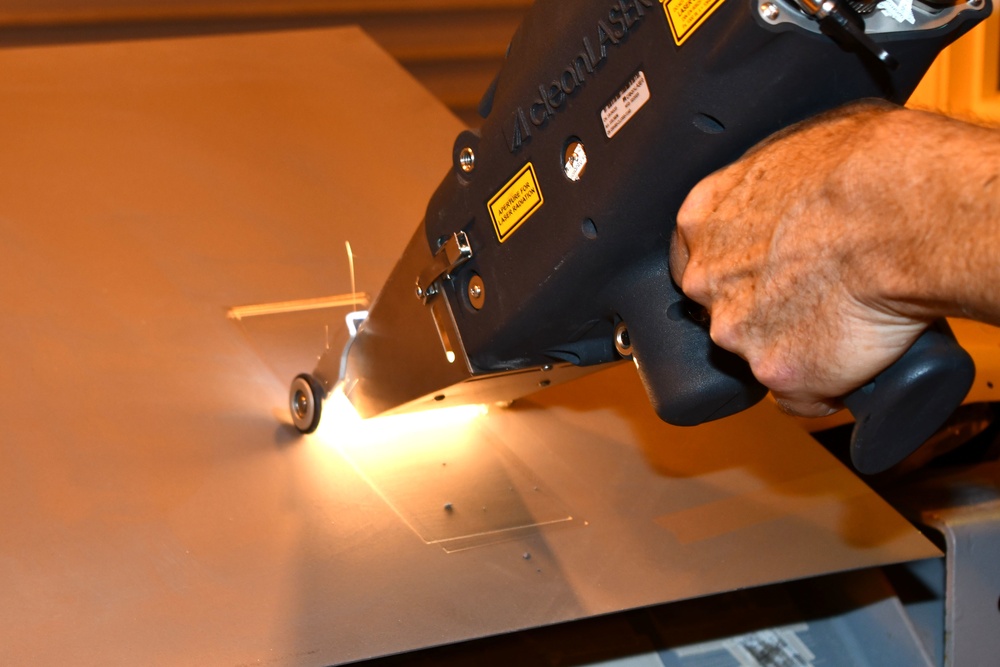
A pulsed laser delivers short bursts of optical energy to a selected surface layer. Absorption, pulse energy, wavelength, spot size, overlap, focus and travel speed determine whether the layer heats, fractures, decomposes or detaches. This can support selective treatment and automation, but only after the real layer and substrate are tested. The beam is not a universal “rust eraser,” and excessive energy or repeated passes can change the base surface.
Dry ice blasting accelerates solid CO₂ particles in compressed air. Particle impact, local thermal change and sublimation help release deposits. The CO₂ turns to gas, so it does not add a sand- or plastic-media residue. The removed oil, coating, soot, corrosion product or hazardous material remains and may need containment, collection and disposal.
Selective versus flexible
Laser can target a repeatable narrow zone and support documented recipes. Dry ice can follow irregular machinery and reach features with a hand-guided blast stream.
Energy versus material flow
Laser cost includes whole-cell electricity for the source, cooling if used, extraction, motion and auxiliaries. Dry ice cost includes pellets plus the real compressor energy or fuel needed at the nozzle.
Different proof of success
A visual check may be enough for some housekeeping tasks. Bonding, coating, welding, electrical contact or corrosion work can require residue, roughness, adhesion or downstream performance tests.
Neither method is damage-free
Laser exposure can alter oxide, roughness or heat-sensitive material. Dry ice blasting can affect delicate features, dislodge seals or fail to remove a strongly bonded layer. Validate the real assembly.
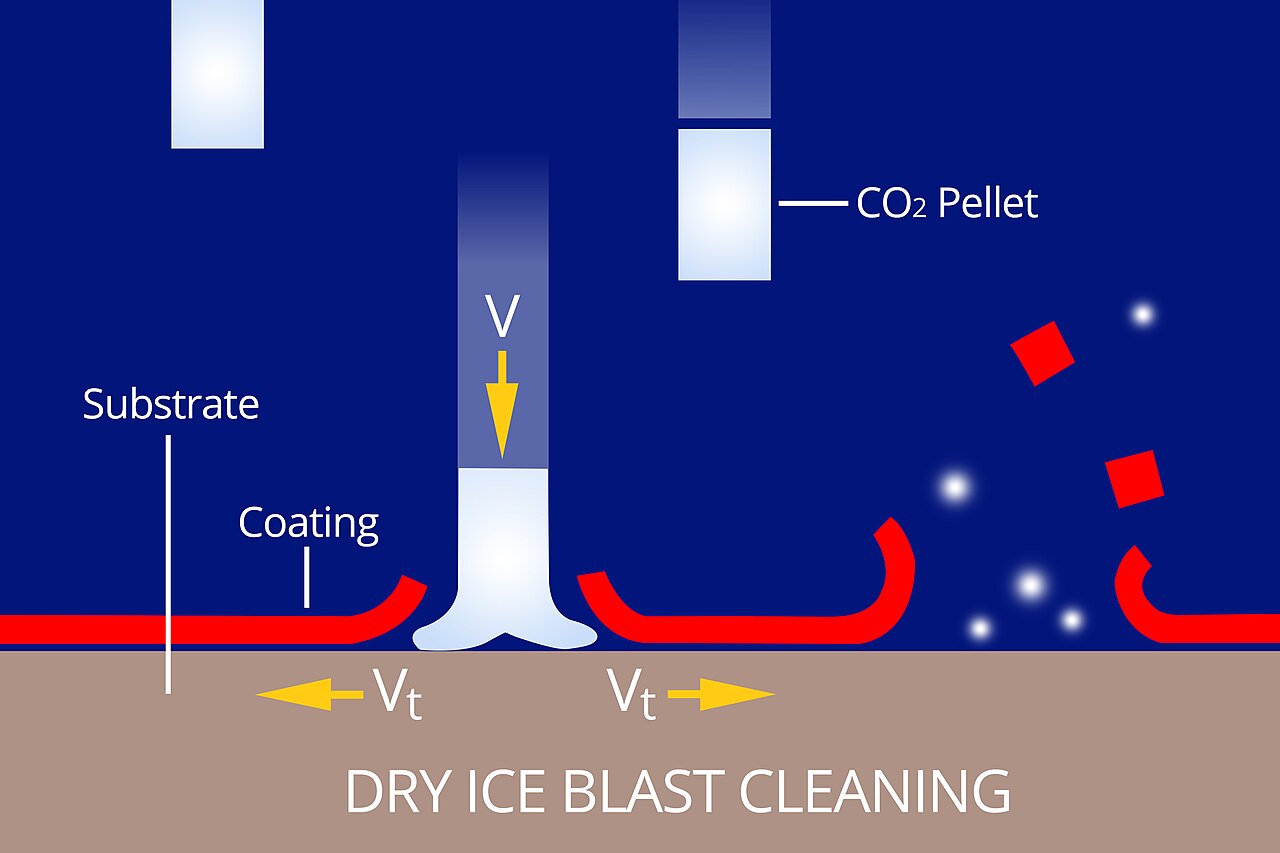

Dry ice blasting is not the same as every CO₂ snow-cleaning process. Particle size, feed method, nozzle, pressure and application design differ. Compare the exact quoted equipment and test method rather than treating all solid-CO₂ cleaning as one category.
Put every required cost inside the boundary
Installed capital is only the first layer. Labor, inputs, controls, nonproductive time and rejected work can change the answer more than the equipment quote. Use the same categories for both methods and ask suppliers to state what their offer excludes.
| Cost category | Pulse laser cleaner: include | Dry ice blasting: include | Evidence to collect |
|---|---|---|---|
| Installed project | Laser source and head, stand or robot, controlled zone or enclosure, interlocks, beam stops, extraction, filters, fixtures, utilities, integration, commissioning and training. | Blaster, hopper, nozzles, hoses, verified compressor capacity or portable compressor, air treatment, CO₂ storage and handling, ventilation, containment, commissioning and training. | Line-item scope, layout, utility schedule, exclusions, responsibility matrix and acceptance test. |
| Direct labor | Loading, fixture adjustment, focus checks, recipe selection, scanning, inspection, filter and protective-window service, fault recovery and handling. | Setup, pellet handling, hose movement, blasting, refill, inspection, containment, debris cleanup and supply coordination. | Timed production study that separates active cleaning from setup, waiting, inspection and cleanup. |
| Media and utilities | Whole-cell kWh: source, cooling if present, extraction, motion, controls and auxiliaries. Add shop air only if the quoted system needs it. | Dry ice mass, delivered price or pelletizer economics, storage loss, compressed-air electricity or fuel, dryers, filters and ventilation. | Metered or allocated consumption under the representative operating condition—not brochure maximums or a free-utility assumption. |
| Maintenance | Protective windows, optics cleaning, filters, cooling system, scanner or robot checks, interlocks, source service, calibration and planned downtime. | Nozzles, hoses, seals, feeder and hopper components, compressor service, dryers, filters, control checks and planned downtime. | Service intervals, labor, consumable list, warranty boundaries, failure response and uptime assumptions. |
| EHS and waste | Laser safety program, access control, extraction, filter disposal, fire awareness, plume-specific PPE and treatment of collected residue. | CO₂ ventilation or monitoring, cold-contact PPE, noise control, high-pressure-air controls, containment and disposal of removed contamination. | Site risk assessment based on the actual coating or contaminant, room and work practice. |
| Quality and downtime | Coupon development, recipe control, inspection, rework, part handling, changeover and production time lost during faults or maintenance. | Trial development, inspection, repeat passes, pellet resupply, compressor availability, cleanup and production time inside the cleaning window. | Qualified output, defect and rework records, downtime logs and downstream performance—not visual speed alone. |
Cost categories are a planning framework, not a price list. Add taxes, freight, financing, floor-space, permits, insurance, outsourcing, disposal or local compliance costs when they are material to the project. Use low, expected and high utilization, meter both energy routes, divide by accepted output and add installed capital only once.
Compare the same business outcome
Enter one currency consistently. Annual cost excludes installed capital; multi-year TCO adds installed capital once. Cost per qualified unit uses only output that passes the acceptance rule.
Illustrative editable example — not a quote or benchmarkDefault values only demonstrate the math. Replace them with supplier scope, measured trial data and finance-approved hard savings. Do not count the same downtime, labor or quality benefit in more than one input.
Pulse laser result
Dry ice result
The result does not prove either process can meet the surface requirement. A lower modeled cost is useful only after both options are technically qualified.
Annual cost = labor + media/utilities + maintenance/EHS/quality

Cost per qualified unit = annual cost ÷ qualified output

Simple payback = incremental installed investment ÷ verified annual hard savings

Multi-year TCO = installed cost + (annual cost × years)
What the calculator deliberately does not do
It does not predict production speed, cleaning quality, machine life, residual value, financing, taxes or inflation. It also does not calculate net present value. For a capital approval, finance can discount yearly benefits and costs using the organization’s approved rate and timing assumptions.
Simple payback appears only when the entered annual method cost is below the current annual baseline. If annual hard savings are zero or negative, the correct output is “No hard-savings payback,” even when the new method has safety, quality or capacity value. Those benefits should be documented separately and converted to money only when the owner can defend the calculation.
The output denominator matters. If the annual volume is 4,000 parts but only 3,700 pass without extra cleaning, use 3,700 qualified units. If a laser trial cleans faster but adds inspection or rework, include those costs. If dry ice avoids disassembly and shortens an outage, include only the verified hours that actually reduce cost or release constrained production.


Recurring inputs can control the answer
Dry ice cost is more than pellet price multiplied by hours. Useful pellets must be available when the job starts. Delivery distance, minimum order, storage method, planned loss, weekend work and emergency response can affect both cost and schedule. A pelletizer changes the model rather than removing the input: add its capital, feed CO₂, energy, service, labor and utilization.
Compressed air is also a production resource. Check required flow and pressure at the blaster under simultaneous plant demand, air quality, hose length, pressure drop and compressor duty. An existing compressor can still consume electricity, require service and limit other equipment. A portable diesel compressor adds rental or capital, fuel, transport, noise and exhaust considerations.
Laser recurring cost is different, not zero. Include electricity for the complete workcell, filters, protective windows, optics service, cooling where present, extraction maintenance, fixtures, trained labor and process-control checks. Filters and collected ablation products can become a meaningful cost when the removed layer contains hazardous metals, coatings or chemicals.
- Use local delivered data.Ask for dry ice price at the actual site and schedule, not a generic commodity number. Ask the laser supplier for complete utility and consumable schedules at the tested duty cycle.
- Measure nonproductive time.Pellet refill, hose movement, focus checks, part loading, barrier setup, inspection, debris collection and permit delays can exceed active cleaning time on small jobs.
- Model utilization honestly.A high-volume laser cell can spread installed cost over more qualified units. A service-based dry ice route can avoid ownership cost when jobs are irregular. Either advantage disappears when the workload assumption is unrealistic.
- Run sensitivity cases.Change workload, labor, pellet price, air cost, filter cost, uptime and rework one at a time. Identify the assumption that flips the preferred option; that is the variable the pilot must measure most carefully.
DOE guidance treats compressed air as an energy system that should be measured and managed. Plant pressure, leakage, controls and end-use efficiency affect its real cost. A blaster’s model-specific air requirement must be matched to the actual system rather than treated as a free utility.
Where each method often starts ahead
This is a trial priority, not a winner table. Geometry, deposit bonding, substrate sensitivity, required endpoint and site controls can reverse the starting direction. Never convert a supplier demonstration rate into a production guarantee.
| Task condition | Likely first trial | Why it may fit | What must be proven |
|---|---|---|---|
| Localized oxide or thin film before welding, bonding or coating | Pulse laser | Selective treatment, recipe control and automation can suit a repeatable narrow zone. | Residual contamination, roughness or chemistry and the downstream weld, bond or coating result. |
| Complex mold or machine with release agent, soot, oil or loose deposit | Dry ice | A hand-guided stream can reach irregular in-place geometry without adding abrasive media. | Complete deposit removal, no unacceptable feature damage, debris control and return-to-service time. |
| High-repeat production with stable part presentation | Pulse laser | Fixed cost may be spread across many qualified units; fixtures and recipes can improve consistency. | Uptime, cycle variation, focus tolerance, extraction capacity and actual annual utilization. |
| Low-frequency, variable maintenance response | Dry ice service or test both | Flexible service may avoid owning an underused laser asset; job access may favor a portable blast route. | Pellet availability, compressor capacity, setup and ventilation at every location. |
| Thick bonded paint, scale or deep pitted rust | Include a third method | Either laser or dry ice may be too slow or fail the required depth/profile on a broad heavy-removal task. | Endpoint, substrate loss, area rate, containment and comparison with mechanical, abrasive or chemical methods. |
| Surface requires a specified anchor profile | Include a qualified profiling process | Cleaning and profiling are different requirements. “Clean-looking” does not prove the needed topography. | Measured roughness/profile and coating or bond performance across normal variation. |
For detailed mold-maintenance differences, see Oceanplayer Laser’s dry ice cleaning vs laser cleaning for mold maintenance. A hybrid route may also be valid: dry ice for general machinery deposits and laser for a local, qualified surface-preparation zone.
Three scenarios show why ROI can reverse
The scenarios contain no claimed production rates or market prices. They show which measurements matter and why the same equipment can be economical in one facility and poor in another.
Complex tool, short maintenance window
A molding team needs to remove release-agent residue and production deposits from complex features. Dry ice may be the first trial because the stream can reach in-place geometry and may reduce disassembly. The model should record setup, active blasting, pellet use, compressor load, debris capture, inspection and the time until the tool can return to service.
A pulse laser may still deserve a trial if the deposit is localized and repeated on the same geometry. Fixtures or automation can make sense when the cleaning path and endpoint are stable. A comparison based only on minutes at the tool would miss pellet logistics, access control, extraction and post-clean verification.
Best denominator: released mold-maintenance event.Repeat aluminum surface zone
A production cell needs a controlled surface before adhesive bonding. Pulse laser cleaning may start ahead because a local path can be integrated and recipe-controlled. The business benefit is not the bright surface; it is an accepted bond, stable cycle, reduced rework and traceable preparation.
Dry ice can be valuable for general equipment housekeeping, but it should not be assumed to create the same chemical or topographic endpoint. Trials must include the actual adhesive, aging condition and joint test. If the laser wins only by assuming every saved minute becomes cash, finance should challenge the model.
Best denominator: accepted bonded assembly.Large irregular asset under outage pressure
A contractor faces a large corroded structure with mixed coatings and restricted access. Dry ice may release loose contamination but may not remove deep pitting or create a coating profile. Pulse laser may remove selected rust or coating but can be constrained by area, line of sight, plume capture and controlled-zone requirements.
The correct comparison includes a mechanical, abrasive or chemical method if it can reach the endpoint faster and safely. A dramatic cleaning clip is not a cost study. The team needs measured area, coating system, corrosion depth, access, containment, disposal route and the actual outage constraint.
Best denominator: accepted area released for the next process.Safe controls belong in the quote
Most industrial cleaning lasers may be Class 4, but the machine nameplate and complete system classification control the assessment. Open-beam work can involve direct and reflected beam hazards, fire, electrical energy and a plume from the removed layer. Guarding or a controlled zone, interlocks where appropriate, beam control, suitable eyewear, training, local extraction and a material-specific waste plan can be required.
Dry ice creates a different hazard set. CO₂ is colorless and odorless. Sublimation can raise concentration in poorly ventilated areas, and dry ice can cause cold-contact injury. High-pressure air, noise, flying debris, hose handling and the toxicity of the removed contaminant also matter. Ventilation and monitoring should be based on room volume, use rate, air exchange and work practice—not on the idea that CO₂ simply “disappears.”
Laser work zone
Define beam paths, reflected energy, access, emergency response, fire risk and plume capture. Use the actual laser wavelength and system information when selecting controls.
CO₂ and ventilation
Assess accumulation, especially in pits, tanks, enclosed rooms or low areas. NIOSH exposure information supports risk assessment but does not replace site monitoring design.
Removed material
Paint, corrosion product, oil or hazardous coating can become airborne or collect as debris. Identify it before choosing filters, containment, PPE and disposal.
Electrical boundary
Neither a dry medium nor a precision beam is permission to work energized. Follow the applicable de-energization, lockout and qualified-person rules for the equipment.
“No water,” “no secondary media,” “non-abrasive” or “portable” do not remove the need for hazard review. Cost the safe operating envelope that will actually be released at the site.

A safe cell or ventilation upgrade can raise installed cost, yet it may also stabilize quality, reduce exposure and support repeat production. Treat the control as part of the process design rather than a hidden surcharge discovered after purchase.
A seven-step pilot for defensible ROI
A useful pilot is a small production study, not a showroom demonstration. It should cover normal and difficult starting conditions, the same endpoint for every method and enough repeat work to reveal setup, variability and nonproductive time.
Freeze the job
Record substrate, contaminant, coating stack, geometry, access, allowable change, work zone, annual demand and time window.
Define acceptance
Choose the visual, residue, roughness, adhesion, weld, electrical or functional test that makes a cleaned unit qualified.
Measure baseline
Time the current method and collect labor, consumables, waste, downtime, rework, outsourcing and quality losses.
Use matched samples
Include ordinary and hard conditions. Record settings, technique, access limits, setup and all inputs for each trial.
Meter the system
Capture dry ice mass, compressor energy or fuel, whole-cell laser energy, filters, optics, PPE, cleanup and disposal.
Record lost time
Count loading, fixture changes, hose or fiber moves, refill, focus checks, containment, inspection, recovery and waiting.
Stress the model
Run low, expected and high workload cases. Release only the safe method, settings, inspection and change-control rules that passed.
A supplier report should state sample identity, starting condition, equipment, settings, operator, passes, active time, total event time, inputs, endpoint, inspection, failed areas and limitations. A cropped before-and-after photo is useful evidence of appearance—not proof of cost, production rate or downstream performance.
Write an RFQ that can support a real comparison
A good request gives both suppliers the same work definition and asks for the same outputs. Share representative samples when practical; disclose hazardous layers and access constraints before the test.
Material and layer
Base material, coating or contaminant, bonding, thickness variation, corrosion severity, photos, sample parts and available SDS or composition information.
What “clean” means
Visual condition, residue limit, roughness/profile, color, adhesion, weld/bond/electrical performance, damage limit and inspection method.
Real workload
Parts or area per shift, annual qualified units, product mix, changeovers, outage window, access, portability and indoor, outdoor or confined-space conditions.
Complete installed scope
Electrical supply, air flow/pressure/quality, ventilation, floor space, robot or fixture needs, material handling, CO₂ storage and transport restrictions.
Transparent assumptions
Installed line items, tested consumption, staffing, maintenance, replaceable parts, qualification, expected setup and a multi-year TCO with sensitivity cases.
Responsibilities and limits
Laser control approach or CO₂ ventilation approach, extraction, noise, PPE, training, debris/filter handling, customer duties and what the quoted process does not guarantee.
Related Oceanplayer Laser tools and guides
Use these pages to refine pulse power, equipment category and cost assumptions. The links are limited to published pages that support the next practical step.
Pulse laser cleaner vs dry ice blasting FAQ
Use these short answers for screening. The correct purchase decision still depends on representative cleaning trials, a site safety review and measured cost data.
Is a pulse laser cleaner cheaper than dry ice blasting?
It can be, but there is no universal winner. Pulse laser cleaning often has higher installed cost and lower dependence on recurring blast media. Dry ice blasting may have a lower equipment entry cost but uses dry ice and compressed air on every job. Compare installed scope, annual operating cost, qualified output and multi-year TCO for the actual workload.
Does dry ice blasting leave any waste?
Dry ice sublimates, so it does not leave a secondary sand, grit or plastic-media stream. The material removed from the surface still remains. Paint, oil, soot, corrosion products, release agent or hazardous residue may need containment, cleanup, testing and disposal.
What costs belong in a pulsed laser cleaning ROI calculation?
Include the laser, delivery head, stand or robot, enclosure or controlled area, interlocks, extraction, filters, fixtures, utilities, integration, training and qualification. Annual cost should include labor, whole-cell electricity, optics and filter consumables, service, inspection, rework, downtime and handling of collected ablation products.
Does dry ice blasting require compressed air?
Yes. Compressed air accelerates the dry ice particles. Required flow, pressure and air quality depend on the exact blaster, nozzle and application. Confirm capacity at the nozzle under real plant demand and include compressor electricity or fuel, service, air treatment, hose loss and any portable-compressor logistics.
Which method is better for mold cleaning?
Dry ice often starts ahead for complex in-place mold geometry and deposits that respond to a flexible non-abrasive stream. A pulse laser can start ahead for a repeatable localized deposit or controlled surface zone. Test representative tools and compare released mold condition, event time, inputs, damage, cleanup and safety controls.
Can dry ice blasting remove deep rust or strongly bonded paint?
Not reliably for every job. Dry ice may remove loose corrosion and many deposits but can be too gentle for deeply pitted oxidation, strongly bonded coating or a required anchor profile. Include mechanical, abrasive, chemical or another qualified method as a third trial when heavy removal defines the task.
Does a pulse laser cleaner need fume extraction?
Plan plume capture or extraction based on the material being removed and the risk assessment. Laser interaction can release particles and vapors from coatings, oxides, oils and contaminants. Extraction, filtration, PPE and waste handling should match the real layer—not only the base metal.
How is simple payback calculated for cleaning equipment?
Simple payback equals incremental installed investment divided by verified annual hard savings. Hard savings are baseline cash costs that will actually be avoided minus the annual cost of the new method. If annual hard savings are zero or negative, there is no hard-savings payback even when quality, capacity or EHS benefits may support the project.
Is dry ice blasting safe for energized electrical equipment?
Do not treat the dry medium as authorization for energized cleaning. Electrical work practices, de-energization, lockout and qualified-person requirements still apply. Dry ice blasting also introduces CO₂, high-pressure air, noise, debris and cold-contact hazards that need a task-specific assessment.
What should I send suppliers for a fair comparison?
Send the substrate, coating or contaminant, thickness and variation, geometry, access, required endpoint, damage limit, annual qualified workload, shutdown window, site utilities and EHS constraints. Require matched sample results, complete installed scope, consumption assumptions, staffing, maintenance, exclusions and a TCO model tied to the tested process.

Oceanplayer Laser Technical Team
Our team creates practical guides on laser cleaning, welding, marking and industrial automation. We combine application experience with cited engineering sources to help manufacturers compare materials, evaluate processes and plan equipment trials with clearer requirements.
Technical sources
These sources support the process, energy-system and safety boundaries used in this guide. Supplier claims and laboratory findings still need confirmation on representative parts and at the customer’s site.
- Fraunhofer ILT, industrial laser cleaning and stripping.
- Fraunhofer IFAM, laser technology for surface treatment.
- Optics & Laser Technology, peer-reviewed review of laser cleaning.
- Journal of Cleaner Production, peer-reviewed review of dry ice blasting.
- U.S. Department of Energy, compressed-air systems resources.
- NIOSH Pocket Guide, carbon dioxide.
- OSHA Technical Manual, dry ice and cryogenic safety context.
- U.S. FDA, frequently asked questions about laser classes.
- OSHA Technical Manual, laser hazards and controls.
- OSHA 29 CFR 1910.333, selection and use of electrical work practices.
Test the same surface endpoint—not two sales demonstrations
Oceanplayer Laser can evaluate representative samples for pulse laser cleaning and help define the information needed for a defensible comparison. Share the real material, contaminant, endpoint, annual workload and site constraints so the trial can record qualified output, inputs and process limits.
- Material: substrate, grade, thickness and sensitive features
- Layer: oil, oxide, coating, corrosion or process deposit
- Endpoint: visual, residue, roughness or downstream performance
- Demand: qualified units, variation, shift and shutdown window
- Site: access, electricity, air, ventilation and safety rules