
oceanplayer

Oceanplayer Industrial Laser Equipment | Cleaning, Welding, Marking, Automation Sample Testing | Free Engineering Tools | Global Shipping
Main Systems
Best Seller Oceanplayer 500W pulsed laser cleaning machine
Featured Model
500W Pulsed Laser Cleaner

Higher pulse cleaning speed with controlled surface impact.

500W PulsedFine ControlBest Seller
Engineering Tools
Applications
Industries
Company
Resources
Laser cleaning buyer guide

Why Are Laser Cleaning Machines Priced So Differently?

Laser cleaning machines are priced differently because the same product name can describe very different laser sources, optics, cooling systems, duty cycles, safety controls, extraction packages, automation scope, testing, and support. Compare quotes only after every supplier prices the same accepted result and the same delivery boundary.

The fair comparison is not price per watt.Compare the complete system, verified complete-part throughput, acceptance evidence, and cost per accepted part.
Answer-first guideInteractive buying toolsSource-backed engineering
Handheld laser cleaning rust from a metal surface
Similar cabinet. Different process window.Source architecture, beam delivery, controls, safety scope and proof can change the value of the complete system.
Frame by Laser Photonics, CC BY 3.0, via Wikimedia Commons.
Same Wdoes not mean the same pulse, beam or result
One RFQlets suppliers quote the same requirement

Why do laser cleaning machine prices vary?

Price can reflect useful capability, unnecessary extras, or simply a different quote boundary. Use this first screen to decide whether two offers are ready for comparison.

On a phone, swipe the table sideways to see the evidence and stop boundary.

Condition in the quotesPractical recommendationEvidence to requireStop comparing by price when…
Only average power matchesTreat the machines as different until the usable recipe and beam delivery are documented.Source mode, pulse map, beam profile, scan field, working distance, passes, duty and settings used on your part.The supplier will not provide the actual test recipe or complete-part result.
One offer is an open handheld tool and another is a guarded cellSeparate tool price from installation-ready system price.Itemized guarding, interlocks, extraction, fixtures, motion, controls, installation and buyer responsibilities.The final safety and integration boundary has no named owner.
Suppliers use different meanings of “clean”Freeze one measurable acceptance endpoint before timing the process.Representative samples, inspection method, residue limit, permitted surface change, yield and complete-part cycle.Success is only a good-looking photograph or an easy coupon.
The cheaper quote omits operating assumptionsCompare annual cost per accepted part, not purchase price alone.Labor, utilities, filters, protective windows, maintenance, downtime, rework and accepted annual output.Costs or output are calculated with different duty and acceptance assumptions.
Start with the buying decision

First make every supplier quote the same job

Two quotes are comparable only when they aim at the same workpiece result. Define the substrate, the layer to remove, the permitted surface change, the complete-part cycle time, the annual volume, the operating pattern and the site conditions. If one supplier is quoting a visual rust-removal demo and another is quoting a validated preparation process for bonding, their prices should not match.

Next, define the delivery boundary. Does the price stop at the laser cabinet and handheld head? Or does it include extraction, an enclosure, fixtures, interlocks, controls, training, freight, commissioning and acceptance testing? A quotation can be accurate and still be incomplete for your site.

Best first move

Send every supplier the same representative samples and the same written acceptance criteria. Ask them to list every inclusion, exclusion, utility and buyer responsibility. This turns a confusing price comparison into an engineering comparison.

If you are still deciding which architecture fits the task, use the laser cleaning machine selector and the application feasibility checker before requesting final quotations.
System boundary

One product name can hide four purchases

These levels are not a quality ranking. Each can be the right purchase when it matches the task. The problem starts when buyers compare them as if they were identical.

Level 1

Basic manual cleaner

A source, cabinet, cable and handheld head for operator-guided work.

  • Best for varied, accessible parts
  • Output depends strongly on the operator
  • Site safety and extraction may be separate
Level 2

Industrial pulsed station

A controlled system with a broader recipe window, production cooling and documented settings.

  • Better for sensitive substrates
  • More control over heat and surface change
  • May include fixtures and recipe storage
Level 3

Automated cleaning cell

A guarded cell with motion, fixtures, controls, extraction and repeatable part handling.

  • Fixed cycle and repeatable path
  • Integration and safety engineering included
  • Traceability may be available
Level 4

Specialty surface platform

An application-specific system for tight limits on residue, roughness, heat or substrate loss.

  • May use special pulse or beam control
  • More testing and inspection
  • Value depends on acceptance evidence
Do not pay for a category. Pay for a verified result.

A manual unit may be perfect for maintenance rust removal. A costly automated cell may be unnecessary. For repeatable weld preparation on critical parts, however, a cheap open tool may leave the buyer to fund integration later.

Performance drivers

Why the same wattage can produce a different result

Average power describes energy delivered over time. It does not fully describe a pulsed laser, the focused spot, the scan path or how much heat builds in the workpiece.

Pulse energy

Energy in each pulse helps determine whether the surface reaches the removal threshold.

Pulse duration

Shorter delivery can change peak power and reduce the time available for heat to spread.

Repetition rate

Pulse frequency affects average power, pulse spacing, heat accumulation and processing rate.

Spot and beam profile

Focusability and energy distribution affect local intensity and the uniformity of the cleaned band.

Scan path and overlap

Line spacing, wobble pattern, passes and travel decide whether coverage is complete or overheated.

Parameter range

A wide, usable control window can help one machine cover more materials—but only if the application needs it.

Average power = pulse energy × repetition rateFor pulsed sources. Approximate peak power also depends on pulse energy, pulse duration and the actual pulse shape. Maximum specifications may not all be available at the same recipe.

Ask for the proposed recipe, not independent maximum numbers

A datasheet may show a maximum pulse energy, a maximum repetition rate and a minimum pulse duration. That does not mean the machine can deliver all three at once. Ask the supplier to report the actual pulse width, energy, frequency, scan field, working distance, passes and speed used on your sample.

A wider scan field can increase coverage, but cleaning area rate still depends on intensity, overlap, number of passes and material response. Scanner velocity is not the same as accepted cleaning throughput.

  • Request settings used on your exact sample.
  • Inspect the whole part, not only the best square centimeter.
  • Define acceptable heat tint, roughness, residue and substrate change.
  • Repeat the test long enough to expose drift and thermal limits.
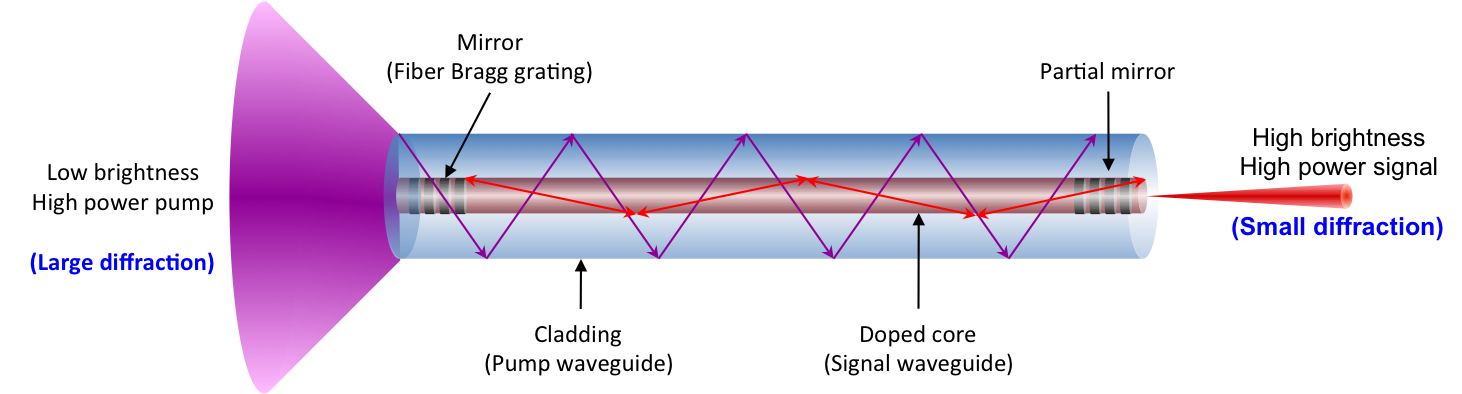
Schematic of a high-power fiber laser using double-clad active fiber
The source is a system, not a wattage sticker.Architecture, pulse control, beam delivery and component limits help define the usable process window.
Educational fiber-laser schematic by Danielsoh8, CC0, via Wikimedia Commons.
Source architecture

There is no universal “best” laser

Choose the architecture from the coating, substrate, acceptable surface change, required throughput and evidence from representative samples.

Broad or heavy removal

CW / high average power

Continuous energy can be productive on robust substrates and larger removal loads. The process may put more heat into the part, so travel, scan strategy and damage limits matter.

  • Ask for substrate temperature or visible-change limits
  • Check utilities, chiller and duty requirements
  • Validate edges, thin areas and complex shapes
Controlled surface work

Nanosecond pulsed

Pulsed energy can create high peak intensity while limiting heat between pulses. A broader adjustable window may raise cost when the application needs tighter control.

  • Compare pulse map, not MOPA label alone
  • Confirm beam profile and overlap
  • Test the full contamination range
Special acceptance limits

Shorter-pulse systems

Short or ultrashort pulses may offer a useful process window for sensitive or demanding surfaces, but may not be economical for rough cleaning unless the acceptance criteria require them.

  • Define the measurable benefit first
  • Compare complete-part rate and yield
  • Require inspection evidence

For a guided comparison, use the pulsed vs CW comparison tool, then review the 100 W vs 200 W vs 500 W buyer guide.

Quote anatomy

The parts you cannot see often explain the price gap

The cabinet and handheld head are only the visible layer. Ask who supplies, integrates, validates, warrants and services every subsystem.

Laser source and power electronicsArchitecture, output stability, parameter range, controls and warranty.
Cleaning head and scan opticsGalvanometers, lens, field size, working distance, coating and protective window.
Cooling and electrical designAir or water cooling, chiller, water quality, supply voltage and thermal margin.
Fume and debris captureHood or nozzle, ducting, airflow, filters, monitoring and waste handling.
Complete delivered system
Guarding and safety controlsHousing, interlocks, access control, indication, stop functions and documentation.
Motion, fixtures and automationPositioning, robot, part handling, vision, focus control and changeover.
Software and traceabilityRecipes, user roles, data logging, interfaces and production reporting.
Validation and lifecycle supportSample development, acceptance, installation, training, spares and response terms.
Compact 200 watt industrial laser cleaning unit
A cabinet is a package of subsystems.The source, controls, power electronics and cooling inside may differ far more than the outside suggests.
Photo by Optola, CC BY-SA 4.0, via Wikimedia Commons.
Questions that expose scope

Ask who owns each interface

A low base price may be reasonable when your factory already has suitable extraction, guarding, motion and controls. It can become expensive when each missing interface requires a separate design change after delivery.

  • Is the advertised price for the source, the mobile unit, or a ready-to-run station?
  • Which chiller, extractor, fixtures, cables, windows and spare filters are included?
  • What are the required electrical supply, airflow, compressed air and floor conditions?
  • Who is responsible for final machine classification and site risk assessment?
  • What does the warranty cover separately for source, scanner, chiller, extractor and complete machine?
  • Are labor, travel, freight, customs, installation and commissioning included?
Safety and extraction

Controls change the price because they change the system

Safety is not a badge added to a source. It is a property of the final machine, operating mode, access conditions, material and site.

Open Class 4-capable tool ≠ enclosed Class 1 final system

An open cleaning head can expose users to direct or reflected laser energy. A properly designed enclosure with interlocks may reduce accessible emission during normal operation, but the final classification must be established for the complete product. Service mode, fumes, hot debris, electrical and mechanical hazards still require controls. For hand-held or hand-operated laser processing machines, ISO 11553-2:2026 adds a dedicated machine-safety reference alongside the broader laser-product and laser-processing-machine frameworks.

Laser cleaning also moves contamination into the air, filters and captured residue. Paint, plating, oil, oxide and base material can create different particles or gases. Extraction and disposal must be selected from the actual material—not from a generic “smoke extractor included” line.

Purchasing boundary

Request the final system classification information, risk-assessment scope, safety-function documentation, labels, manuals and destination-market declaration. A CE mark, FDA registration or accession number should not be described as government approval.

Diagram showing a Class 4 laser inside a Class 1 protective enclosure
Diagram by Clemenspool, CC0, via Wikimedia Commons. Illustration only; it does not classify a specific machine.
BeamAccessible emission, reflections and beam path.
AirSource capture, filter media and monitoring.
MachineInterlocks, motion, hot debris and electrical hazards.
SiteAccess, training, procedures and local rules.

Use the fume extraction airflow calculator only as a planning aid. Final capture and filtration need an application-specific industrial-hygiene and safety assessment.

Evidence before purchase

A clean-looking patch is not a qualified process

A convincing demonstration proves that removal is possible under one set of conditions. Production qualification asks whether the process stays acceptable across real parts, operators, shifts and contamination variation.

Comparison pointDemonstrationQualified buying evidenceWhy it affects value
Cleaning resultLooks clean in a photoDefined residue, oxide, roughness, adhesion, contact resistance or other acceptance measurePrevents visual success from hiding functional failure
ThroughputFast on the easiest patchComplete-part cycle including positioning, edges, passes, inspection and changeoverConnects equipment to production capacity
Substrate protectionNo obvious damageWritten limits for temperature, color, dimensions, roughness or microstructureProtects yield and downstream performance
RepeatabilityOne successful runRepeated parts across the expected duty period and contamination rangeReveals drift, cooling limits and process sensitivity
SupportMachine operates during demoAcceptance method, training, recipe record, spares and response commitmentsDefines who carries risk after delivery
Illustrative scenario — not a customer case

Why the lower quote can become the higher-cost project

A buyer chooses a low-price handheld unit after a fast phosphate-removal demonstration. Later, the full part needs two passes, the edges overheat, extraction is inadequate and operators cannot hold a repeatable path. The buyer then adds a stronger extractor, fixture, enclosure, training and extra inspection.

The first quotation was not necessarily dishonest. It simply covered a different boundary. A comparable RFQ and acceptance test would have exposed the missing scope before purchase.

Interactive buying tool

Is your quote complete enough to compare?

Check only what the supplier has defined in writing. This score does not judge machine quality; it shows how much of the purchasing boundary is visible.

Check the written quotation

Each item carries ten points. A verbal promise should stay unchecked until it appears in the proposal or contract.

Quote completeness
0/ 100
Not ready to compare

Important scope is still undefined. Ask for written details before choosing by price.

Missing: all ten quote sections.
Review My Quotes with Oceanplayer Laser
Lifecycle comparison

Use cost per accepted part

Purchase price is paid once. Labor, filters, protective windows, utilities, service, downtime and quality loss continue. Compare realistic annual cost against accepted annual output.

Planning assumptions

Enter one supplier scenario. Then record the result and repeat with another quote using the same output and acceptance assumptions.

Include the system boundary being compared
Simple straight-line annualization
Operation, handling and changeover
Laser, cooling, extraction and motion
Filters, windows, nozzles and cooling items
Preventive work, spares and support
Scrap, rework and lost productive time
Accepted output, not attempted parts
Calculated planning view

This simple model does not include financing, tax, salvage value or every site cost. Use it to expose assumptions, not as a guaranteed ROI.

Annualized equipment$12,000Delivered cost ÷ planning life
Total annual cost$54,600Equipment plus annual operating costs
Cost per accepted part$1.09Total annual cost ÷ accepted output
Operating share78%Share beyond annualized equipment
Compare scenarios with the same part, acceptance limits, shift pattern and delivery boundary. If a cheaper machine raises labor, rework or downtime, its cost per accepted part can be higher.

A more complete business case may also include financing, utilization, ramp-up yield, floor space, compliance work, disposal, downtime probability and residual value.

Comparable RFQ

Give every supplier the same brief

A complete request does not need to prescribe a machine. It should define the work, result, duty and site boundary clearly enough for suppliers to propose and prove a suitable system.

1. WorkpieceMaterial, grade, geometry, dimensions, mass and representative photos.
2. Layer to removeRust, oxide, paint, oil, plating or residue; type, thickness and variation.
3. Accepted resultVisual and measurable cleanliness, adhesion, conductivity or other function.
4. Damage limitsMaximum heat, color, roughness, substrate loss, dimensions or microstructural change.
5. Production needComplete-part cycle, annual volume, shifts, changeover and availability target.
6. HandlingManual, fixture, conveyor or robot; part presentation and access constraints.
7. Site conditionsVoltage, space, environment, utilities, extraction and integration interfaces.
8. Acceptance and supportSample test, FAT/SAT, training, documentation, spares, warranty and service.
Frequently asked questions

Laser cleaner price questions

Short answers for buyers comparing quotations, specifications and tests.

Why is one laser cleaning machine much cheaper than another with the same power?

Equal average power does not mean equal pulse energy, pulse duration, frequency range, beam profile, scanner, optics, cooling, duty, guarding, extraction, controls or service. First normalize the delivered scope and the acceptance test. Then compare cost per accepted part.

Does higher wattage always clean faster?

No. Throughput also depends on the coating and substrate, pulse behavior, spot, beam profile, scan field, overlap, passes, focus and permitted heat or surface change. A higher-power machine can be underused or can damage a sensitive part if the process window is wrong.

Why can a pulsed laser cleaner cost more than a CW cleaner?

A pulsed system may cost more when the source, pulse control, scanner, optics and cooling provide a wider or more stable process window for heat-sensitive surfaces. That added cost is valuable only when representative tests show a measurable benefit in accepted result, yield or complete-part cost.

What should a laser cleaning machine quote include?

It should define the source and usable parameter range, cleaning head, optics, cooling, utilities, safety boundary, extraction, fixtures, controls, software, automation interfaces, sample-test result, acceptance method, training, delivery, warranty, service, spares and exclusions.

What is the best way to test a laser cleaner before buying?

Test normal parts and difficult edge cases. Record the actual recipe, complete-part cycle, quality result and duty period. Inspect residue and substrate change with the method that matters to your downstream process, then write those checks into the acceptance plan.

About the authorOceanplayer Laser Technical Team

Our team creates practical guides on laser cleaning, welding, marking and industrial automation. We combine application experience with cited engineering sources to help manufacturers compare materials, evaluate processes and plan equipment trials with clearer requirements.

Technical references

Sources and method

This buyer guide combines the supplied article draft with primary technical and regulatory sources reviewed on September 2, 2026. It avoids presenting one universal market price because configuration, destination, delivery terms and time change the number. Use the current supplier proposal, destination-market requirements and sample-test evidence for the machine being quoted.

Turn price into a comparable proposal

Send the part, contamination and accepted result.

Oceanplayer Laser can review representative samples, the required finish, damage limits, cycle target, annual volume and site constraints—then recommend a machine boundary that suppliers can quote and test clearly.

A useful request includes:Material • layer to remove • photos • dimensions • acceptance method • damage limit • target cycle • annual volume • operating environmentGet a Laser Cleaning Recommendation