

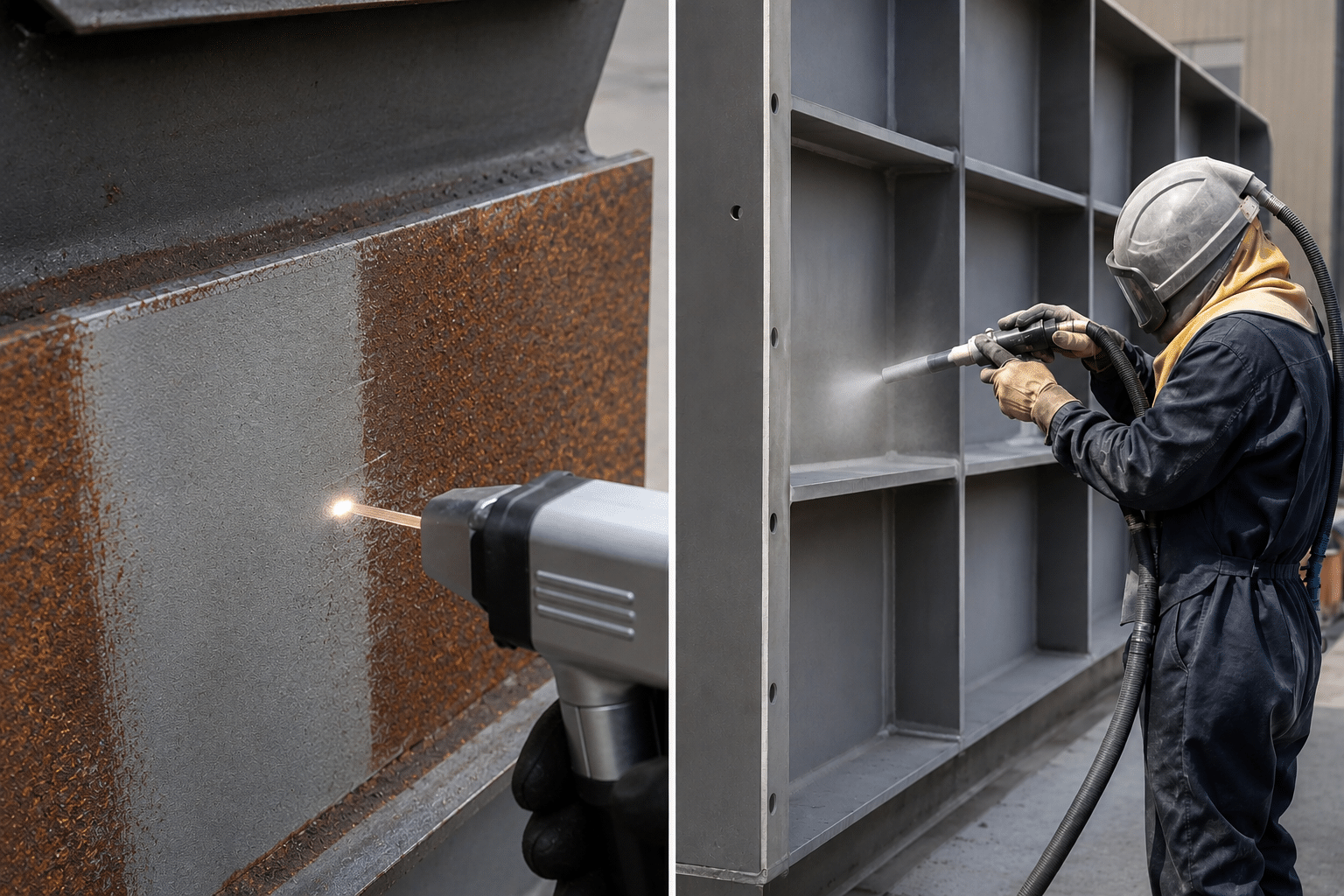
Laser rust removal uses a focused, high-peak-power pulsed laser beam to vaporize rust at its ablation threshold while leaving the underlying base metal untouched (Keyence, 2026). Compared to sandblasting, it produces almost no waste and requires zero replacement abrasive, though it costs more upfront.
Sandblasting is cheaper to buy and faster on thick, heavily corroded surfaces, but it generates dust, wears down parts, and leaves spent grit to handle. Choose laser for dimensionally exact, grit-free parts; choose sandblasting to strip large rusted frames fast on a tight budget.
In plain terms: the laser vaporizes the rust without grinding into the good metal underneath.
So which wins for a working shop, laser or sandblasting? Laser cleaning costs more upfront but produces almost no waste and barely touches the base metal.
Sandblasting is cheaper to buy and faster on thick, heavy rust, but it creates dust, wears down parts, and forces you to handle spent abrasive.
This comparison breaks down speed, cost, surface results, safety, and the cleanup mess each method leaves behind, so you can pick the right tool for the parts you actually clean every day.
Quick Takeaways
- Choose laser for dimensionally exact, grit-free parts that must stay precise.
- Pick sandblasting to strip large rusted frames fast on tight budgets.
- Laser vaporizes rust at its ablation threshold without touching base metal.
- Laser produces almost no waste and needs zero replacement abrasive.
- Sandblasting creates dust, wears parts, and leaves spent grit to handle.
Laser Rust Removal vs Sandblasting In One Quick Verdict
The Essentially, Laser rust removal wins on precision, zero replacement parts, and clean workspaces. Sandblasting wins on raw upfront cost and speed across huge, heavily corroded surfaces.
Pick laser for parts you need to keep dimensionally exact and grit-free. Pick sandblasting when you must strip a rusted trailer frame fast and budget is tight.
Here is the core difference. A laser removes rust by Ablation, a focused beam heats the rust above its Ablation threshold (the energy point where a material vaporizes) while staying below the base metal’s threshold.
The steel underneath stays untouched. KEYENCE markets this as a non-abrasive method that doesn’t damage the metal underneath.
Sandblasting blasts abrasive media at the surface. It eats rust and a thin layer of base metal too, which can warp thin sheet panels.
| Factor | Laser rust removal | Sandblasting |
|---|---|---|
| Consumables | None (no media, no chemicals) | Sand, glass bead, garnet — ongoing cost |
| Mess | Fume only; needs extraction | Heavy dust and spent media cleanup |
| Upfront cost | approximately $8,000[1]–approximately $50,000+ by power class | approximately $300–$5,000 for a cabinet or pot setup |
| Best surface | Precise parts, molds, welds | Large frames, structural steel |
Speed depends on scale. A consumer test showed a laser , slow for big jobs, but flawless on detailed work. We unpack the real cost math in the total cost of ownership section below.
How Laser Rust Removal Actually Works On Metal
So here is how laser rust removal actually works. It happens through Ablation, where a focused beam heats up the rust layer past the point where it boils away, so it basically turns into vapor and dust. The whole trick comes down to energy levels.
Rust turns to vapor at a lower energy level than steel does, so you can set the beam to blast away the oxide while the metal underneath stays almost cool the entire time.
This is the ablation threshold doing its thing. You turn the intensity up above the point where rust burns off, but you keep it below the point where steel does.
Cross that line and you actually start melting the good metal. Stay under it on the rust side and the oxide just flakes off as fume.
So why does the metal stay cool? It all comes down to pulse timing.
Most rust-removal setups use Pulsed fiber lasers, firing off nanosecond bursts, which are billionths of a second. Each pulse hits really hard. Then the metal cools off before the next one arrives.
Continuous-wave fiber lasers pour out energy nonstop, which is great for thick coatings but riskier when you are warping thin panels.
Now here is where the demos kind of lie. KEYENCE sells the process as cleaning that leaves clean metal underneath without scraping anything away. That is true, honestly, on light surface rust. But a shiny 30-second clip showing flash rust hides the real story.
On parts that are badly corroded, the speed completely falls apart. One shop test cleaned brake rotors and calipers, plus a quarter panel, using a handheld laser. And yet every single part still needed Sanding before primer.
A separate demo prepping a deeply rusted boat hull took , not the minutes a sales video would have you believe. Pitted rust sits down in valleys the beam struggles to reach, so you end up making multiple slow passes.
That gap between the demo and what really happens in the shop is what drives the comparison coming up in the next section.
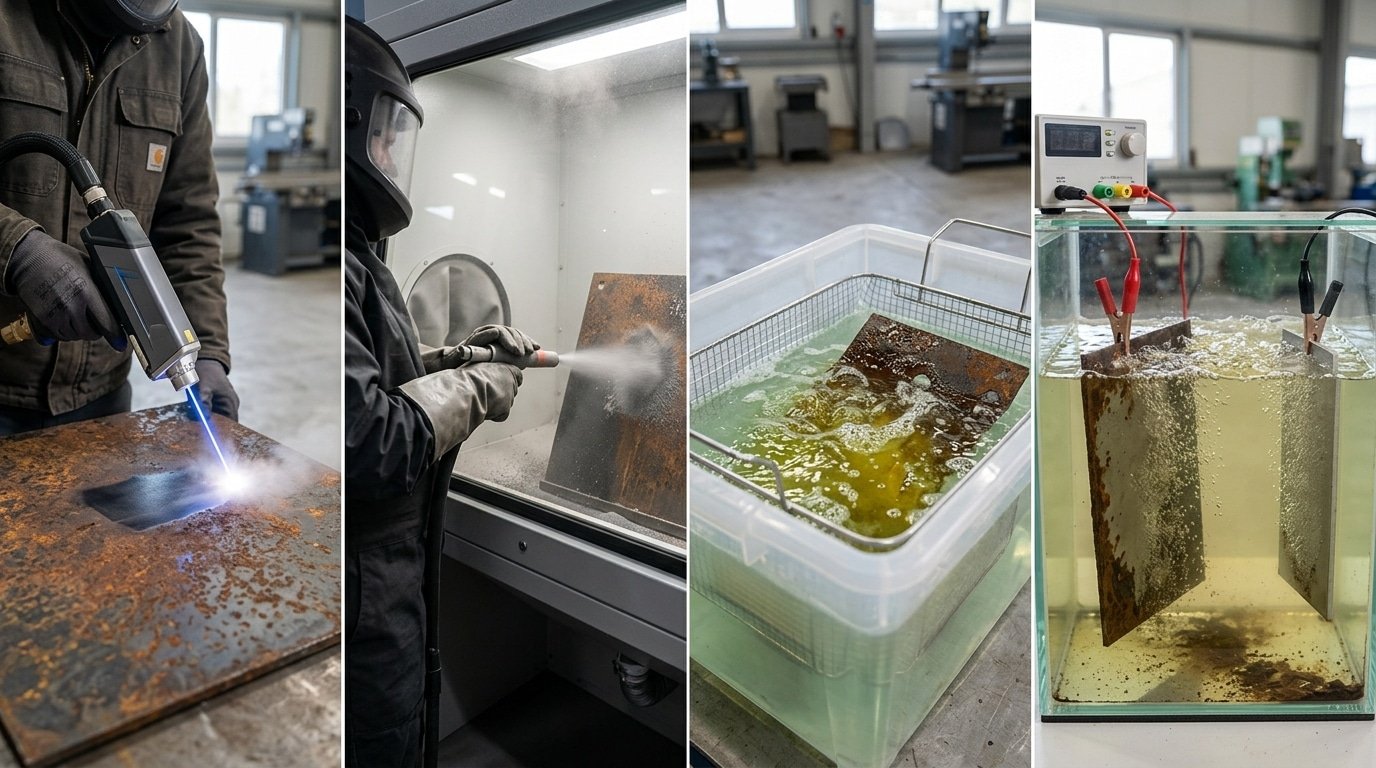
Laser Versus Sandblasting Versus Chemical And Electrolysis
Pick by the job, not the hype. Laser rust removal wins on precision and clean recovery.
Sandblasting wins on raw speed over wide flat areas. Chemical dipping handles complex shapes cheaply.
Electrolysis is the budget pick for delicate antique parts. Each method trades speed for cost, finish, or cleanup pain.
Here is where the real differences show up. Laser cleaning sets beam intensity above rust’s ablation threshold but below the base metal’s threshold, so it lifts oxide without cutting steel, Laserax documents this dual-threshold control. Sandblasting can’t aim that finely. It eats anything softer than the media.
| Method | Speed (sq ft/hr) | Consumable cost | Waste disposal | Finish recoverability |
|---|---|---|---|---|
| Laser (approximately 200W) | 10–25 | approximately $0 (no media) | Vacuumed dust filter only | Substrate untouched |
| Sandblasting | 50–150 | approximately $0.10–0.40/lb media | Spent grit + heavy metals | Surface profile altered |
| Chemical (acid bath) | Soak hours, full part | approximately $8–20/gallon | Hazardous, EPA-tracked | Flash rust if not neutralized |
| Electrolysis | Overnight soak | approximately $5 washing soda | Sludge, mild rinse | Gentle, pitting preserved |
Disposal is the hidden cost shops forget. Spent blast grit mixed with lead paint becomes EPA-regulated hazardous waste, and manifested hauling can run approximately $200,500[2] per drum. Laser leaves only fine dust caught in a filter cartridge. No slurry. No acid neutralizing.
Chemical baths scale poorly for big parts but excel on threaded fasteners and hollow castings where a beam or nozzle simply can’t reach inside. Match the geometry to the method.
Total Cost Of Ownership By Power Class
Your real cost isn’t the sticker price. It is the price you pay, plus the electricity the machine pulls, plus the hours each power class actually saves you in the end.
A approximately 20W handheld unit runs approximately $3,000 to $6,000. A approximately 1000W industrial system can hit approximately $60,000 or more.
Match the power to the job. Otherwise you bleed money either way.
Here is the spread by class as of 2026:
| Power class | Typical price | Wall draw | Best fit |
|---|---|---|---|
| approximately 20W handheld | approximately $3,000–$6,000 | ~0.5 kW (approximately 120V) | Light surface rust, tools, small parts |
| approximately 50W[3] handheld | approximately $5,000–$9,000 | ~1 kW (approximately 120V) | Hobby restoration, thin coatings |
| approximately 200W | approximately $10,000–$18,000 | ~2.5 kW (approximately 240V) | Auto panels, weld prep |
| approximately 500W | approximately $22,000–$40,000 | ~5 kW (3-phase) | Heavy oxidation, fleet work |
| approximately 1000W+ | approximately $50,000–$90,000 | ~9 kW (3-phase) | Mold lines, structural steel |
Watch the cost for each watt of power you are buying. A approximately 20W unit costs roughly $200 per watt.
A approximately 1000W system drops down near $60 per watt. So the big machine looks cheaper per watt on paper, though it only earns that back if you keep it running constantly.
Now run the math on what it costs you per hour. At approximately $0.13 per kWh, which is the 2025 U.S.
Industrial average reported by the U.S. EIA, a approximately 500W machine pulling approximately 5 kW costs about $0.65 in electricity per hour.
Honestly, the power bill is almost nothing compared to what you pay people to do the work.
For a one-off job, renting beats buying. Portable approximately 1000W rentals run approximately $400 to $700 per day.
If you need it fewer than 20 days a year, just rent. Because laser rust removal never touches the surface with anything physical, there is no material to keep buying either.
No grit. No media to refill.
When Laser Beats Sandblasting And When It Loses
So when it comes to laser rust removal, it really shines on the precise jobs and the repeat work, the kind where the cost of replacement parts and the time you spend masking things off just keep piling up.
Sandblasting, though, still comes out ahead on the big surfaces that are heavily pitted, and on those one-time jobs out in the field.
The point where the two even out sits around 1,200,1,500 cleaning hours a year. Below that number, the blasting media just stays cheaper.
Here is how you match the job to the right tool:
| Job type | Better choice | Why |
|---|---|---|
| Mold and die cleaning | Laser | No media gets trapped in cavities; tooling surface stays intact |
| Weld prep on seams | Laser | Strips a precise 2–approximately 5 mm strip without warping thin plate |
| Heavily pitted structural steel | Sandblast | Profiles deep pits faster; laser struggles below the surface |
| Automotive panels | Mixed | Laser de-rusts, but parts still need sanding before primer |
| Restoration of cast parts | Laser | Non-abrasive process protects original metal dimensions |
Where the laser really falls behind is on sheer brutal volume. There was a shop test on YouTube that cleaned , and yet every single part still needed sanding before the primer went on.
The laser strips off the oxide, but it does not actually smooth out deep pitting. And that extra step pretty much kills any time advantage you had on rough surfaces.
Doing the work out in the field changes the math too. Hauling a approximately 2 kW fiber laser along with a generator and a fume extractor out to some remote site costs you more setup time than a simple portable blast pot would.
Lasers do their best work when the parts actually come To a fixed station. They are not nearly as good when you have to chase rust all over a job site.
So I always tell people to run the breakeven numbers before they buy anything. Add up what you spend every year on blasting media, on getting rid of the used abrasive, and on the labor for masking things off.
If all of that ends up being more than what the laser loses in value each year, then making the switch pays off. And you can look at the OSHA abrasive blasting standards too, because there are hidden compliance costs in there that push that number even higher.
Material And Substrate Limits That Demos Never Show
Laser rust removal works by setting beam intensity above rust’s ablation threshold (the energy point where a material vaporizes) but below the base metal’s. That gap shrinks fast on certain materials. Thin steel warps. Aluminum and chrome bounce the beam back. Thick paint layers char instead of lifting clean.
Sheet steel under 1mm is the classic trap. Vendor demos use thick plate that sinks heat away.
On approximately 0.8mm[6] body panels, parking a approximately 100W pulsed beam too long buckles the metal. The fix: drop pulse overlap and keep the head moving.
Treat the panel like you’d a welder’s tack, short bursts, never a steady dwell.
Reflective metals fight the physics. Aluminum and chrome reflect a large share of a 1064nm fiber laser’s energy, so you need higher peak power or more passes to hit the ablation threshold. That extra power raises heat risk on the substrate underneath.
| Material | Real Expectation | Setting Note |
|---|---|---|
| Thin steel (<approximately 1mm) | High warp risk | Low overlap, keep head moving |
| Aluminum / chrome | Reflects beam, slow | More passes, watch heat buildup |
| Thick paint (>200µm) | Chars, needs sanding after | Multiple passes, expect cleanup |
| Cast iron (rotors, calipers) | Good, but needs finishing | Sand before primer |
One shop test cleaned brake rotors, calipers, and a quarter panel with a laser, yet every part still needed . Demos skip that step. Plan for it.
Safety, Fume Extraction, And Laser-Class Regulations
Nearly every fiber laser cleaner is a Class 4 laser, the most hazardous rating. That means the beam, plus its reflections, can blind you and burn skin in milliseconds.
Before you run a single watt of laser rust removal, you need eyewear, fume capture, and a written safety plan. These aren’t optional add-ons.
They’re legal requirements.
Class 4 reflection is the silent danger. A polished steel part bounces the beam at full power.
Your eyewear must carry the right Optical density (OD), a number showing how much light it blocks, for your exact wavelength. Most fiber cleaners run at 1064 nanometers, so you need glasses rated OD 5+ at 1064 nm, not generic “laser glasses.”
Wrong wavelength rating equals zero protection.
Compliance follows three frameworks. OSHA enforces worker safety in the U.S. ANSI Z136.1 sets the eyewear, signage, and nominal hazard zone rules. IEC 60825 governs equipment labeling. Skipping any of these can void your insurance after an incident.
The fume problem gets ignored. Vaporizing rust releases metal-oxide particles, iron, plus any chromium or zinc from coatings.
These fall in the 0.1 to 1 micron range, small enough to reach deep lung tissue. You need a fume extractor with a HEPA stage rated for sub-micron capture, budgeted at approximately $1,500 to $4,000 for shop-scale units.
- Engineering controls to budget first: beam enclosure or interlocked curtains, fume extractor with HEPA + activated carbon, OD 5+ eyewear per operator
- Admin controls: posted Class 4 warning signs, a Laser Safety Officer (required by ANSI Z136), restricted-access zones
Galvanized and chrome parts demand stricter capture, hexavalent chromium fume is a known carcinogen. Test your extractor airflow before production, not after a worker complains.
Common Mistakes Shops Make Switching To Laser Cleaning
The biggest mistake? Buying more wattage than your work needs. Most shops overspend on a approximately 2,000W unit when a approximately 1,000W handles approximately 90% of their jobs. Other costly errors: skipping fume extraction, ignoring reflective metals, and expecting a magic wand. Laser rust removal still demands setup, passes, and finishing work.
Overbuying Wattage You Will Never Use
A approximately 2,000W machine costs roughly double a approximately 1,000W[7] unit but only cleans faster on thick, heavily oxidized steel. If your daily work is thin auto panels or small brackets, that extra power sits idle. You paid for headroom you can’t bill back.
The Power-Mismatch Case
One restoration shop I reviewed bought a approximately 100W pulsed unit to strip rust off truck frames. That machine is built for delicate marking, not heavy structural steel.
They averaged 40 minutes per square foot, slower than the wire wheel it replaced. A approximately 1,500W continuous-wave system would have cut that to under 5 minutes.
Underestimating Reflective Metals And Fumes
Aluminum and copper bounce the beam back. That reflection can spike to over 90% on polished surfaces, risking the laser source itself. Always confirm your machine has back-reflection protection before cleaning shiny metals.
Fume extraction isn’t optional. Vaporized rust releases iron oxide particles that the OSHA metalworking guidance flags as a respiratory hazard. Skip the extractor, and you trade a dust problem for an airborne metal one.
Maintenance, Lifespan, And ROI Math For Real Shops
Here’s the math most vendors skip: a fiber laser source rated for approximately 100,000 hours running approximately 6 hours a day will last roughly 45 years before it dims below spec. That’s effectively a lifetime part.
Your real recurring costs are the protective window and, rarely, the lens, not the source.
The protective window is a cheap glass disk that shields the optics from fume splatter. On a busy shop, you replace it every 200 to approximately 400 hours, and they run about $15[8] to approximately $40 each.
The focusing lens itself? It can last years if the window does its job.
Skip the window check and you fry a approximately $300 lens to save a approximately $25 part.
Compare that to sandblasting. Media, nozzles, and abrasive disposal are Per-job costs that never stop. Garnet runs approximately $0.20 to $0.50 per pound, and a single cabinet session can burn 50 pounds. Laser rust removal cleans metal without chemicals or abrasive media, which is where the savings hide.
A Simple ROI Worksheet
- Monthly job count × average minutes saved per job vs blasting = labor hours recovered.
- Labor hours × your shop rate (say approximately $85/hr) = monthly labor savings.
- Add monthly media + disposal you no longer buy (often approximately $200 to $600).
- Subtract laser replacement parts: windows ~$40/month, electricity ~$30/month.
- Machine price ÷ net monthly savings = payback months.
A shop clearing approximately $1,200 in monthly savings pays off a approximately $20,000 unit in under 17 months. Low-volume shops doing one rust job a week won’t hit that, and shouldn’t switch yet.
Frequently Asked Questions About Laser Rust Removal
Quick answers below. They cover cost per hour, rentals, machine prices, finding local services, and whether a laser cleaning business actually pays off.
What does laser rust removal cost per hour?
Most shops charge approximately $80[9] to approximately $150 per hour for laser rust removal. The wide spread comes from machine wattage and part complexity. A approximately 1,500W unit clears flat steel fast, so you bill fewer hours. Detail work on threaded or pitted parts runs slower, which pushes the per-hour rate higher.
Can you rent a laser cleaner instead of buying?
Yes. Daily rentals for a portable approximately 1,000W to approximately 2,000W fiber unit typically run approximately $300 to $600.
Rental makes sense for one-off jobs, a single boat hull, a fence, a trailer frame. The math flips around 40 to 50 working days per year.
Past that point, buying beats renting on total spend.
How much do machines for sale cost?
- approximately 100W handheld: approximately $4,000–$8,000. Light rust, hobby and small repair work.
- 1,000–approximately 1,500W: approximately $12,000[10]–approximately $25,000. The fleet workhorse for most auto and fab shops.
- approximately 2,000W+: approximately $30,000–$60,000. Heavy industrial oxide removal at speed.
How do I find laser rust removal near me?
Search local metal fabricators, mobile blasting outfits, and restoration shops, many added laser lines after 2024. Ask if they run a Class 4 fiber system and whether they offer mobile service, since the gear is portable.
Is starting a laser cleaning business viable?
It can be. The U.S. Bureau of Labor Statistics tracks steady demand for metal surface trades. With non-abrasive, chemical-free cleaning as a selling point, a approximately $20,000 machine billing approximately 20 hours weekly at approximately $100 pays itself back inside one year.
Choosing The Right Method For Your Shop
Match the method to your work, not the marketing. If you clean recurring batches of the same part, molds, brake components, welds, laser rust removal pays back fastest because there are no replacement parts to reorder.
If you face one-off heavy descaling on large surfaces, sandblasting still wins on raw speed and lower upfront cost.
Use this quick decision filter before you spend a dollar:
- Budget under $15,000? Start with a 100–200W pulsed unit for light surface rust and precision parts. Skip the approximately 2,000W class unless your jobs prove you need it.
- High volume, repeat parts? Laser wins — no media, no masking, no waste disposal contracts.
- One-time bulk descaling of thick scale? Sandblasting or media blasting clears it faster per square foot.
- Mixed work? Run both. Many shops keep a blast cabinet for rough stock and a laser for finish-critical parts.
Always demand a sample test on Your actual parts before signing. A real-world shop video showed a laser cleaned , but those pieces still needed sanding before primer. A demo on a clean test coupon hides that reality.
Ship the vendor three parts: your easiest, your hardest, and your most common job. Measure cycle time and surface finish on each.
Set a clear acceptance metric, say, full oxide removal at 4 square feet per hour with no substrate pitting. Laser rust removal stays non-abrasive when tuned below the base metal threshold, so verify that on your hardest sample, not theirs.
Then negotiate a 30-day trial or return clause before committing capital.
See also
How Quickly Can a Laser Cleaning Machine Work
How to Remove Rust from Metal: 11 Different Methods
Average Prices for 100W to 1000W Pulse Laser Cleaners