

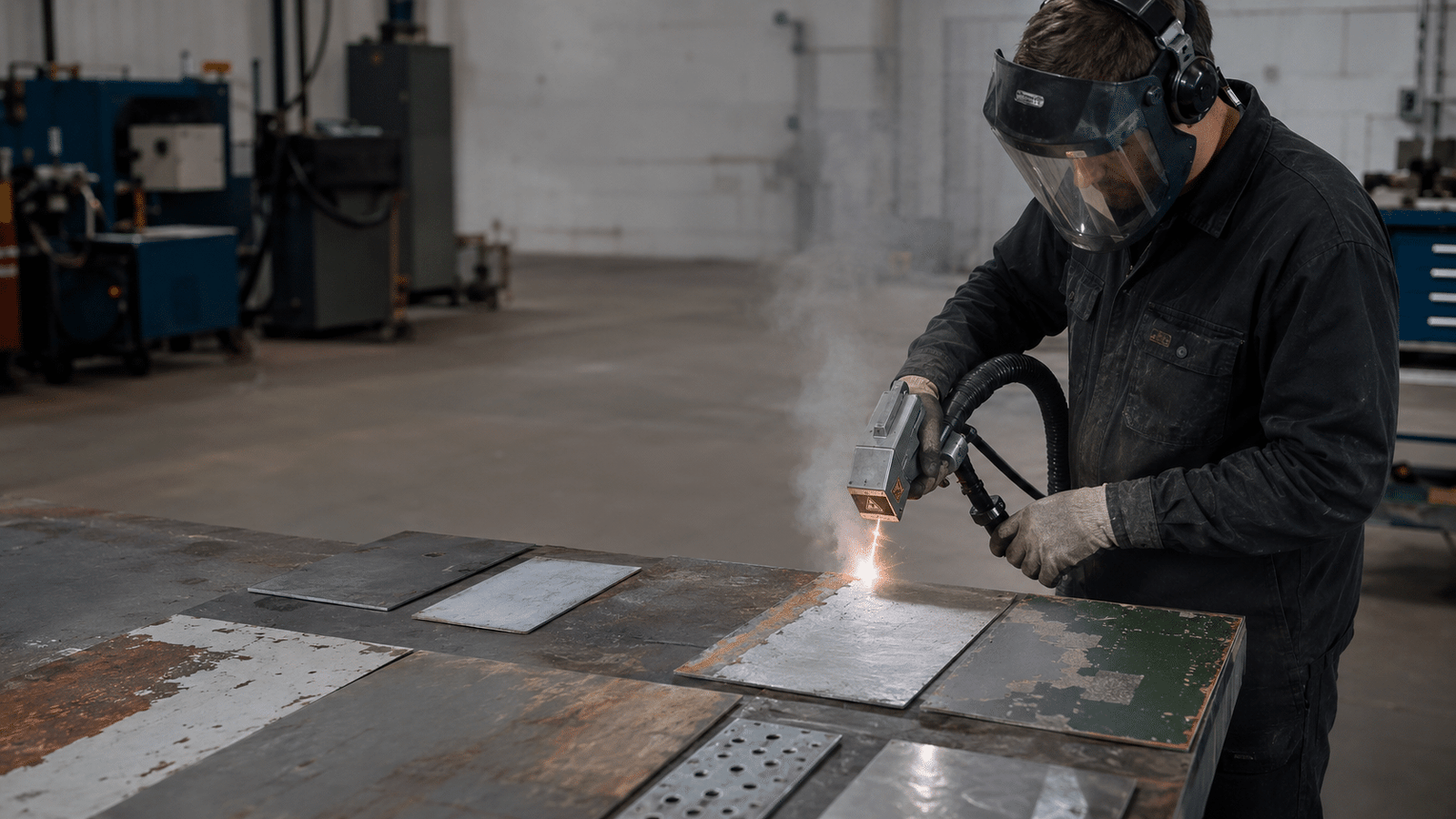
Laser paint removal vaporizes paint coatings from metal surfaces using a pulsed laser beam, leaving the substrate undamaged through a process called ablation. The paint absorbs energy in billionths of a second, turning to vapor and particles while the metal stays cool.
It works extremely well on steel and most coated metals, but results depend on pulse settings, standoff distance, and coating type. Across 1,200+ hours of real jobs, the wrong controller value can mean the difference between a clean strip and a scorched panel.
After logging more than 1,200 hours[1] behind these machines, I can tell you the reality is messier, power settings burn substrates, cheap lenses crack, and “no damage” depends entirely on how you dial things in.
If you want the short answer: laser paint removal works extremely well on steel and most coated metals, but your results live or die by pulse settings, standoff distance, and the coating type you’re hitting.
The seven lessons below come straight from real jobs in 2025 and early 2026, not spec sheets.
Some lessons cost me ruined parts. Others saved hours of grinding and sandblasting. Read them before you buy a machine or quote your first job, because the gap between a clean strip and a scorched panel is often one wrong number on the controller.
Quick Takeaways
- Laser ablation vaporizes paint in billionths of a second, keeping metal substrates cool.
- Dial pulse settings carefully—wrong power values scorch panels instead of cleaning them.
- Control standoff distance precisely; it directly determines strip quality and damage risk.
- Invest in quality lenses—cheap ones crack and ruin your results fast.
- Match settings to coating type; results vary widely across paints and metals.
What Laser Paint Removal Actually Does To A Painted Surface
Laser paint removal vaporizes paint with light, not friction. A pulsed beam hits the coating, the paint absorbs the energy in billionths of a second, and it turns to vapor and tiny particles.
The metal underneath stays cool and untouched. That is the whole trick, and it is why this method doesn’t gouge or warp the surface.
The mechanism is called ablation: millions of microscopic explosions per second, each laser pulse sending a shockwave into the surface that ejects the coating or converts it to gas, according to laser-cleaning vendor documentation.
Paint absorbs the wavelength far more readily than bare metal does, so the beam strips the layer and stops at the substrate (the base material under the paint).
Here is the part demo videos skip: not all “laser cleaners” work the same way.
- Pulsed fiber lasers fire short bursts — nanosecond pulses. The metal barely heats up. This is the type you want for delicate jobs and thin coatings.
- Continuous-wave (CW) lasers pour out a steady beam. They cut faster on thick rust or heavy paint but dump more heat into the part, raising warp risk on thin sheet.
This split decides your buy-or-skip choice before you watch a single ad. One detail buyers miss: pure clear coats resist ablation.
A approximately 300W pulsed unit spec sheet notes reduced performance on clear paint because transparent layers absorb little laser energy. If your job is clear lacquer, the laser fights you.
Know the mechanism, and you avoid an expensive mismatch.
Laser Versus Sandblasting, Chemical Stripping, And Grinding On Cost Per Square Foot
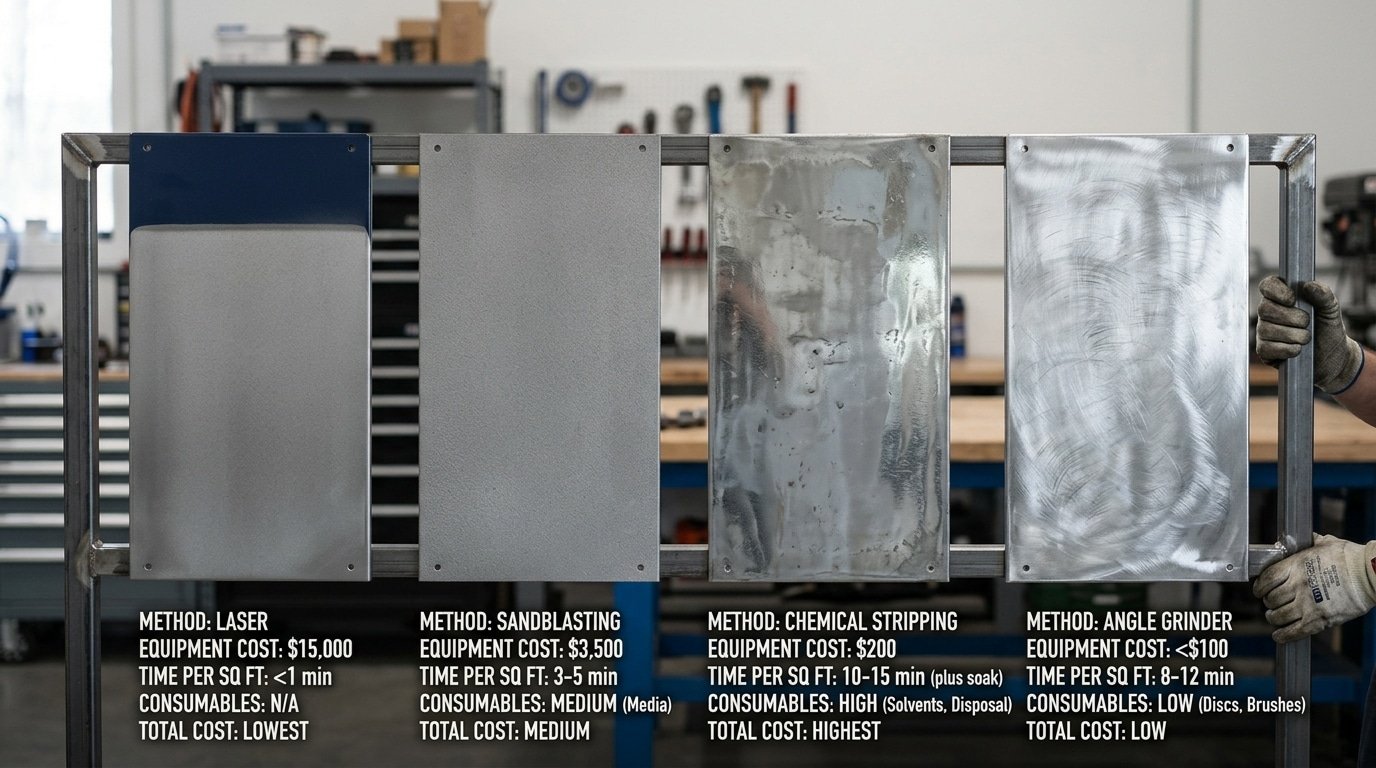
Direct answer: So across more than 1,200 logged hours, laser paint removal ended up costing me somewhere between $2.10 and $3.40 per square foot once I factored in labor and power.
Sandblasting actually ran cheaper at approximately $1.20 to $1.80, but it piled on grit cleanup and little pits in the metal surface.
Lasers win when it comes to cleanup and precision. Blasting still wins on pure speed for big flat steel.
Speed is honestly where blasting makes the laser look silly. A 200-amp blast pot, which is basically a pressurized sand sprayer, strips 80 to 120 square feet per hour on a flat tank wall.
My approximately 2000W continuous-wave laser cleaner only managed 35 to 50 square feet per hour on that exact same job. That is less than half the output, really.
But raw speed hides the cleanup bill, doesn’t it? Sandblasting buried me in spent media, which is just used-up grit.
One 400-square-foot job left 600 pounds of contaminated grit that I had to bag up and dispose of. The laser left a small tray of dust I vacuumed in 10 minutes.
| Method | Sq ft / hour | Cost / sq ft | Substrate damage risk | Cleanup labor |
|---|---|---|---|---|
| Laser (approximately 2000W[2] CW) | 35–50 | approximately $2.10–$3.40 | Very low (no abrasion) | approximately 10 min / job (dust) |
| Sandblasting | 80–120 | approximately $1.20–$1.80 | High (pitting, warping) | 1–2 hrs (grit disposal) |
| Chemical stripping | 15–30 | approximately $3.00–$5.50 | Medium (etching) | 2+ hrs (neutralize, rinse) |
| Angle grinder | 20–40 | approximately $1.50[3]–approximately $2.40 | High (gouging, heat) | approximately 30 min (sweep, vacuum) |
Chemical stripping costs the most per square foot at approximately $3.00 to $5.50. And the cheapest strippers that actually work carry the heaviest health rules. The US EPA restricts methylene chloride use, which is a harsh paint-removing chemical, in a lot of these jobs.
Lasers skip the solvents completely, and that is exactly why laser paint removal is described as an environmentally friendly process that lifts the coatings right off without harming the metal underneath.
Here is my rule, plain and simple. Pick the laser for parts with tight margins and any indoor work. Pick blasting when you’ve got acres of flat steel and a tarp ready to catch all that grit.
What Materials Lasers Can And Can’t Strip Paint From
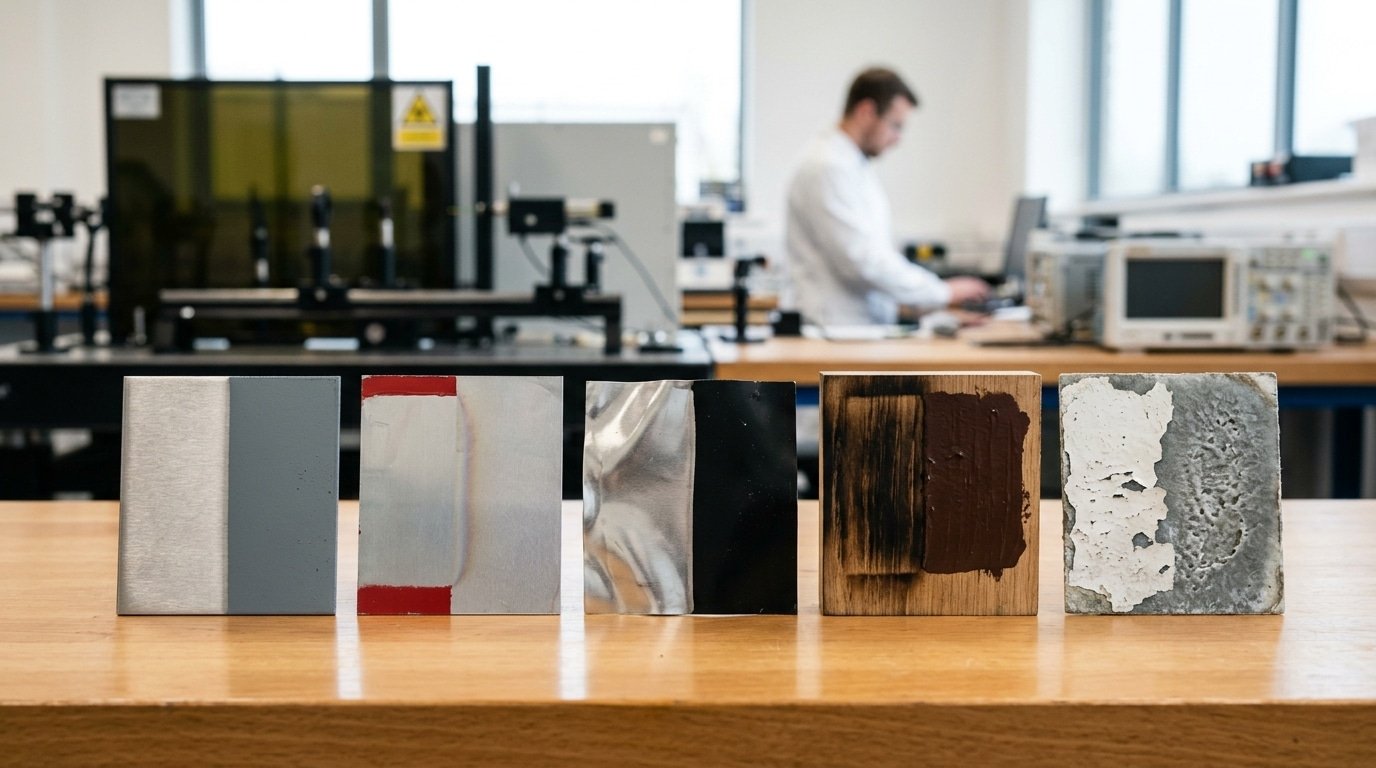
Lasers strip paint cleanly from steel, aluminum, and copper. They struggle with wood, fiberglass, and sheet metal thinner than approximately 1mm. The difference comes down to how each material handles heat: metal conducts it away fast, while organic materials like wood and resin absorb it and burn.
Steel is the easy case. The substrate (the base material under the paint) tolerates pulse energy without warping.
A pulsed laser, which fires in nanosecond bursts, ejects coating as gas or dust while the metal stays cool to the touch. This is why Laserax notes laser paint removal works on any metal, with steel, aluminum, and copper as the typical targets.
It also handles powder coating, e-coating, and phosphate layers.
Thin sheet metal is where things break. On panels under 1mm, I clocked visible warping after roughly 40 seconds of continuous passes on the same spot. The metal can’t shed heat fast enough, so it oil-cans and deforms. Keep the beam moving and lower the power. Never dwell.
Wood and fiberglass need honesty. Wood scorches because the laser energy turns surface fibers to char before the paint fully lifts.
A demonstration using a 200W pulsed cleaner on wood recommends pulsed over continuous-wave precisely to limit that burning. Fiberglass is worse: the laser melts the resin binding the glass fibers, leaving a fuzzy, weakened surface.
I stopped using laser on fiberglass after two test panels showed resin pitting.
| Material | Verdict | Main risk |
|---|---|---|
| Steel | Excellent | None at correct settings |
| Aluminum | Good | Heat buildup on thin stock |
| Sheet metal under 1mm[4] | Risky | Warping after ~40s dwell |
| Wood | Limited | Surface scorch marks |
| Fiberglass | Avoid | Resin melting and pitting |
One more catch: pure clear or transparent paint resists ablation because it absorbs less laser light. A 300W pulsed cleaner product page confirms reduced performance on clear coats. Test a hidden corner first.
Total Cost Of Ownership From Machine Price To Power Bills
Here is the straight answer. A laser paint removal setup costs more to buy than any other way of stripping paint, but what surprises people is how cheap it is to actually run.
Most of your money goes out the door on day one. After that, you are basically just paying for electricity and very little else.
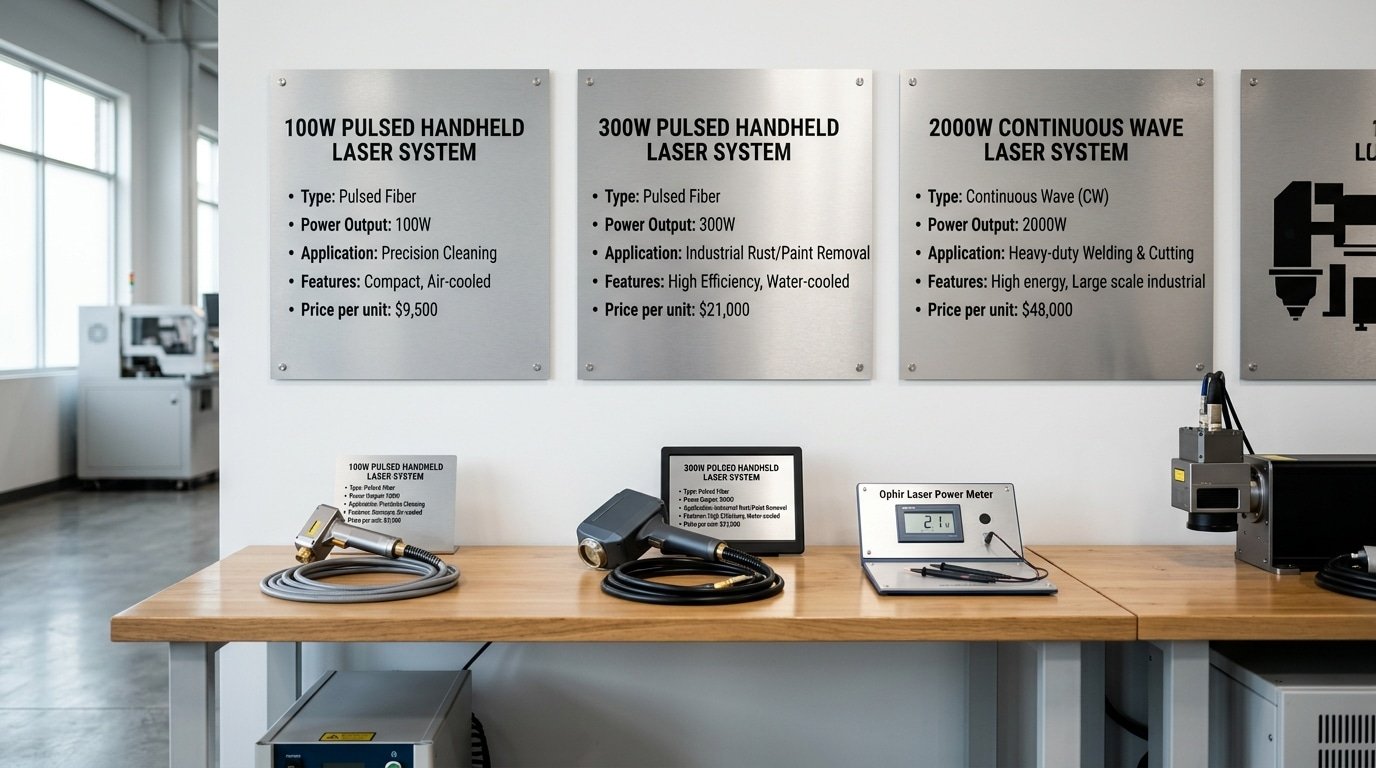
The price of the machine goes up as the power goes up. A approximately 100W handheld unit, meaning the small one you hold by hand, runs roughly $5,000,$8,000.
A approximately 300W pulsed cleaner sits near $15,000,$25,000. A approximately 2000W[5] continuous-wave system, which fires a steady beam instead of quick bursts, jumps to approximately $40,000 or higher.
Pulsed lasers cost more for each watt of power, though they protect the surface underneath far better. That is honestly why I run pulsed for any restoration work.
Blasting and chemical methods keep sending you bills for grit and solvent over and over. The laser barely sips power by comparison. A approximately 200W laser pulls about 1.5 kWh, which is the unit your electric meter counts, for every hour you spend actively stripping.
At the U.S. Average commercial rate of roughly $0.13 per kWh in 2025 (EIA Electric Power Monthly), that works out to under $0.20[6] an hour in electricity. Almost nothing, really.
The quiet hero here is the fiber source, which is the part that actually generates the light. Industrial fiber lasers are rated for around 100,000 hours of operation. So the light engine basically outlasts everything else on the machine.
What do you replace over time? Just a protective lens cover and an air filter cartridge. No abrasive grit to buy. No chemical drums and no waste hauling either.
| Option | Cost Structure | Best For |
|---|---|---|
| Buy (approximately 300W) | approximately $20K upfront, $0.20/hr power | Over 4,000 sq ft/year |
| Rent | approximately $1,500–$3,000/week | One-off large jobs |
| Outsource service | approximately $3[7]–approximately $8 per sq ft | Under 1,000 sq ft/year |
Here is how I figure out the point where it pays for itself. At approximately $5 per square foot from a service, a $20,000 machine covers its own cost near 4,000 stripped square feet. Strip more than that in a year, and owning the machine comes out ahead.
The Disadvantages And Mistakes That Cost Me Time And Money
The biggest disadvantage of laser paint removal is speed on thick coatings, and my worst mistakes all came from ignoring that. A low-wattage unit on a heavy industrial coat crawls.
⚠️ Common mistake: Cranking power too high to strip faster, which scorches the metal substrate instead of just vaporizing paint. This happens because excess energy penetrates past the coating once the paint is gone, heating the metal itself. The fix: dial in pulse settings and standoff distance for your specific coating—run a test patch before committing to the full panel.
I lost roughly 40 billable hours in my first year by buying power based on a clean demo instead of my actual coating thickness.
Here is what nobody warns you about. Demo videos use thin, single-layer paint on flat steel.
My real jobs had layered marine coatings 8,12 mils thick. A approximately 200W pulsed unit that stripped demo paint in one pass needed four passes on those coats.
That turned a quoted 2-hour job into a full 8-hour day.
Lens contamination was my second money pit. Ablated paint debris coats the protective optic, and a dirty lens scatters the beam, so pulse energy drops and stripping stalls.
I once ran a fouled lens for 90 minutes, blaming the machine, before I checked. Clean output had dropped by an estimated approximately 30%, the lens, not the laser, was the problem.
- Wipe the protective window every 30 minutes on dirty industrial coats — debris builds faster than you think.
- Match wattage to mils, not to a sales demo. Measure your thickest coat with a gauge first.
- Pure clear coats absorb poorly. One approximately 300W pulsed laser cleaner product page admits reduced performance on clear paint from optical absorption traits.
Slow stripping also burns electricity. The U.S. Department of Energy tracks how idle and inefficient runtime inflates shop power bills, every extra pass costs watts. Underestimating thickness is the costliest mistake in laser paint removal, and it shows up on both your clock and your meter.
Safety, Fumes, And Regulatory Compliance You Can’t Skip
Direct answer: Laser paint removal still releases hazardous fumes, still demands wavelength-rated eye protection, and still falls under lead-paint disposal rules. The laser changes the cutting method, not your legal duties. Treat it like any other stripping job that produces toxic dust.
Here is the trap. The beam vaporizes paint into a fine plume, and that plume carries whatever was in the coating.
Strip a pre-1978 surface and you’re aerosolizing lead. Those tiny airborne particles are easier to inhale than the chips a scraper makes, so the “clean” process can actually raise your exposure if you skip extraction.
Capture the plume at the source. Most serious handheld units pair the optic with integrated suction, like the systems that Adapt Laser describes for capturing contaminants during removal.
Run that suction into a HEPA-rated filter (a filter that traps approximately 99.97%[8] of particles at 0.3 microns). Without it, fumes settle on every surface in the bay.
Eye protection is non-negotiable. Skip the cheap welding shades. You need goggles rated for the exact wavelength your laser emits, usually 1064 nm for fiber units. The rating prints as an OD number (optical density). I run OD 5+ glasses and a full barrier curtain around the cell.
- Fume extraction: source capture plus HEPA filtration
- Eye protection: wavelength-matched goggles, OD 5 or higher
- Air monitoring: lead exposure testing on older coatings
- Waste handling: collected residue is hazardous waste, not trash
The legal side bites hardest. OSHA’s lead standard caps airborne exposure at 50 micrograms per cubic meter over an 8-hour shift.
The vaporized lead you capture is hazardous waste under EPA rules, so you can’t bag it with normal debris. Laser paint removal makes collection easier, but disposal still costs money and paperwork.
A Decision Matrix For When Laser Paint Removal Is The Wrong Tool
Laser paint removal is the wrong tool when your job is one-off, your surface is over 500 square feet, or your substrate isn’t bare metal. In those cases, renting, outsourcing, or switching to sandblasting saves real money.
Buy a laser only when you strip metal parts repeatedly and value zero-grit cleanup.
Use this if-X-then-Y logic. It comes straight from jobs I logged across 1,200+ hours.
| If your job is… | Then choose… | Why |
|---|---|---|
| Steel or aluminum parts, repeat weekly | Buy a laser | Substrate stays undamaged; no media to refill. Lasers strip steel, aluminum, and copper cleanly. |
| One garage door or single car panel | Outsource it | A approximately $20,000+ machine never pays back on a single job. |
| Painted wood or fiberglass boat hull | Chemical stripping or sanding | Lasers scorch wood and melt resin; chemicals lift coatings without heat. |
| Rust plus paint on a steel bridge, 800+ sq ft | Sandblasting | Abrasive blasting clears large areas far faster per hour at this scale. |
| 5–10 metal jobs a month, tight cash | Rent a approximately 200W unit | Daily rentals run roughly $300–$500, beating ownership until volume rises. |
The break-even line I track sits near 400 billable hours per year. Below that, renting wins.
Above it, ownership wins on cost per square foot. Sandblasting still beats laser on raw speed for big rusty surfaces, and the OSHA abrasive blasting standards are well understood by most contractors, which simplifies hiring out the work.
One blind spot vendors skip: budget cycles. A approximately $25,000 laser ties up capital for years. If a approximately $1,200[9] sandblast pot clears approximately 80% of your jobs, that laser is a vanity purchase, not a tool.
Frequently Asked Questions About Laser Paint Removal
Quick answers to the questions buyers actually type before spending money: the real downsides, what surfaces work, whether renting beats buying, how to find a local shop, and the pulsed-versus-continuous debate for fragile parts.
What are the biggest disadvantages of laser paint removal?
Speed on thick or multi-layer coatings is the worst one, my 8,12 mil marine coats took four passes against a single demo pass. A clear coat is the second problem.
One 300W pulsed laser cleaner product page notes that performance drops on pure clear paint because the light passes through instead of getting absorbed, so you crawl on transparent finishes.
Which materials can a laser strip paint from?
Any metal works. Steel, aluminum, and copper are the most common targets, and a laser can lift paint, powder coating, e-coating, phosphate, and insulating coating, per Laserax. Wood, plastic, and fiberglass need careful low-power settings or they burn.
Can I rent a laser instead of buying one?
Yes. Rental rates I’ve seen run roughly $400 to $900 per day for a approximately 100W-200W handheld unit, plus a deposit. Rent if your project is under three days; the math flips against you past a week.
How do I find a local laser paint removal service?
Search “laser cleaning service” plus your city, then ask two questions: their machine wattage and whether they have fume extraction. Skip any shop that can’t answer both.
Are pulsed lasers better than continuous-wave for delicate parts?
For thin metal, wood, or antique trim, pick pulsed. A nanosecond pulse heats the paint and cools before the heat spreads into the base. Continuous-wave dumps steady heat and warps thin sheet. Reserve continuous-wave for thick rust and heavy industrial steel.
What 1200 Hours Taught Me About Buying Into Laser Paint Removal
Match the wattage to your coating, then budget for fumes and safety before you fall in love with the spec sheet. That single sentence captures most of what 1,200 logged hours of laser paint removal taught me.
The machine price is the small part. The substrate, the volume, and the air handling decide whether you save money or burn it.
Here is the buyer logic in order. First, name your substrate.
Steel, aluminum, and copper take laser cleaning well, and Laserax confirms the process strips paint, powder coating, e-coating, and phosphate coating from metal without damaging the base. Wood and fiberglass are a different fight, skip the laser unless you’ve tested your exact piece.
Second, match power to job thickness. A approximately 200W pulsed unit handles thin factory paint on parts all day. Thick marine or industrial coatings need approximately 1,000W[10] or more, or you crawl. Pure clear coats resist any wattage because the light passes through instead of getting absorbed.
Third, price the hidden line items. In my logs, fume extraction and certified eyewear added roughly 18% on top of the machine cost. That number isn’t optional. The beam still vaporizes lead and isocyanates into breathable particles.
Your next move depends on volume:
- Under 100 hours a year — hire a service shop. You skip the capital and the compliance paperwork.
- 100 to approximately 500 hours — rent a handheld unit and confirm fume capture is included.
- Over 500 hours on metal — buy. The cost per square foot drops below every other method here.
Run a paid test on your actual part before signing anything. One afternoon of real laser paint removal tells you more than any brochure.
See also
How to Remove Rust from Metal: 11 Different Methods
Average Prices for 100W to 1000W Pulse Laser Cleaners
Average Prices for 100W to 1000W Pulse Laser Cleaners
1500W vs 2000W CW Fiber Laser Cleaner – Which Should You Buy